Can't sleep, always tired, feeling like your immune system is running on empty... and thinking about "tonics" but afraid of falling for a scam — this is a familiar moment before opening any shopping site. Reishi is probably the most mythologized of all Chinese tonic ingredients. Does it actually work? What does modern research say? Who really shouldn't take it? This article clears it up from a mycological perspective — no hype, no bashing, just the evidence. The following is compiled from public research literature and traditional sources and is not medical advice.
What Is Reishi: From "Immortal Herb" to an Edible Fungus
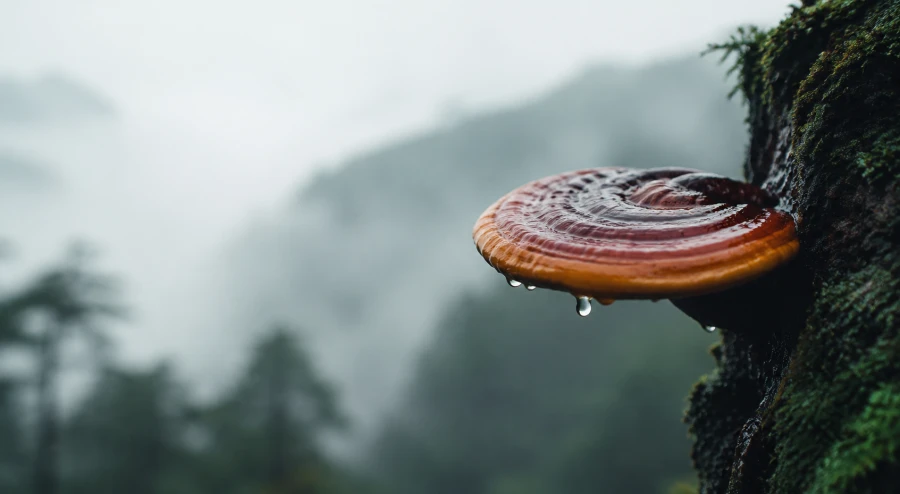
Reishi (scientific name Ganoderma; the main species are the red Ganoderma lucidum and the purple Ganoderma sinense) is a polypore fungus. In taxonomy, it is a "relative" of shiitake mushrooms and wood ear — not some mystical plant. When ancient Chinese texts speak of "lingzhi," they mean the lacquered shine and distinctive shape of its cap. The Shennong's Classic of the Materia Medica listed it as a top-grade herb, claiming it "lightens the body and delays aging with long-term use." The ancients placed great hopes on it, but in today's context we should treat it as a fungus with active compounds that deserves evidence-based scrutiny.
The ancients classified reishi into five colors (red, green, yellow, white, black) corresponding to the five organs — a system continuous with the five-element thinking of TCM. Today this reads more as a philosophical classification than a pharmacological conclusion, yet the traditional direction "reishi enters all five organs, tending to tonify qi and calm the spirit" subtly echoes the immune-modulating and calming directions modern research has been exploring.
Reishi, the Immortal Herb of China
A Westerner passing a dead tree that happens to host a reishi would probably give it a second glance at most; an ancient Chinese person, on seeing one, might have knelt on the spot. In thousands of years of Chinese mythology, reishi is not a mushroom — it is an "immortal herb": eat it and live forever, use it in medicine and raise the dead. This obsession, told properly, is enough to make any foreign friend's jaw drop.
The reishi story every Chinese person knows comes from the Legend of the White Snake. When Xu Xian, the mortal husband of the White Lady, was frightened to death — an ordinary man, his soul scattered — she climbed Mount Kunlun alone, fought a life-and-death battle with the immortal crane guarding the mountain, all to steal one "soul-restoring herb." That herb was reishi. In the story, a single mushroom drags a dead man back from the gates of hell. The Chinese entrusted the words "raise the dead" to a fungus.
The obsession goes back even further, over two thousand years. After unifying China, the First Emperor sent the alchemist Xu Fu and thousands of boys and girls across the sea in search of the legendary "elixir of immortality." Later scholars combing through ancient texts have most often identified that "elixir" as reishi.
In the imperial courts, the obsession grew even stranger. From the Han dynasty onward, if a local official found a wild reishi in the mountains, he had to report it to the capital by express courier as a major auspicious omen — because reishi was seen as "heaven's approval," proof that the emperor's virtue had moved heaven and earth. Emperors like Wu Zetian and Kangxi are said to have issued general amnesties over "reishi presented as an omen." National holidays and prisoner releases — for a few mushrooms. It really happened, recorded in official histories.
These tales are beautiful, but remember one scientific fact: reishi is a mushroom, not an elixir — it is special, but it cannot raise the dead, and it cannot make you immortal.
What Modern Research Says: Polysaccharides, Triterpenes and the Evidence
Two groups of compounds in reishi receive the most research attention: reishi polysaccharides and triterpenoids (ganoderic acids). The evidence so far points mainly in two directions:
The first is immune modulation. A large body of in-vitro and animal studies shows that reishi polysaccharides can affect the activity of immune cells such as macrophages and T cells; human studies are more limited, but some randomized controlled trials suggest possible improvements in certain immune markers in people with "lower immune function." The second is calming and sleep support. In animal experiments, reishi extracts show some sedative and sleep-promoting tendency; human evidence remains scarce and mixed — this is the honest state of affairs we must state plainly: at the human level, the evidence that "reishi improves sleep" is "promising but not yet confirmed".
"Reishi cures cancer" and "reishi fixes everything" — claims like these have no reliable evidence and are exaggerated marketing. Reishi is a food-grade/health-supplement material: it is not a medicine and cannot replace any proper treatment. Treat it as a "wholesome food ingredient" and your mindset is in the right place.
How to Take Reishi: Slices, Spore Powder and Soups
Reishi products on the market mainly come in three forms, each with its strengths:
| Form | Characteristics | Best for | Note |
|---|---|---|---|
| Reishi slices (fruiting body) | Classic use; flavors soups and water | People who enjoy traditional simmered soups | Bitter; needs long simmering |
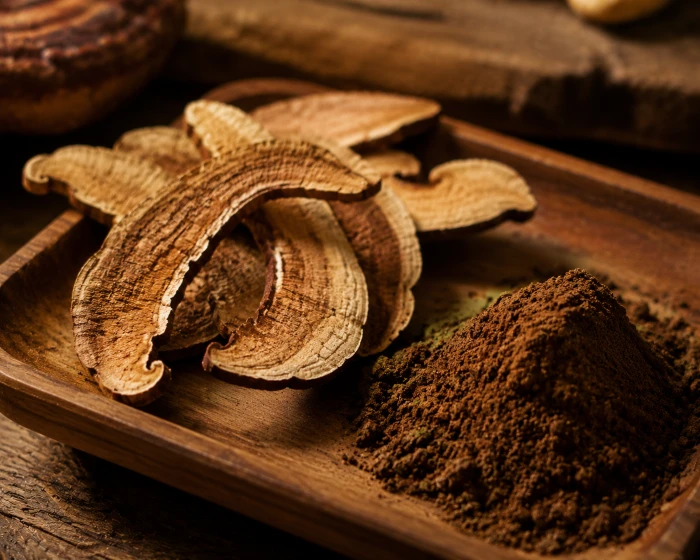
| Broken-cell spore powder | Spores cell-wall-broken for absorption | People who want quick, direct intake | Look for cell-wall-breaking process and test reports |
| Reishi extract/capsules | Standardized triterpene/polysaccharide content | People who want a fixed dose | Check the ingredient list and active-compound labels |
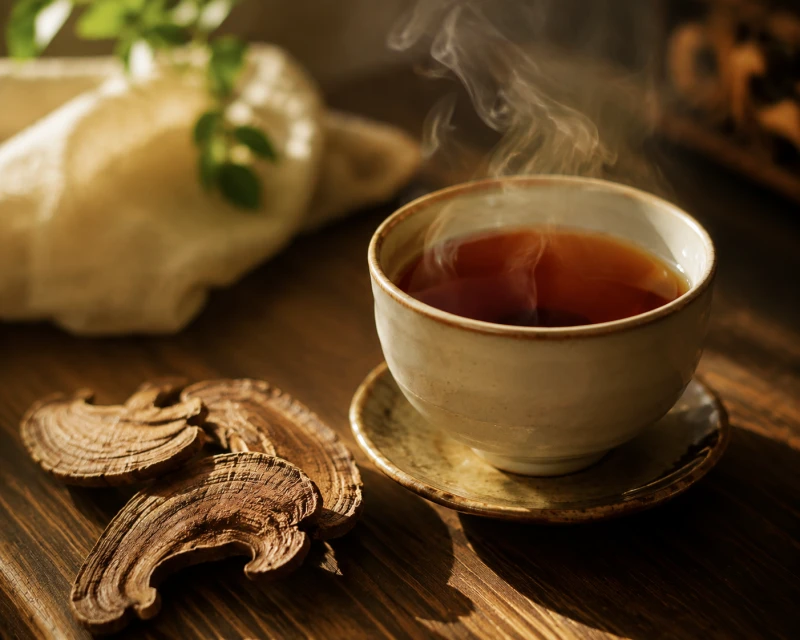
The traditional way is to add slices to chicken or pork-bone soup and simmer for at least 40 minutes over low heat to release the bitter compounds; spore powder is usually taken stirred into warm water. There is no single "pharmacopoeia dose" for daily use; as a food or dietary supplement, most sources suggest starting at half the label dose and watching how your body responds. One practical rule: start with a small amount for a short period and observe for 2 weeks.
"Cell-wall-broken" is not a marketing buzzword but a technical step: spores have a hard outer wall, and without breaking it, absorption is very low. When buying spore powder, prefer products that state the "breakage rate" and provide third-party testing — more reliable than vague origin stories.
Who Should Not Take Reishi (Cautions and Contraindications)
Overall, reishi is a relatively safe medicinal-and-food item, but the following groups should be especially cautious or avoid it:
- People with bleeding tendencies: some compounds in reishi (such as adenosine-related substances) may affect blood clotting. If you are on anticoagulants (e.g., warfarin) or preparing for surgery, consult your doctor first.
- People with autoimmune diseases: the direction of reishi's immune modulation is uncertain; those with rheumatoid arthritis, lupus, etc., should not self-medicate.
- People using immunosuppressants: compounds may interact with medications; avoid stacking them on your own.
- Pregnant and breastfeeding women: human safety data is insufficient; use is not recommended.
- People with low blood pressure: some reports suggest reishi may slightly lower blood pressure; those who already run low should be mindful.
No "natural supplement" means "safe for everyone." If you take medication, have a chronic condition, or are preparing for surgery, ask your doctor before taking it — more important than agonizing over which brand to buy.
Beyond Reishi: The Real Key Isn't a Supplement
Back to the opening scene: poor sleep, constant fatigue, a struggling immune system. Treating reishi as a master key makes it easy to overlook what truly matters — sleep rhythm, diet structure, and physical activity. These "free fortifiers" usually come before any supplement. The following self-check questions are worth answering before anyone starts "tonifying":
- In the past month, have I gone to bed at a fixed time every night?
- Have my staples and vegetables been crowded out by takeout and processed foods?
- Is my daily continuous sitting time more than 6 hours?
If any answer is "no," the solution is usually not to buy reishi but to fix these small things first — How to Fall Asleep Faster: A Non-Drug Guide for Tired Minds and Abdominal Breathing: The Simplest Stress Relief Technique and 4-7-8 Method have concrete steps. Supplements are bonus points; lifestyle is the foundation score.
FAQ
Animal studies show a sedative tendency, but human evidence is limited and mixed — currently "promising, not yet confirmed." If insomnia is troubling you, investigate sleep hygiene and seek a medical diagnosis first; that is more reliable than relying on reishi.
Taxonomically they are all fungi, but reishi is hard and not practical to cook as a dish. Traditionally it is used as a medicinal-and-food item, simmered in soups or made into powder/extract. This is also why safety awareness matters — not every "mushroom" can be casually eaten in large doses over long periods.
Traditional sources and most studies use observation windows of weeks to months, but individual responses vary greatly. Use 2 weeks as an initial observation window; stop immediately and consult a professional if you feel unwell.
There is currently no reliable human evidence that reishi prevents or treats cancer; related marketing is exaggerated. Treating reishi as an ordinary wholesome food and proper medicine as your only reliance is the responsible attitude.
A Note from Bong

When I was a child, a jar of reishi sat on the top shelf of our pharmacy, gathering dust. When my father filled prescriptions, he never even glanced at it. I asked about it once; without looking up he said, "The day you truly need it, there is nothing else left to try." I didn't understand then. Looking back now, I think he was saying something else: supplements are a fallback left for people who have options — what truly matters are the things that cost nothing and can be done every day: sleeping well, eating well, letting the breath settle.
Writing this, the more I think about it, the more reishi feels like a mirror: the more urgently you reach for it to fix something, the more it shows that what you're missing is not it.
May you sleep well tonight.
References
- Public materials from Kunming Institute of Botany, Chinese Academy of Sciences, and others: overview of the taxonomy of the genus Ganoderma.
- Reviews on reishi polysaccharides and immune regulation (public review articles, mainly in-vitro and animal studies).
- Animal studies on reishi's sedative/sleep effects (public literature; human evidence limited).
- Pharmacopoeia of the People's Republic of China (current edition), reishi entry: functions and indications "tonify qi and calm the spirit, relieve cough and wheezing."
Before you supplement, see what you're missing
Poor sleep and constant fatigue may not mean "you should take something." Take a few minutes to check your constitution first, then decide whether and in which direction to supplement.
Start the TCM Constitution Quiz