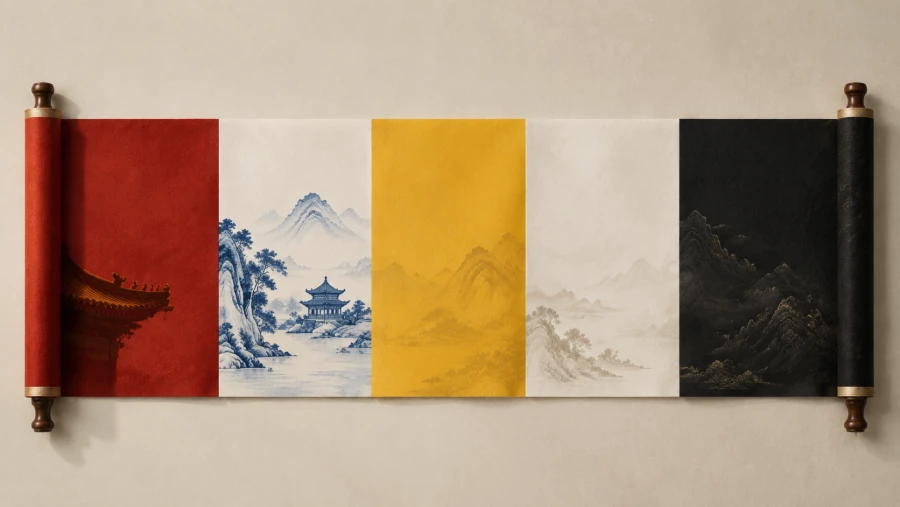
Why are the walls of the Forbidden City red? Why is blue-and-white porcelain almost always blue? Why are the houses of the Jiangnan region white-walled with dark tiles? These colors are not merely beautiful — in the Chinese view, colors have "temperament." Green belongs to Wood, red to Fire, yellow to Earth, white to Metal, and black to Water: the five elements left the Chinese a complete "color personality system." Understand it, and you'll see that the clothes you wear, the cup you drink from, and the color of your phone case are all speaking silently. The following is compiled from public TCM theory and traditional cultural materials and is not medical advice.
Why Colors Have "Temperament": The Source of the Five Colors and Five Elements
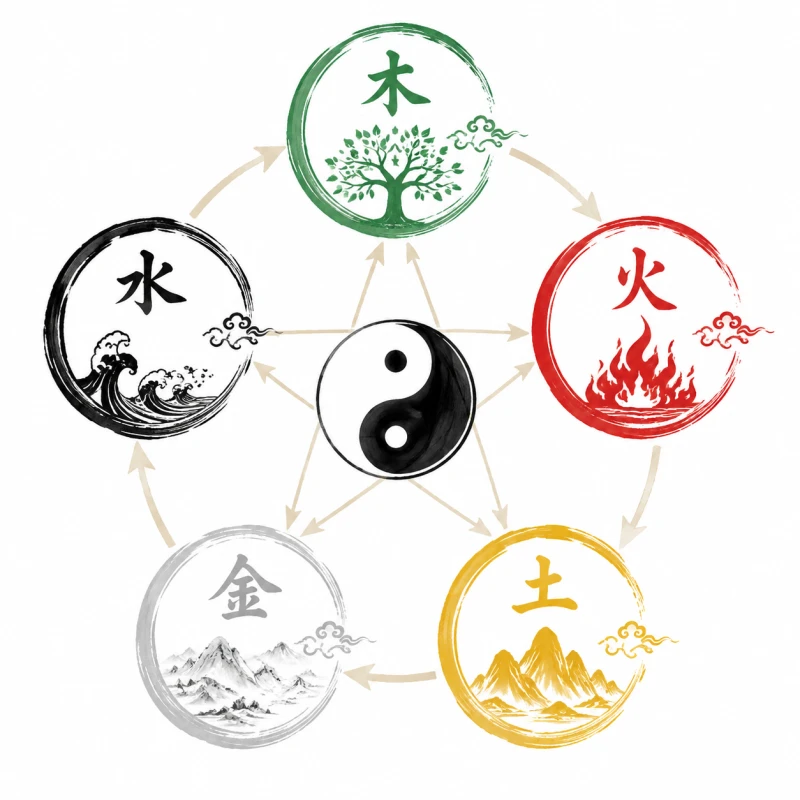
In Western color theory, color is a light wave, a wavelength, a physical fact. In the ancient Chinese view, color is "qi" — the face of the five forces that move through heaven and earth. This is the "five-color view": green, red, yellow, white, and black correspond to the five elements Wood, Fire, Earth, Metal, and Water, to the five directions (east, south, center, west, north), and to the five organs (liver, heart, spleen, lungs, kidneys).
This system was formalized very early. From the Zhou dynasty onward, the "five colors" and "five primary colors" entered ritual law: the emperor's chariots, officials' robes, and palace rooftops were never a casual aesthetic choice but a symbol of order. Yellow, standing for the center and the earth, gradually became the color of imperial power; red, standing for the south and fire, became the color of celebration and the principal wife.
Among ordinary people, it became daily life — dark-brick walls, red lanterns, white walls, black clothes: the Chinese dyed their homes, festivals, births, and deaths in the colors of the five elements. This "color personality system" comes closer to everyday Chinese life than any fashion theory.
Green · Wood: The Mild Moisture of the South
In classical Chinese, "qing" (green) is a large family: it can mean deep green (green grass), blue (the "green" of blue-and-white porcelain is actually cobalt), or even blackish (dark hair). But its base color is "germination" — the color of new vegetation, belonging to Wood, corresponding to the east and the liver.
The Jiangnan region knows "qing" best: mossy stone paths in the plum-rain season, bamboo leaves after rain, a clump of banana plants beside a white wall. The feeling of this color is "moist" — not harsh, not dry, alive with water vapor. TCM links green to the liver for the same reason: when liver qi flows freely, the complexion is greenish-moist (not the sickly "green-gray"); people under long-term emotional strain take on a greenish, dull cast — what TCM calls "liver qi stagnation."
"Qing" in daily life: a morning walk, the faint fragrance of green tea, a potted plant on the windowsill — small things that keep the "Wood" supplied. If you've been irritable and your eyes feel dry lately, try looking at more green — not mysticism, just letting both your eyes and your liver qi unwind.
Red · Fire: The Ardor of Palace Walls
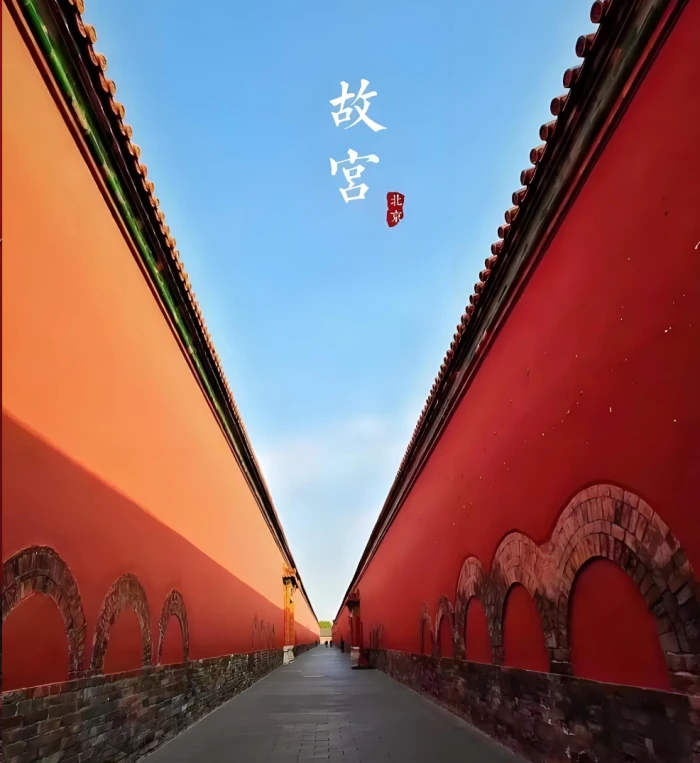
"Chi" (red) is the color of the sun and of fire, belonging to Fire, corresponding to the south and the heart. In China, no color is more "useful" than red: celebrations use red, store openings use red, the New Year uses red, and even the Forbidden City's walls and colonnades are red — because red symbolizes "flourishing fire," meaning yang energy at full strength and prosperity for home and country.
The organ of Fire is the heart. TCM says "the heart governs blood vessels; its luster shows in the face" — when qi and blood are ample, the complexion is rosy; when they fall short, the face turns pale or sallow. So "a rosy complexion" in China was never just a compliment; it is a plain health judgment.
But "red" also has its measure: when fire burns too high, people become agitated, irritable, with flushed faces (for instance, when angry or after drinking). The same applies to wearing red — a head-to-toe bright red is energizing, but if you are already anxious and sleepless, a sea of red adds to the agitation. This is why TCM speaks of "nourishing the heart and calming the spirit": both emotions and colors demand a sense of measure.
Yellow · Earth: The Orthodoxy of the Land
"Yellow" is the color of soil, belonging to Earth, corresponding to the center and the spleen and stomach. Among the five elements, Earth holds the center and is the force that "transforms all things" — just as the soil turns seeds into crops, the spleen turns food into qi and blood.
Yellow holds a special place in Chinese color history. It became the symbol of imperial power: the emperor's dragon robes were bright yellow, the Forbidden City's rooftops were golden tiles, imperial edicts were written on yellow silk. Why yellow of all colors? Because Earth dwells at the center and is the mother of all things; the ancients regarded the "center" as the most honored position, and so yellow acquired the weight of "orthodoxy."
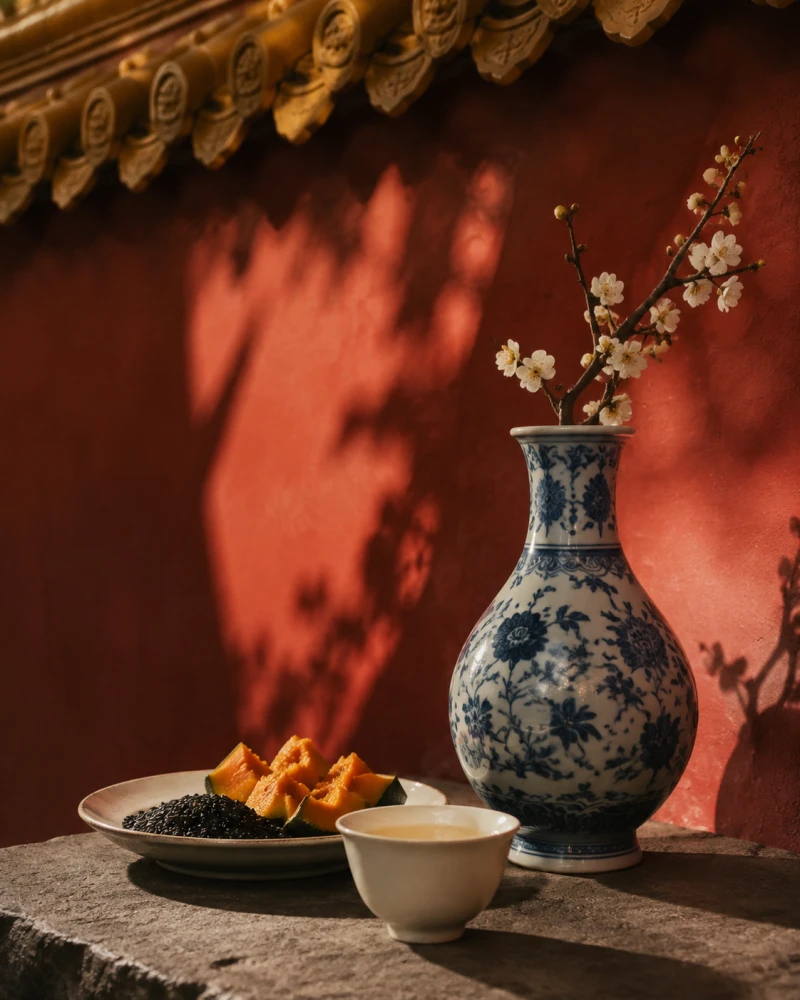
From a health perspective, yellow is also the color of the spleen and stomach: millet is yellow, pumpkin is yellow, and millet porridge for a happy stomach is common sense engraved in Chinese DNA. In late summer (the end of summer and beginning of autumn), when dampness is heavy and the spleen is weakest, more yellow on the table — millet, corn, pumpkin, yam — is a way of helping "Earth." Interestingly, modern nutrition agrees that these yellow foods are rich in dietary fiber and carotene and easy on digestion — what the ancients told through the five elements, modern science tells again through nutrients.
"Qing" shares its sound with "sheng" (to be born); its original meaning is the color of new vegetation — which is why it can hold deep green, pale blue, and blue-black all at once: they all carry the undertone of "germination." With a single character, the ancients tucked an entire spring into language.
White · Metal: The Plainness of Porcelain
"White" is the luster of metal, belonging to Metal, corresponding to the west and the lungs. In Chinese culture white is contradictory: it is the color of mourning (plain mourning clothes, white banners) and also the elegance of scholars (the "white-robed" gentleman, plain white porcelain). Its temperament is "clear" — clean, restrained, unshowy, like the first cool breeze of autumn.
The lungs of Metal fear "dryness" most. When autumn dryness arrives, people get dry mouths, sore throats, dry skin — and here Chinese folk wisdom says "eat white": pear, white fungus, lily, lotus root, yam — all white foods that moisten the lungs. You can notice a lovely pattern: when Chinese people talk about color, they never only say "pretty" — they always connect it to a way of eating.
White also teaches "leaving space." The reserved emptiness of Chinese painting, the "flying white" of calligraphy, the blue on the white ground of porcelain — white is not "nothing"; white is "room." The lungs govern qi and breathing, and breathing itself has its pauses; those with healthy lung qi speak with depth and know when to fall silent. This is the deeper lesson of white: cleanliness is a form of cultivation.
Black · Water: The Depth of Night
"Xuan" (black) belongs to Water, corresponding to the north and the kidneys. The ancients rarely said "black" directly; they preferred "xuan" — the "unfathomable darkness of dusk," which holds more mystery and vastness than plain black.
Water's character is "to store." In TCM the kidneys are the "root of innate constitution," governing the storing of essence — keeping the body's finest substance deep within, like winter water, still and deep. So the season of black is winter, and its hour is the night. The plainest truth of TCM health: sleeping early in winter and not staying up at night is "nourishing Water." For those who stay up for years, kidney essence is drained bit by bit, and the clearest signal is early graying hair and sore, weak lower back and knees — a problem with the "black" of color.
Black's everyday wisdom is equally plain: wearing dark clothes in winter absorbs heat and keeps you warm; eating dark foods at dinner — black beans, black sesame, wood ear, black rice — is the traditional "kidney-tonifying list." Modern nutrition does find these dark foods rich in anthocyanins and minerals. What the ancients explained through "Water" and "kidneys" still holds today.
Five-Color Self-Check Table
| Color | Element | Organ | In balance | Out of balance |
|---|---|---|---|---|
| Green (green/blue) | Wood | Liver | Moist clear complexion, bright eyes, easy mood | Irritable, dry eyes, greenish face |
| Red | Fire | Heart | Rosy complexion, energetic, calm mind | Flushed face, restless insomnia, agitation |
| Yellow | Earth | Spleen & stomach | Moist skin, good appetite, lively | Sallow face, poor appetite, sleepy after meals |
| White | Metal | Lungs | Clear skin, easy breathing, moist skin | Pale face, shortness of breath, dry skin |
| Black (xuan) | Water | Kidneys | Glossy hair, strong back and knees, deep sleep | Early graying, weak back and knees, frequent night urination |
One note on self-checking: this table is a directional reference, not a diagnosis. Complexion and skin tone depend heavily on genetics, sun exposure, and daily routine — don't "diagnose yourself" by matching your face to a row. If discomfort persists, see a doctor.
Wearing the Five Colors into Daily Life
You don't need deep theory — the five colors are the easiest "life recipe" to use:
- Office workers missing "green": look at the trees outside the window for 15 minutes a day, set your desktop wallpaper to greens, drink green tea — all ways to let Wood breathe.
- The weary missing "red": instead of reaching for coffee, try adding more warm-toned light to your room, wear an energizing red-toned top, and get a light sweat from exercise to bring color to your face.
- Weak-digestion types missing "yellow": swap part of your staple to millet or corn, add pumpkin and yam to the table, and take a walk after meals — the yellow "eats itself in."
- Autumn-dry types missing "white": rotate pear soup, white fungus porridge, and lily-lotus porridge; keep your neck covered so the autumn chill doesn't reach your lungs.
- Night owls missing "black": dim the lights an hour before bed, switch your screen to warm tones, and choose darker bedding for better sleep — let the night truly turn "black."
Color wellness is a clever touch in life, not a medical plan. If your complexion has been abnormal for a long time, or you struggle with insomnia or fatigue, see a doctor first — don't tough it out on "adding color" alone.
FAQ
The five elements and five colors are an ancient observation model, not a modern scientific conclusion. But the life directions they point to — green leaves resting the eyes, warm tones lifting mood, white moistening foods, the nutritional value of dark ingredients — often overlap with modern nutrition and color psychology. Use them as life wisdom, not as law.
The difference is degree and state. Rosy is a clear, natural, healthy blood tone from within; a flush is sudden, localized red accompanied by irritation or heat (from emotion, alcohol, or yin-deficiency heat). The former is fire in balance; the latter is fire in excess.
They do. The five elements are the framework, and whichever you lean toward shapes your "color temperament" — Wood-leaning people suit green environments and expression, Fire-leaning people need to learn to cool their enthusiasm, and Water-leaning people need more quiet "dark time." To find your dominant element, take the Five Elements Personality Quiz: Which Element Are You?.
Not exactly. Black beans and black sesame do have benefits, but "dark color equals kidney tonification" is a simplification. The key is overall dietary balance and regular routines, with dark foods as a bonus. No single food can replace good sleep.
A Note from Bong

The small town I grew up in had very distinct seasonal colors: spring was the green of the field ridges, summer the yellow of the threshing ground, autumn the white after frost, winter the black of the tiled roofs. I used to take this for granted — until I met a guest from the north, who looked at our endless rain and said, "How is it that you have green all year round here?" I paused, and for the first time realized that farther north, winter has no green at all.
Color is like that — if you live inside it, you stop seeing it. But it keeps speaking for you: the nights you stayed up are written in the dark circles under your eyes; the anger you swallowed is written in the gray of your face; on the days you slept well, your complexion turns rosy on its own. The body does not lie, and neither does color.
This article has been a long one, and I imagine you are tired of reading. Let me say no more — let your thoughts rest for a while. We'll talk another day.
References
- Huangdi Neijing · Suwen, "Discourse on the Essential Truths of the Golden Chamber": in the east, green enters through the liver; in the south, red enters through the heart; in the center, yellow enters through the spleen; in the west, white enters through the lungs; in the north, black enters through the kidneys.
- Zhou Li · Kaogong Ji: "In the work of painting, the five colors are blended… when all five colors are complete, it is called embroidery."
- Li Dexin (ed.), Fundamentals of Traditional Chinese Medicine, People's Medical Publishing House.
- Survey of traditional Chinese color and ritual: primary and secondary colors, the five-element five-color system (public academic materials).
Which element does your "color temperament" lean toward?
The five elements are the framework; your dominant element is the key. Spend a few minutes finding out whether you are green Wood, red Fire, yellow Earth, white Metal, or black Water — then take care of yourself in your color.
Start the Five Elements Personality Quiz