You feel it in the way you snap at someone after a long, repressed day. Or in the way you overthink one conversation for hours. Traditional Chinese Medicine (TCM) has a word for these patterns: the Five Elements — Wood, Fire, Earth, Metal and Water. Each one "owns" an emotion: anger belongs to Wood, joy to Fire, overthinking to Earth, grief to Metal, and fear to Water. Below is a plain-language overview based on public TCM literature; it is not medical advice.
Why did the ancients sort emotions into five groups?
Chinese medicine condenses this into one famous line: "Anger injures the liver, joy injures the heart, overthinking injures the spleen, grief injures the lungs, fear injures the kidneys" (Huangdi Neijing, Suwen). In the Five Elements framework, each emotion maps to one element — anger-Wood, joy-Fire, overthinking-Earth, grief-Metal, fear-Water — and each element in turn connects to an organ, a season and a colour.
To be clear: "injures" here doesn't mean one bad day of anger wounds your liver. It means a chronic, excessive emotion shifts how that organ system runs. Occasional anger is fine — the liver is not fragile. What TCM considers unhealthy is the two extremes: exploding at everything (Wood in excess) versus swallowing every irritation for years (Wood stagnating). Both drift from the ideal of "free, smooth flow".
What makes this framework useful is that it doesn't treat emotions as enemies to be eliminated, but as signals from the body — each of the five asks to be seen and rebalanced in its own way.
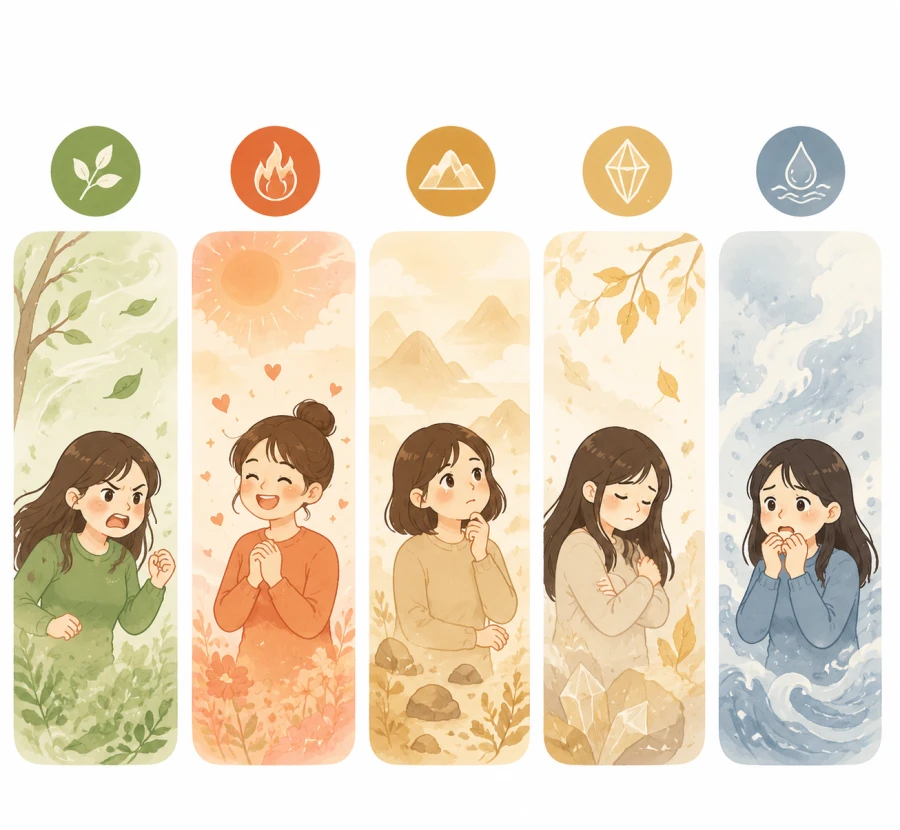
Wood and anger: why "anger injures the liver"
Wood maps to the liver. Its quality is growth, expansion and rising — like a tree pushing upward in spring. The liver governs "free coursing" (shu xie): think of it as the traffic controller for the flow of qi through the whole body. When you express yourself openly and move on, the flow stays smooth. When anger is swallowed for months, the qi gets stuck.
That is what "liver qi stagnation" describes: a stuffy chest, distension under the ribs, sighing, a lump-in-throat feeling (plum-pit qi), and breast tenderness before periods. And anger itself is the most direct signal of a Wood imbalance — if you explode easily, you have probably been holding things in for a long time.
Wood = liver = anger. Health is speaking up when you need to, and letting go when it's time — neither short-fused nor endlessly suppressed.
Fire and joy: elation drains the spirit too
Joy maps to Fire and to the heart. This is probably the most misunderstood mapping in the Five Elements — isn't happiness good? What TCM means by "joy injures the heart" is excessive, sustained excitement: manic highs, weeks of non-stop stimulation, euphoria that never settles. That burns the spirit.
The heart is called the "monarch" of the body, hosting the shen (spirit/mind). When shen is scattered, the mind feels messy: insomnia, racing dreams, palpitations, an attention that won't land, the harder you try to calm down the less it works. Fire imbalance has two poles — too much fire is "hyper": irritability, flushed face, red tongue tip, wired but tired. Too little fire is "cold": flat mood, no interest in anything, cold hands and feet.
Earth and overthinking: the spleen tires first
Overthinking maps to Earth and the spleen. The spleen is the "root of acquired constitution" — it turns food into qi and blood, and it also "transforms and transports", which covers digesting meals and digesting worries. What TCM calls "overthinking injures the spleen" is not thinking per se, but rumination: chewing the same problem for hours, catastrophising, going in circles.
You know the feeling: when something is weighing on your mind, food loses its taste, digestion slows, and you end up "no appetite and no energy". Done habitually, this shows up as a sallow face, loose stools, post-meal drowsiness, and fatigue that sleep doesn't fix. Earth's healthy state is acceptance — like the ground itself: it receives, it holds, and it doesn't get rattled by every breeze.
Stress-related eating disorders and functional dyspepsia are everywhere in gastroenterology — patients get every scope and scan, everything is "normal", and yet the symptoms are real. The "overthinking injures the spleen" view and modern gut-brain axis research (the two-way dialogue between the brain and the gut via nerves and hormones) point in the same direction.
Metal and grief: prolonged sorrow is costly
Grief and melancholy map to Metal and the lungs. The lungs govern the body's qi and house the po (the "corporeal soul"). Grief is a normal emotion — loss, separation and failure all bring it. But living inside prolonged grief slowly depletes the qi.
What TCM observes: people who grieve long-term speak in a thin voice, tire easily, catch colds often, and have dry skin. The lungs rule the skin and the wei qi (defensive energy) — grief weakens the guard, and the body becomes a window that never quite latches, letting every draft in. Metal's healthy state is "descending and gathering" — like autumn: able to let go, to close things down, to cry when it's time and still return to life afterwards.
Water and fear: why a scare makes your knees go weak
Fear and shock map to Water and the kidneys. The kidneys govern the bones, generate marrow, store jing (essence), and host the zhi (willpower). "Fear injures the kidneys" looks like this: right after a sudden scare — weak legs, urgent urination, racing heart, a blank mind. What all of it shares is that the body's safety margin was just drained in a second.
Living in a low hum of fear — chronic worry about health, about money, about not sleeping well enough — is understood as draining kidney essence: aching weak lower back, frequent night urination, ringing ears, worsening memory, and a tendency to panic at small things. Water's healthy state is "storing" — like winter water: deep, still, and with enough depth that a passing wave doesn't topple it.

Emotional self-check table
| Element | Emotion | Chronic imbalance may look like | A healthy state |
|---|---|---|---|
| Wood | Anger | Exploding easily — or bottling everything up, stuffy chest, sighing | Speaking up, then moving on |
| Fire | Joy | Agitated, wired, palpitations, can't sleep, can't settle | Warm-hearted, yet able to be still |
| Earth | Overthinking | Replaying one issue, no appetite, tired after meals | Can absorb change without being thrown |
| Metal | Grief | Prolonged low mood, weak breath, catches colds easily | Can cry, can release, then return |
| Water | Fear | Easily startled, weak legs, night urination, poor memory | Grounded, steady when tested |
Use this as a directional reference, not a diagnosis. Most people are a blend of several elements, and the emotional sticking points are rarely just one. And if your emotional state has been noticeably affecting sleep, eating or work for more than two weeks, please seek professional help first.
Five directions for daily balance
The lovely thing about Five Elements emotional wisdom is that every imbalance comes with an "antidote" — not suppression, but working with the flow. These are everyday self-care ideas from TCM, not treatments:
- Wood (anger) → let it move: regular movement is the best way to free the liver — brisk walking, jogging, badminton. Move the body, and the qi moves. Writing out what you wanted to say also clears half the block.
- Fire (joy) → let it land: on wired-up nights, put the phone away, soak your feet, play something slow, do ten minutes of slow deep breathing. Let the heart-fire settle.
- Earth (overthinking) → back to the body: when the mind spins, do something with your hands — cook a meal, tidy a room, take a walk. Earth likes action; chewing slowly is spleen care too.
- Metal (grief) → allow the grief: cry if you need to — don't rush to "cheer up". Afterwards, drink a glass of warm water and go outside; let the lungs breathe deep and the qi return slowly.
- Water (fear) → build safety: write down the worst-case scenario — most fears shrink when they're on paper. A fixed bedtime and no phone for the last hour are daily ways to "charge the kidneys".
Emotional regulation is life wisdom, not a treatment. If you have been stuck in a persistent low mood, anxiety or insomnia, please don't tough it out with "lifestyle advice" alone — counselling and proper medical care matter just as much, and they are not mutually exclusive.
Frequently asked questions
The Five Elements are an ancient Chinese model for observing nature and the body — not a physiological theory in the modern scientific sense. But its direction — that chronic emotion shapes physical health — overlaps with modern mind-body medicine (stress and immunity, gut-brain axis research). Treat it as a lens for self-understanding, not as medical evidence.
That's the classic Wood qi-stagnation pairing — the anger is qi pushing outward, the sighing is the body trying to let the qi through. Movement, honest expression and letting go of a grudge all help; if the chest tightness and rib distension persist, see a doctor.
Quite the opposite. TCM warns against the two extremes — too much and too little. Normal anger, grief and fear are part of being human. What drains the body is being stuck in a feeling and unable to move through it, not the feeling itself.
Closely. The Five Elements are the framework; body constitution is how it shows up in a specific person — liver-qi stagnation, for example, often appears as a qi-stagnation constitution. To see your own pattern, try the TCM constitution test.
A note from Bong
My grandfather used to say, when weighing herbs: "The medicine can't cure the mind, and the mind can't cure by medicine alone." I didn't understand it as a kid. After years behind the counter I do — six or seven people out of ten come in with an illness that doesn't start in the body, but in a breath that never got released.
People ask me whether the Five Elements and emotions are scientific. My answer is always the same: you don't have to believe it, you just have to use it. Treat it as a mirror. Look at whether you've been a Wood that's holding everything in, or a Fire that won't cool down — then move when you need to, cry when you need to, sleep when you need to. The body is more honest than the mind.
I hope tonight you sleep deeply, and that the breath you've been holding slowly lets go.
References
- Huangdi Neijing, Suwen, "Yinyang Yingxiang Da Lun": anger injures the liver, joy injures the heart, overthinking injures the spleen, grief injures the lungs, fear injures the kidneys.
- Li Dexin (ed.), Fundamentals of Traditional Chinese Medicine, People's Medical Publishing House.
- Mayer, E. A. (2011). Gut feelings: the emerging biology of gut–brain communication. Nature Reviews Neuroscience.
- American Psychological Association, stress effects on the body (public education resource).
Which element runs your body?
The Five Elements are the framework — your constitution is the answer. Take a few minutes to discover your TCM constitution and see how your emotional patterns connect to it.
Take the constitution test