Your body has been leaving you voicemails. You just haven't been answering them. That dull ache in your shoulders at 6 p.m.? That's your neck sending a message about eight hours of sitting. That mid-afternoon yawn you can't hold back? That's your brain asking for more oxygen. That sigh you let out in meetings? Your lungs trying to take one proper breath. This article will teach you to read those signals — and give your body a real reset, right at your desk.
This article is for wellness education and self-care. It is not medical advice. If shoulder or neck pain persists or spreads to your arm, please see a doctor.

What Your Body Is Trying to Say
Before we start, take ten seconds. Run through this little checklist and be honest with yourself — it's your body asking for help, not a report card on your worth:
- You catch yourself sighing deeply to "feel better"
- By the end of the day, your shoulders and neck feel tight and heavy
- Around 2-3 p.m., your focus drifts and your eyelids get heavy
- When you try to take a deep breath, it feels like it stops at your chest
- The busier you get, the less you remember to rest
The more boxes you ticked, the more your body could use a proper reset. Here's the good news: all five signals point to the same root — shallow breathing plus too much sitting — and they share one key.
Why Sitting Makes Your Breathing Shallow
Think of a balloon that's been squashed for hours: it slowly loses its bounce. Your diaphragm works the same way. When you sit, your body tenses your abdomen slightly to hold your torso up, and your diaphragm gets "stuck." Instead of sinking all the way to your belly, your breath crowds into your chest. That's shallow chest breathing.
Breathe one inch shallower, and the world feels one notch more stressful. It's not the world getting worse — it's your shock absorber going quiet.
TCM puts it more simply: the lungs govern qi, and qi needs room to move. When your ribcage stays half-locked, the flow of qi gets stuck — which is why people who sit all day often feel short of breath, chest-tight, and only comfortable after a good sigh. Every sigh is your lungs trying to rescue you.
Tight Shoulders, Seen Through TCM

In TCM, the shoulders and neck are closely tied to one meridian: the Bladder Meridian. It runs from the top of your head, down your neck and back, like the "main highway" of your spine. When you sit hunched for hours, qi and blood move slowly along this road. "No flow, then pain" — that's your 6 p.m. shoulder ache.
But there's another participant that's easy to miss: emotion. Watch yourself — when stress spikes, do your shoulders creep up toward your ears? Emotional tension and muscle tension share the same neural pathway. So loosening your shoulders is half about relaxing muscle, half about unwinding emotion. And breathing is the only switch that touches both at once.
The 5-Minute Desk Reset

No need to leave your desk or strike any "meditation pose." The whole thing takes about five minutes, and the goal is one thing: get your diaphragm back to work.
- Breath stops at the chest, shoulders rise with each inhale
- Fast, shallow, no pause
- When busy, they simply "forget to breathe"
- Breath sinks to the belly, shoulders stay relaxed
- Slow and even, exhale longer than inhale
- Breath becomes a "remote control" you always have
Three Micro-Stretches You Can Do "Secretly"
Breath work gets the qi moving; micro-stretches open up the shoulders and neck all the way. All three can be done sitting down, and no one around you will even notice — perfect for the gaps between meetings:
- Look over your shoulder: slowly turn your chin toward your right shoulder, feeling the stretch along the left side of your neck. Hold 5 breaths, switch sides. Twice each way.
- Chair chest opener: grip the back of your chair, push your chest forward and squeeze your shoulder blades back, like a silent chest expansion. Hold 5 breaths.
- Shoulder rolls: roll your shoulders forward in 10 small circles, then backward 10. Slow and small, feeling your shoulder blades glide.
Want something more systematic? Try Qigong (Baduanjin) for beginners — moves like "Holding the Sky" and "Swaying the Head" are basically the ancient version of desk stretches plus breathwork.
Making the Reset Automatic
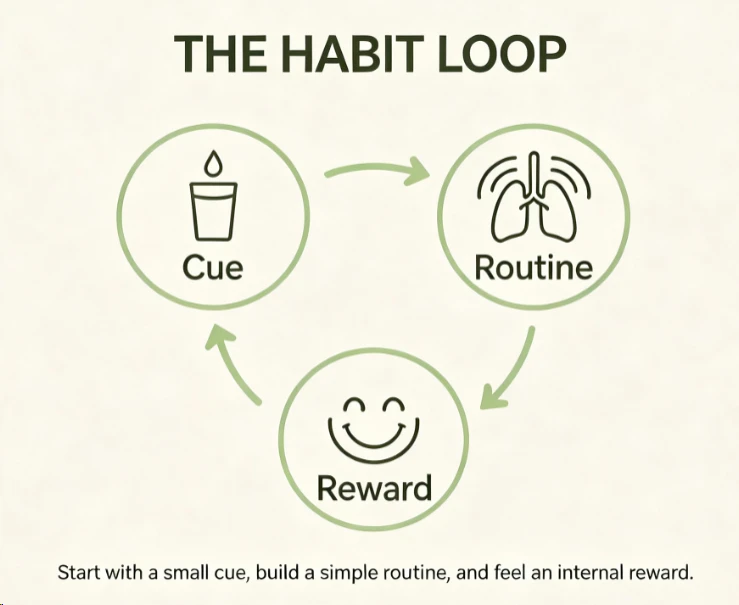
One reset feels good in the moment; the real payoff comes from frequency. Here's a humble suggestion: don't rely on willpower, rely on triggers.
Try a few ready-made triggers: every time you pick up your water bottle, every time you wait for your computer to boot, every time you step into an elevator — take 2-3 belly breaths. That adds up to dozens of micro-resets a day, far more practical than a one-hour session on weekends. After a week, you'll notice your shoulders no longer live "up by your ears."
If your fatigue and low energy have been going on for a long time, breathwork is only part of the answer. Check out 10 Reasons You're Always Tired and take the sleep quality quiz to rule out an overlooked sleep issue.
A Note from Bong

In the old dispensary, we had a saying when weighing herbs: "steady hands, settled mind, even breath." Three rules, but really one thing.
You don't need a perfect rest day. Before your next meeting, on your next commute home, give yourself three good breaths. Let your shoulders down. The sky isn't falling.
AI Assistant: Build Your Own Desk Breath & Shoulder Plan
References
- Huangdi Neijing, Suwen: "The lungs gather the hundred vessels" — on breath and the circulation of qi.
- NCBI reviews on deep breathing and autonomic nervous system (parasympathetic) activation.
- Ma, X. et al. (2017). Systematic review of sedentary behavior and musculoskeletal discomfort.
- World Health Organization guidance on sedentary behavior and taking regular movement breaks.
FAQ
Frequency beats duration. Two to three sessions of 5 minutes daily beats one hour once a week. Attach the practice to daily triggers — water breaks, elevators, before meetings — and you'll build in dozens of micro-resets.
Breathing too fast or too hard can cause lightheadedness from over-breathing. Slow down and make your exhale longer than your inhale, and it usually won't happen. If dizziness recurs, ease off and consult a doctor.
If you have numbness in your arm, constant severe pain, morning stiffness lasting more than 30 minutes, or pain that disrupts sleep, see a doctor to rule out cervical spine issues. Everyday tightness and soreness can be managed with breath resets and stretching.
Not replace — complement. Breath resets handle the tension of the moment; regular movement (walks, qigong, strength training) handles your long-term fitness. Do both for the best results.
Check Your State
How are your sleep and stress, really?
A few minutes of self-assessment to find the clues behind your fatigue and tension.
Start the quiz