"Do I have too much dampness?" — in the world of Chinese wellness, this might be the single most asked question. Heavy limbs, waking up unrefreshed, a thick-coated tongue, a soft belly, stools that cling to the bowl… these get bundled under "dampness" all the time. But what does dampness actually mean? And is "phlegm-dampness constitution" the same as just "feeling damp"? This article breaks the phlegm-damp constitution down: how to recognize it, why it happens, and how to adjust without falling for the usual traps. A cultural lens on TCM — not a diagnosis.

What is phlegm-dampness: damp, phlegm, constitution
Water that the body failed to move along. TCM holds that fluids must be "transported and transformed" by the internal organs; whatever can't be moved stays put as damp — like a river whose channel silted up, water just sits there.
In TCM, phlegm is not only what you cough up. It also means the sticky, condensed residue of fluids the body couldn't process — the thick, sluggish by-product that lingers.
One of the nine TCM body constitutions: a tendency to retain fluids, marked by heaviness and stickiness. It's not a disease — it's a "gravity" that pulls your body toward damp.
Here's a simple way to picture it: in a desert the same air is dry; in a southern plum-rain month it's so humid you can practically wring it out. Bodies are the same — given identical food, some people process it cleanly, and others "store" it. What gets stored is the phlegm-damp tendency.
Typical signs of the phlegm-damp constitution
- Heavy body and foggy head; mornings feel like you never really woke up, no matter how long you slept
- Soft, easily bloated belly; even water feels like it "stays"
- A swollen tongue with a thick, greasy white coating, often with tooth marks at the edges
- Stools that are soft, sticky, hard to wipe clean
- A sallow complexion and oily skin; lots of phlegm, especially in the morning
- Preferring to sit still; out of breath and tired after a little effort
To be clear: these are clues to a tendency, not a diagnosis. A TCM practitioner weighs tongue and pulse together before concluding anything.

Why it happens: the spleen is the key player
TCM says "the spleen governs transformation and transportation" — it's the body's transport-and-processing system: the food and water you take in are turned into energy and moved to where they're needed. When the spleen runs weak, the "moving" slows, fluids stall in place, and that stalled water is damp.
The Chinese character for damp, 湿, pairs the water radical 氵 with 显 ("to show"). The ancients built the word around it: when water builds up and gets sticky, it shows. The character itself is a reminder that dampness is "water that stopped and became visible."
What most often weakens the spleen and piles up phlegm-damp? From the TCM view, three habits:
- Eaten in: rich, greasy, sweet, heavy food; raw and cold things; alcohol — all of it weighs down the "transporter."
- Sitting in: too little movement. TCM says "movement generates yang" — without it, yang doesn't rise and water doesn't move.
- Stayed up in: chronic late nights and overthinking drain the spleen's energy and weaken its transport.
Curiously, modern research on "sedentary behavior and slow metabolism" and "high-sugar, high-fat diets and low-grade inflammation" points in the same direction as "spleen deficiency breeds dampness" — just in a different vocabulary.
How to adjust (1): eating right beats eating less
The key to phlegm-damp isn't eating less — it's making the spleen's job easier. In practice: strengthen the spleen and clear damp together:
| Category | Eat more | Eat less / avoid |
|---|---|---|
| Staples that strengthen the spleen | Coix seed, millet, Chinese yam, poria, lotus seed, fox nut | Glutinous rice, fried carbs |
| Vegetables | Winter melon, daikon radish, celery, mung bean sprouts, lotus root | Cold raw salads (for a cold-deficient spleen) |
| Protein | Crucian carp, chicken breast, tofu (in moderation) | Fatty meat, rich broths, organ meats |
| Drinks | Tangerine-peel water, corn-silk tea, light tea | Ice drinks, sugary sodas, beer |
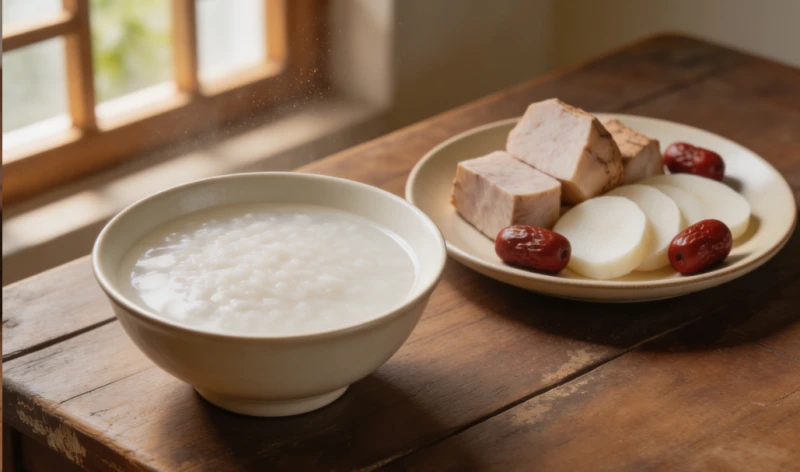
A classic "damp-clearing" meal: coix-seed and yam porridge as the staple, winter-melon soup alongside, and a cup of tangerine-peel water after — coix drains damp, yam strengthens the spleen, winter melon moves water, tangerine peel moves qi. Four things from any kitchen.
How to adjust (2): move, so the water flows
If eating well is about reducing the damp coming in, exercise is about pushing the stored damp out. For phlegm-damp types, the worst mistake is going "all out" — heavy sweat drains qi, and someone already deficient gets more depleted. What works is gentle aerobic movement that breaks a light sweat and can be sustained: brisk walking, jogging, baduanjin qigong, swimming — 3-5 times a week, 30-40 minutes each, the goal being "warm the body, move the water," not "punish yourself."
An honest observation: phlegm-damp people tend to move less because they feel heavy, and feel heavier because they move less. The key to breaking the loop is surprisingly small — starting with a 15-minute walk a day beats planning a two-hour workout that never happens.

The traps: adzuki-bean water is not a cure-all
This is the most common mistake, and it's wrong on two counts. First, most people cook "red beans" (hong dou) when the ingredient that drains damp is the adzuki bean (chi xiao dou) — they're different. Second — and more importantly — coix seed is cooling, and someone with a cold-deficient spleen who drinks it heavily gets a weaker spleen, and more damp. Clearing damp is really about strengthening the spleen: when the spleen is strong, water leaves on its own; forcing it with cold diuretic foods is robbing Peter to pay Paul.
One more reminder: phlegm-damp often comes paired with qi deficiency (you tire easily). The approach needs to be "clear damp + strengthen spleen + support qi" together — not just chase the single word "damp." To see which constitution you lean toward, taking the TCM constitution quiz once is a good way to see qi deficiency, yang deficiency and phlegm-dampness side by side.
If the heaviness and sleepiness come with chest tightness, noticeably worsening fatigue, or rapid unexplained weight gain, please see a doctor first — these can be signs of metabolic or endocrine issues, not something to treat as "just dampness."
FAQ
Constitutions aren't fixed. A biased state like phlegm-dampness responds well to long-term adjustments in diet, movement and sleep. The key is "slow down and stay consistent" — not a one- or two-month blitz.
Yes, but use adzuki beans (chi xiao dou), not red beans, and match it to your body: if you tend toward cold or a weak spleen, dry-roast the coix seed first or pair it with yam and tangerine peel to soften the cold. It's not a one-size-fits-all "dampness miracle drink."
"Heavy dampness" describes symptoms; phlegm-dampness is a constitutional tendency. People with the constitution are more likely to show a cluster of damp symptoms, but feeling damp now and then doesn't make you phlegm-damp.
From the traditional view, dairy is on the rich, sticky side — when damp is obvious and the tongue coating is thick, many people reduce it or swap to yogurt or soy milk. It varies by person; no need for a hard rule.
A Note from Bong
The walls of the south sweat in plum-rain season. The town I grew up in — every June, the walls, the ground, the backs of people walking down the street, all of it damp. I didn't understand it then. Later I did: the body has its own rainy season too. When it comes, don't try to blast it dry — open the windows, let the sun in. A person works the same way.
References
- Wang Qi et al.: Constitutionology of TCM (nine-constitution classification and criteria).
- China Association of Chinese Medicine: TCM Constitution Classification and Determination (ZYYXH/T157-2009).
- TCM basic theory textbooks: spleen governing transformation, and fluid metabolism.
- Sedentary behavior and metabolic health (public-health reviews, as a modern parallel to "sitting damages the spleen").
Which of the nine constitutions are you?
Phlegm-damp, qi deficiency, yang deficiency, yin deficiency… each has a different direction of care. Take the standard TCM constitution quiz and see your tendencies at once.
Take the TCM constitution quiz