A simple picture: on the same mountain path, whether you walk, run, or carry a heavy load, the flow is completely different. Your body is the same — at the same age and a similar daily life, some people's qi and blood move as freely as a stream, while others have been "[stagnated]" for half a lifetime. TCM constitution theory broadly sorts these tendencies into nine types, and blood stasis is one of them. If you want to see which types you lean toward overall, first read through The 9 TCM Body Types: Which One Are You?.
Put plainly, a blood stasis constitution isn't a disease — it's a temperament that "keeps pushing toward blocked". Like the water in a house: the water isn't short, it's the pipe that has scaled up at a bend. What you need to do isn't to change the water, but to warm and clear that stretch of pipe so it flows on its own.
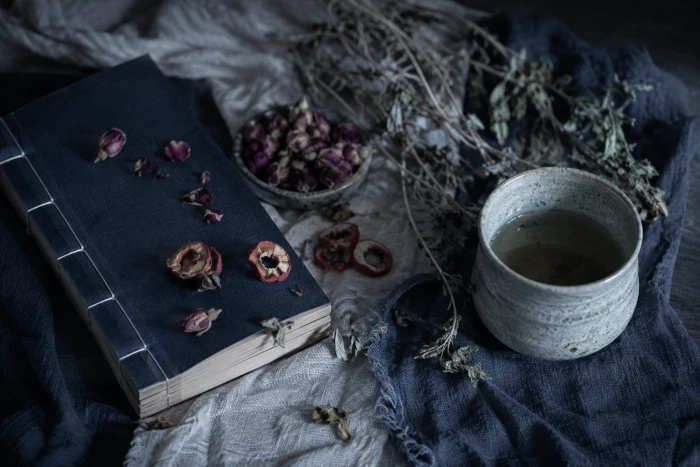
Typical signs of a blood stasis constitution
You almost certainly have someone like this around you: dresses thickest of anyone in winter, gloves and scarf all in place, yet still rubs her hands half the time after stepping inside; her face is a shade duller than others her age, she talks little and sighs before she speaks; after an afternoon of sitting she has to brace her lower back to stand and walk. Ask her where she's uncomfortable and she can't really say, only tosses off an "old problem". Blood not moving freely is a daily constant for such people, not an accident.
- Skin that bruises easily, taking days to fade after a bump, and you often notice bruises you can't explain
- A dull face, darker lips, dark under-eye rings, and a tendency to spots (especially melasma)
- Pain in a fixed spot that worsens at night (a fixed headache, period pain, low back or leg pain) — the tender point feels "driven in like a nail"
- Noticeable period pain, heavy menstrual flow with clots, and dark colour
- A darker tongue, sometimes with stasis speckles or patches, and fuller veins under the tongue
- Fear of cold, cold hands and feet, dry rough skin that flakes or looks "scaly"
One thing to stress: these are just common clues about a tendency, not diagnostic criteria. Whether you really count as a blood stasis constitution is something a TCM practitioner weighs using tongue and pulse signs (such as "thin and choppy"). Don't spot one matching line and rush to stamp "blood stasis" on yourself. The body's account is best settled by someone professional.
Why blood gets stuck: blocked qi, cold, and too much sitting
"瘀" is made of 疒 (illness) and 於. The ancients were blunt: blood stopping and building up in one place is illness. There's also the more common "淤" — water that's blocked is called "淤". Stagnation and blockage are really one idea: let it through and it's fine; block it and there's trouble.
Why won't the blood "move"? Sort it out and the most common causes are three:
- From blocked qi — it's "thought into being". TCM says "where qi moves, blood moves; where qi stalls, blood congeals." When emotions are bottled up for a long time — brooding, worrying, failing to think it through — qi gets stuck first and blood slows down to follow. It's also why heavy-hearted people often carry a face a shade darker than others their age. For how to address the emotional side, see Five Elements and Emotions: Which Element Matches Yours?.
- From cold — it's "frozen into being". "Blood moves with warmth and congeals with cold." Chronically cold hands and feet, a constant iced drinks habit, thin winter clothes — when the vessels contract, the blood slows and thickens. Behind a lot of people's period pain and "old-cold" knees stands a single "cold".
- From sitting — it's "sat into being". Eight hours a day in a chair, no bumps involved, yet the qi and blood simply won't get pushed along. TCM says "movement generates yang"; sit still and yang can't rise, so blood stalls in the neglected corners — low back, legs, neck and shoulders.
What's interesting is that modern medicine's view of "prolonged sitting slowing circulation and causing local ischemia", and of "vessel constriction and inflammation under chronic stress", lines up remarkably with TCM's observation of "stasis from blocked qi, cold and sitting" — just speaking in a different language. So the sooner you match yourself to those three, the easier the adjustment: your blood doesn't move because it was thought into stasis, frozen into stasis, or sat into stasis. The first two depend on your environment and mindset; the last one, all on whether your chair is willing to let go.
How to adjust (1): kitchen foods that get your blood moving
The key to blood-stasis care is not "force-drain the blood or slam it with heavy herbs" but "warm-it-through" — add warmth to the blood and let it flow on its own. In broad terms, warming yang, moving qi and moving blood go forward together, and mostly with things already in your kitchen:
| Category | Eat more | Ease off / avoid |
|---|---|---|
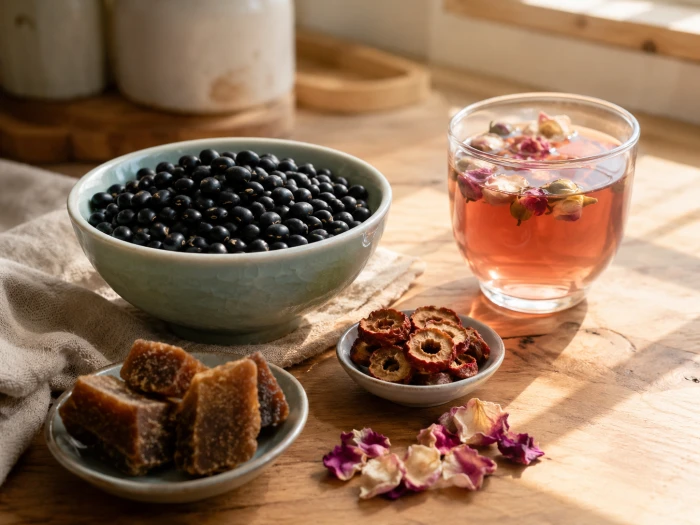
| Qi-moving, blood-moving foods | hawthorn, rose, black beans, brown sugar (in moderation), tangerine peel | excess rich greasy food, binge-eating |
| Warming foods | ginger, longan, red dates, a little beef or lamb, chives | raw-cold and iced drinks, excessive cold fruits and melons |
| Dark and blood-friendly vegetables and fruit | onion, black fungus, eggplant, grapes, purple cabbage | excessive spicy frying |
| Drinks | rose tea, hawthorn water, brown-sugar ginger tea | iced drinks, iced beer, strong tea on an empty stomach |
Here's a "warming brew" for a regular guest: three slices of ginger, three red dates, a pinch of brown sugar, boiled for about ten minutes. Brown sugar warms, ginger scatters cold, red dates lift the qi — all everyday choices that are hard to get wrong. After a meal, if you want to help settle rich food, a cup of hawthorn-and-tangerine-peel water, and rose tea as you go to move the qi. You don't need much; the value is in it being convenient and consistent.
Summed up in one line: blood fears cold, not warmth. Offer it a warm bowl and it will walk a few more steps through your body. Thinking in this direction is far more practical than fixating on "what heavy medicine should I take".
How to adjust (2): movement gives rise to yang, and blood follows qi
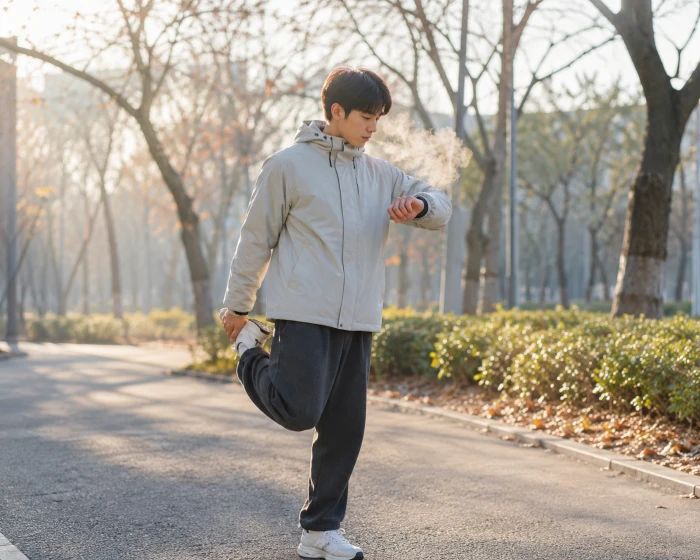
What exercise does for blood stasis, in one line: blood is "moved", not "toned up". The two extremes a blood-stasis body most fears are — never moving at all, or suddenly pushing into a drenching sweat. What suits you better is gentle activity with a light sweat that you can sustain: brisk walking, jogging, yoga, tai chi, baduanjin — 3–5 times a week, 30–40 minutes each time, aiming to "warm the limbs and get the blood circulating", not to "push yourself to collapse".
One detail that's easy to overlook: people with blood stasis often feel stiffer after remaining still (sore low back after sitting, numb limbs first thing in the morning). So more than a "single big workout", "moving a little every so often" fits better — every 40–50 minutes of sitting, get up and move your arms and legs for 3–5 minutes, so the blood doesn't keep congealing in one spot. This small habit is often closer to your everyday life than one hard run at the weekend.
Ever thought about it: you don't lack one drenching session — you lack dozens of "little shifts" through the day. Your body has a better memory than you think; when you get it moving, it remembers the way. That stuck breath is usually not blown open by heavy medicine, but warmed back to life one post-meal stroll and one stand-up at a time.
Pitfalls to avoid: moving the blood isn't violently "breaking up stasis"
These are the two most common traps. Take the first: promoting circulation is not the same as relentlessly "breaking up stasis". Herbs like sanqi and danshen that carry real "break-up" force belong under a doctor's guidance, for a clearly diagnosed stasis pattern — not as a daily "supplement" you gulp whenever you feel like moving your blood. High doses of blood-moving herbs during a period can send flow into overdrive; they can disturb a pregnancy; and mixing them with blood-thinners is more dangerous still. Now the second, sneakier one: many people think that once qi and blood are weak you should build them up hard, so they eat ejiao, longan and red dates like meals. But for a blood stasis constitution, ejiao is cloying, and when the blood is already stuck, the more you pile in, the more blocked the road gets — like pouring syrup onto an already congested road. Sort out the "clearing" first, then talk about "building"; the order can't be reversed.
One more layer to remind you of: blood stasis often runs alongside qi-and-blood deficiency (both "stuck" and "empty"). The care needs to weigh "move blood + tonify qi + warm yang" together — don't fix only on the two characters "break stasis". If you want to see in one go which types you lean toward and how stuck you are, take a standard TCM constitution test and line them all up — blood stasis, qi deficiency, yang deficiency and the rest — for comparison.
If what appears is sudden chest pain, one-sided limb numbness or weakness, unclear speech, a wandering or unbearable fixed sharp pain, or a hard lump on the body surface appearing for no reason — seek medical attention immediately. This may not be something "constitution" can explain; don't just carry it yourself as "stasis". Likewise, if you're pregnant, have heavy periods, or are taking anticoagulants or any long-term medication, consult a professional before using any blood-moving food or herb.
Common questions
Not the same concept. Blood stasis is a state described in TCM constitution theory of "blood not flowing smoothly", concerned with flow and nourishment; "high blood viscosity" is one indicator at the lab level. The two may be linked, but don't draw an equals sign, and don't let a lab report replace how your body feels.
The occasional one or two bruises that fade quickly are mostly about bumps or a tendency. But if bruises spread in patches, keep growing larger, or come with gum bleeding, a clear increase in skin bleeding spots, or difficulty stopping bleeding, see a doctor as soon as possible to rule out clotting problems.
Not recommended. Period pain has many causes (cold, stasis, deficiency, blocked qi — any can be involved), and many blood-moving herbs are fairly strong; taking them carelessly during a period can worsen bleeding or mask the real problem. How to match the pattern is safest guided by a TCM practitioner's differentiation.
From a TCM perspective, warming moxibustion may help with "stasis from cold congealing" (fear of cold, cold period pain, fixed cold ache), because it follows the reasoning of "warmth keeps blood moving". But for complex constitutions or bleeding tendencies, self-operation isn't advised. If you're interested, do it under professional guidance rather than following online wellness posts on your own.
A word from Bong
I run a pharmacy and sit behind the counter all day, so I have the most say on this — the moment I stand up, my legs are heavy, and I don't know when another bruise has appeared on the back of my hand. The body lives in experience; leave it idle too long and it pays you back with bruises and coldness.
Later I took up swimming and tai chi, for no other reason than to understand one point: if blood is to move on its own, you have to be willing to move first. Whether supplements work is another matter — just getting your backside off the chair can't be wrong.
References and sources
- Wang Qi et al., Constitution Theory of Chinese Medicine (classification and criteria for the nine constitutions).
- China Association of Chinese Medicine, Classification and Determination of Constitution in TCM (standard ZYYXH/T157-2009).
- World Health Organization (WHO) fact sheet on physical activity and health: Physical activity (a modern-side parallel on sedentary behaviour and health).
- National Center for Complementary and Integrative Health (NCCIH) overview of traditional acupuncture/TCM: Traditional Chinese Medicine.
- Mayo Clinic patient overview of menstrual cramps: Menstrual cramps.
Which of the nine constitutions are you?
Blood stasis, qi deficiency, yang deficiency, phlegm-dampness — each constitution asks for a completely different approach. Take one standard TCM constitution test and see your tendencies at a glance.
Start the TCM constitution test