For self-checking only — not medical advice.
Free · Anonymous · ~2 minutes
GUT JOURNAL · Field Notes on Your Gut
Gut Health Self-Check
A gentle, thorough gut health assessment. It maps your digestion across five dimensions — sensitivity, regularity, digestion, resilience, and the gut-brain link — then adds a Traditional Chinese Medicine perspective to point you toward the right daily care.
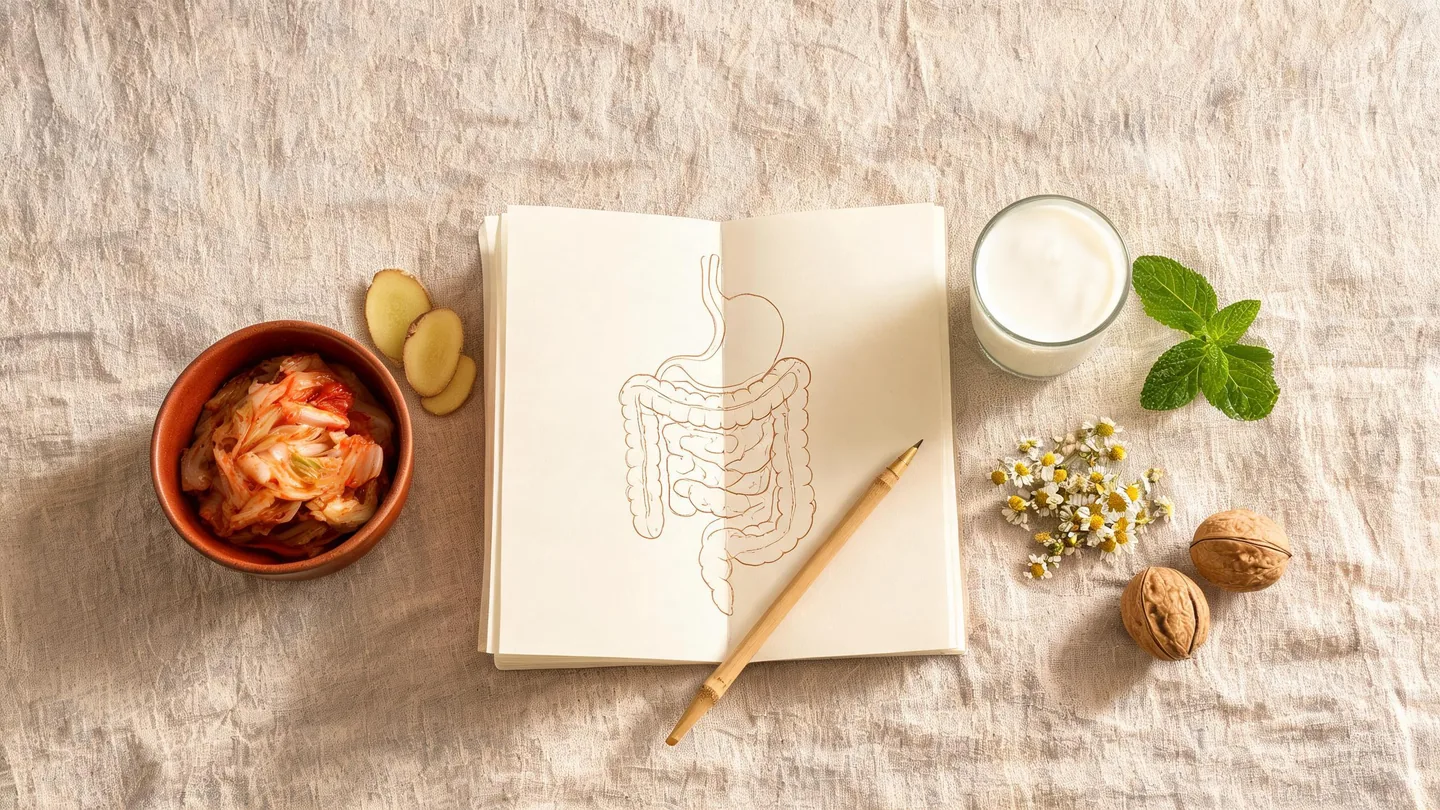
Why this test
Your gut is a star map waiting to be read
The gut is far more than a digestive pipe — it is linked to mood, immunity and daily energy. This test turns “hard-to-describe gut feelings” into a measurable map you can actually read.
Five-dimension portrait
From sensitivity, rhythm and digestion to resilience and the gut-brain axis, five dimensions sketch a full outline of your gut state.
A classical medicine lens
Each type comes with a gentle TCM perspective rooted in spleen-stomach theory and classical texts.
Instant report
Finish 20 questions and get your gut type portrait, daily rhythm, food and movement guidance right away — no sign-up, no waiting.
Private by design
Everything is computed locally in your browser. No answers are uploaded, no personal data is collected.
What we measure
5 · Five dimensions, one galaxy
Each dimension is built from 4 questions about the past three months. There are no right answers — only honest ones.
Sensitivity
How reactive your gut is to triggers: does one sip of something cold set it grumbling, or does it shrug off anything you throw at it?
Regularity
How steady your bowel and hunger rhythms are — a punctual clock, or an old watch that resets itself whenever it feels like it.
Digestion
Whether what you eat actually gets transformed: bloating, burping, and post-meal heaviness are all digestion trying to say something.
Resilience
How fast your gut returns to baseline after a hotpot feast or a short night — in other words, its self-repair speed.
Gut-Brain Axis
How strongly mood and stomach feed each other: does nervousness send you straight to the bathroom, or does your belly hold its ground under any pressure?
How it works
Three steps, two minutes
Answer honestly
20 questions about how you have actually felt in the past three months.
Local computation
Your browser computes the five dimension scores on the spot — nothing leaves your device.
Read your report
Get your gut type portrait, daily rhythm, food & movement plan, and TCM guidance.
Possible results
6 · Six gut star-map types
Every type is a way of living with your gut — no good or bad, only knowing it.

Steady Balance
Your gut runs like a well-kept clock: steady rhythm, reliable recovery, barely a complaint. Digestion and emot
TYPE 02
Highly Responsive
Your gut is a precision sensor: fast to react, loud to signal. Nothing gets past it. Food and mood both come t
TYPE 03
Slow Transit
Your gut runs a beat behind: lazy peristalsis, drifting rhythm, and bowel movements that feel like waiting for
TYPE 04
Low Transformation
Your gut is an underpowered grinder: food goes in, but "processing" lags — post-meal bloating, heavy gas, unfo
TYPE 05
Skin-Gut Reactive
Your body runs a dedicated "gut-to-skin hotline": the moment your gut stirs, your skin answers — flushing, bre
TYPE 06
Mind-Gut Resonance
Your "belly brain" and your "head brain" are a pair of hi-fi speakers wired in sync: when the stomach drops, m
Fit & boundaries
Who should take it, who should see a doctor first
It fits you, if —
- People whose gut feels "not exactly painful, but somehow off" most of the time
- Highly sensitive people who want to understand how emotions and digestion feed each other
- Anyone planning to change their diet who wants to know their baseline first
- People curious about the Traditional Chinese Medicine view of the Spleen and Stomach
- Busy people who'd like an annual-physical-style gut checklist
See a doctor first, if —
- Anyone already diagnosed with IBS, IBD, or celiac disease and under active follow-up
- Recent blood in stool, black tarry stools, or unexplained weight loss
- Abdominal pain, fever, or night-time diarrhea lasting over two weeks
- Family history of colorectal cancer, over forty, never had a colonoscopy
- Pregnant or breastfeeding with noticeable digestive symptoms
Scientific basis
The research behind the questions
The items draw on the following research directions, for lifestyle self-reflection only — not a medical diagnosis.
- Gut microbiota & mood
Gut microbes take part in producing serotonin and other neurotransmitters; microbiome composition and emotional state influence each other in both directions.
- Gut sensitivity screening
The frequency-and-intensity phrasing of the discomfort questions draws on how IBS epidemiological screening questionnaires are designed.
- Bowel rhythm indicators
Regular bowel movements are a key outward sign of stable gut motor function, and are widely used in digestive health self-assessments.
- Digestive tolerance self-report
How often post-meal bloating and belching show up is a standard self-report dimension for evaluating digestive function.
- Gut-brain axis research
The gut's nervous system and the brain stay in constant dialogue via the vagus nerve, immune signals, and hormones — the "second brain" concept.
Warm up with AI
Copy this prompt to any AI assistant — it can walk you through the test, and dig deeper into your result afterwards.
Privacy & limits
About your data and medical boundaries
Computed locally, never uploaded
All questions and scoring run inside your browser. This page never sends your answers to any server.
Anonymous, no account needed
No sign-up, no name or email. Your test history stays on your own device only.
A mirror, not a diagnosis
Results are for self-reflection and lifestyle observation. If discomfort persists, please see a doctor.
FAQ
You might be wondering
Are my answers uploaded to a server?
How long do the 20 questions take?
Is the result a medical diagnosis?
Why are there questions about my mood?
What's the difference between the quick and full versions?
Will my result change if I retake it later?
Ready when you are
Now, light up your gut star map
20 questions, two minutes, and a portrait of your gut that is truly yours.