If you feel tired even after a full night's sleep, catch a cold every time the season changes, and break into a light sweat just from talking a lot — you've probably thought about "boosting your energy." Search "qi tonic," and the first result is almost always astragalus. It is one of the most frequently used qi-tonifying herbs in traditional Chinese medicine (TCM), so common that folk practitioners say "nine out of ten prescriptions carry astragalus." But what is it actually doing? What does modern research say? Why do some people feel overheated after taking it while others feel fine? This article cuts through the hype and explains astragalus from the ground up.
What is astragalus: from famous qi tonic to "China's adaptogen"
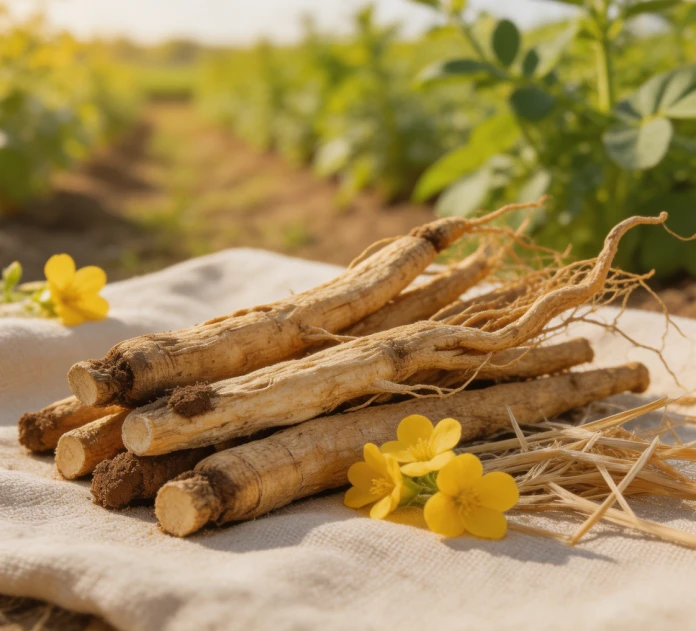
Astragalus (scientific name Astragalus membranaceus, mainly the species Astragalus membranaceus var. mongholicus and Astragalus membranaceus) is the root of a legume plant. You probably know someone like this: they don't look overweight, but they get winded climbing three flights of stairs, speak so softly it seems they don't want to wake anyone, and their hands are colder than anyone else's in winter — a seasoned TCM practitioner would almost always reach for astragalus when they see that face. This herb has been used in China for more than two thousand years. The Shennong Bencao Jing (The Divine Farmer's Materia Medica) listed it as a top-grade herb, noting it "supplements deficiency." In the Jin and Yuan dynasties, the physician Li Dongyuan put astragalus in nearly every qi-strengthening formula, which is why later generations boiled it down to "nine out of ten prescriptions carry astragalus."
To place astragalus among qi tonics, think of it this way: ginseng is the "heavy artillery" of qi — it comes in with a bang. Astragalus is more like the "steady base salary" of qi — gentle, sustained, built for the long haul. Interestingly, Western herbalism has recently found a familiar label for astragalus: adaptogen. Along with ashwagandha and reishi, it is grouped with plants that help the body cope with stress and maintain balance. That label may not be perfectly rigorous, but it captures astragalus's temperament: it doesn't aim for dramatic results; it helps you hold the line through the daily grind of burnout. In TCM this is called "tonifying qi and securing the exterior" — keep your qi guarded, and external pathogens have a harder time getting in.
What modern research says: polysaccharides, astragaloside and the weight of evidence
The two most-studied components of astragalus are astragalus polysaccharides (APS) and astragaloside IV. The evidence currently clusters around two directions:
The first is immune modulation. A large body of in-vitro and animal studies shows that astragalus polysaccharides can influence the activity of immune cells such as macrophages and T cells. Human studies are more limited, but some small trials suggest that in people with relatively low immune function, interventions containing astragalus may have a positive effect on certain immune markers. The second is anti-fatigue. In animal experiments, astragalus extracts show some anti-fatigue tendency, with mechanisms involving energy metabolism and oxidative stress — but to be honest: the human evidence for "astragalus fights fatigue" is "promising but unconfirmed."
Separately, astragalus injections have entered the clinical research picture in China as an adjunct in conditions like chronic heart failure and viral myocarditis. But that is a prescription-drug context — a world apart from brewing the root as tea. Don't confuse the two.

"Astragalus cures everything" or "astragalus tea fixes fatigue" — no reliable evidence backs these claims. Astragalus is a food-and-medicine ingredient, not a drug, and it cannot replace any proper treatment. See it as "a daily food for gentle nourishment," and you have the right mindset.
How to take astragalus: tea, soup and how to pick it
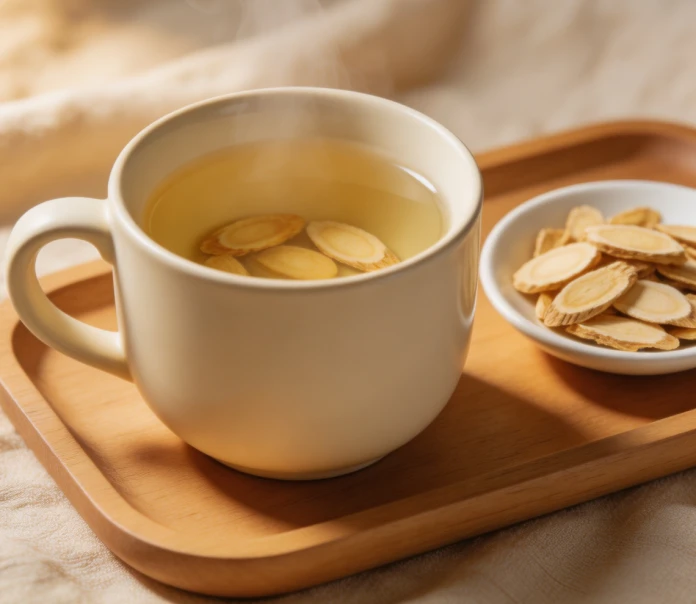
The most common ways to use astragalus are to steep sliced root as tea or add it to soup, often paired with red dates or Chinese yam. Here are three mainstream ways to choose from:
| Method | How to | Best for | Note |
|---|---|---|---|
| Astragalus tea | Use 10–15 g of root, steep in boiling water or simmer 10 minutes | Daily qi support, easily tired people | Can re-steep until flavorless |
| Simmered soup | Cook slowly with chicken or pork ribs | Soup lovers, autumn–winter nourishment | 2–3 times a week is enough, not daily |
| Paired brews | Astragalus + red dates / goji berries / yam | Richer flavor, balancing blood and qi | If your body runs hot, be cautious with red dates |
As for dosage, daily food therapy has no "pharmacopoeia standard" you must copy. Most sources suggest starting at 10–15 g per day, in small amounts, short-term, while watching your body's response. A practical rule: try it for 2 weeks at first — continue if you feel good, stop if you feel overheated or bloated. Boosting qi works like renovation: if the foundation isn't stable, all the gold leaf in the world won't help — your body knows it.
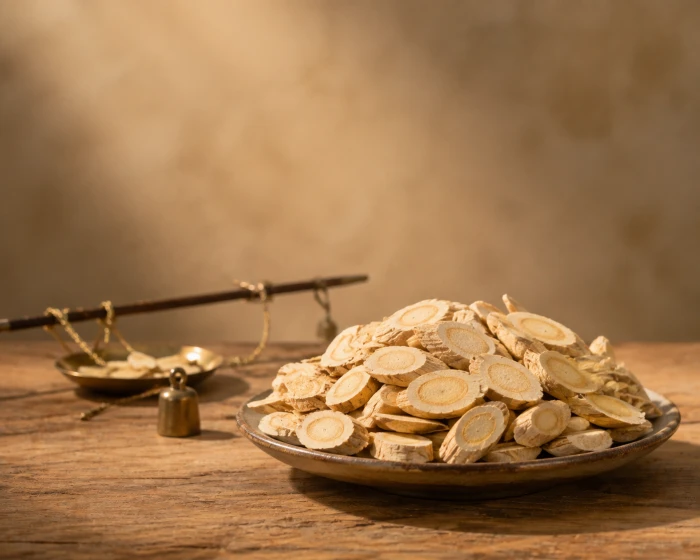
Good astragalus slices often show a "golden well, jade railing" cross-section — a pale yellowish-white outer ring with a deeper yellow center, grain like a well curb; they smell faintly beany and taste slightly sweet. Pick large, evenly cut, pest-free slices. That matters more than chasing a "wild" label (wild resources are scarce; most on the market are from standardized cultivation).
Who should not take astragalus
Astragalus is generally gentle, but if you fall into any of these groups, please pull your hand back from the shopping cart:
- During a cold with fever, sore throat, or other exterior/excess conditions: TCM holds that tonifying qi at this stage can "lock the pathogen in." Clear the exterior first, then talk about tonifying.
- If you clearly have yin deficiency with fire: people with hot hands and feet, night sweats, or a dry mouth and red tongue may find astragalus alone "adds fuel to the fire" and need a TCM practitioner to pair it carefully.
- If you have heavy damp-heat: a yellow greasy tongue coating, bitter taste in the mouth, or sticky stools mean clear the damp-heat before tonifying qi.
- If you have high blood pressure: traditional views suggest small doses may raise blood pressure, while some modern research hints large doses may lower it — the direction is debated. If you take it yourself, monitor your blood pressure and consult a doctor when needed.
- If you are pregnant or breastfeeding: human safety data are insufficient; self-administration is not recommended.
- If you are taking immunosuppressants: astragalus's immune-modulating effects may interfere with the medication; avoid stacking them on your own.
No "natural supplement" means "safe for everyone." If you are on medication, have a chronic condition, or are preparing for surgery, ask your doctor before taking it — that matters more than which brand you buy. You spend money on astragalus, but you risk your body if you get it wrong. Easy math.
Before you boost qi: stop leaking it
Back to the opening scene: always tired, easy colds, no energy. Many people's first instinct is "let me buy some astragalus and top up my qi," but they miss the most plain-spoken lesson of qi theory — qi is saved, not poured in. Late nights, sitting all day, and a racing mind all quietly drain qi; what astragalus adds may not even cover what you're losing. It's like filling the bathtub while pulling the drain plug — do you think the water will stay?
- In the past month, have I often been going to bed at 1 or 2 a.m.?
- During the day, do I sit for more than 6 hours straight almost without getting up?
- Am I always juggling three things at once, my mind never off?
If you answered "yes" to two or more, the answer is usually not to buy astragalus first, but to fix these small things — Why Am I Always Tired? 10 Overlooked Causes and TCM-Style Fixes has concrete steps. Supplements are bonus points; lifestyle is the base score. Fail the base, and no amount of bonus points will save you.
Frequently asked questions
Ginseng tonifies qi with a stronger, faster punch, but it is also more likely to cause overheating. Astragalus tonifies qi gently and steadily, better suited to long-term care. If you want to slowly nourish qi through daily food, most people are better off starting with astragalus.
If it suits your constitution, short-term daily use is fine, but try drinking it for about 2 weeks, then pause for a few days to observe, or simply settle on 2–3 times a week. Stop immediately if you feel a dry mouth, overheating, or bloating.
Better not. A cold with fever or sore throat is an exterior/excess stage, and tonifying then can "lock the pathogen in." Wait until the cold is fully gone before resuming daily care.
For the elderly with everyday qi deficiency and a normal appetite, a small amount can be tried with observation. Children should not take it on their own, and pregnant or breastfeeding women should not either. People in special groups should ask a doctor first.
A note from Bong

In the pharmacy's wall of drawers, astragalus was never in the most prominent slot. It sat in the bottom row, in the biggest drawer, because it was used the most and needed restocking constantly. My father was the one who stood at the counter filling prescriptions — of every ten slips that came in, nine had astragalus written on them. He weighed and measured without asking why, the way rice never makes it to the fancy part of a menu yet shows up at every meal.
Years later, far from home, I worked myself sick in a foreign winter — and only then remembered that drawer that was always full. It never dazzles, but it is always there, quietly holding things up. Maybe the rarest thing in Chinese medicine isn't the moment someone reaches for a dramatic remedy, but this kind of day-after-day, wordless steadying.
I'm going to brew myself a cup of astragalus tea. Save a breath for yourself too.
References
- Pharmacopoeia of the People's Republic of China (current edition), astragalus entry: functions and indications include "tonifying qi and raising yang, securing the exterior and stopping sweating, promoting diuresis to reduce edema, generating fluids and nourishing blood."
- Astragalus polysaccharides and immune regulation (PubMed search): pubmed.ncbi.nlm.nih.gov/?term=astragalus+polysaccharide+immune
- Astragaloside IV pharmacological research (PubMed search): pubmed.ncbi.nlm.nih.gov/?term=astragaloside+IV
- Astragalus and anti-fatigue research (PubMed search): pubmed.ncbi.nlm.nih.gov/?term=astragalus+antifatigue
Before you boost, see what you're missing
Always tired, catching colds easily — it may not mean "you need astragalus." Take a few minutes to assess your constitutional type, then decide whether — and in what direction — to supplement.
Start the TCM constitution quiz