If you've ever hit snooze three times on a workday morning, body heavy as lead; if breakfast leaves you sleepy again and you blame "food coma" — but really, something is pulling you back to bed — you may be feeling something Ayurveda calls Kapha. Earth and water, gone heavy.
Last time we talked about Pitta (fire). This one is about Kapha (earth-water) — the slowest, steadiest, and most underestimated of the three doshas. Vata fears chaos, Pitta fears burning out of control, Kapha fears stagnation. Wind scattered deranges; fire over-fueled destroys; earth-water left too long turns to sludge. Chinese medicine calls this "phlegm-dampness." Ayurveda calls it "Kapha imbalance." Different words, same phenomenon. This article is plain wellness education, no ads or product pushes. Read easy.

What Is Kapha: The Earth-Water Inside You
The Sanskrit root of Kapha is kshir — "to bind" or "to cohere." Ayurveda sorts human energy into three doshas: Vata (wind), Pitta (fire), Kapha (earth-water). Kapha sits third, not because it's the weakest, but because it's the most "settled" — it governs everything in the body that involves structure and cohesion: bones, muscles, fat, joint fluid, immunity, and the part of emotion that holds steady and contains. If Vata is the body's delivery driver and Pitta is the cook, Kapha is the one who keeps house: holding things together, making sure nothing falls apart.
Want to know if you're Kapha-dominant? The Ayurveda Constitution Quiz will give you a working answer. What follows is what you can do once you know.
Are You Kapha: Four Signatures
Kapha-dominant people carry four signatures: cold, heavy, oily, steady. See how many you recognize —
You probably know someone like this: solid frame, broad build, gains weight easily and loses it slowly. Skin leans oily but not broken out, hair thick and glossy. Moves slowly, speaks slowly, but every word lands. Eats without rushing, sleeps deeply — ten hours and still wants more. Emotionally steady as a mountain; when others panic, they don't, but once they decide something, ten oxen can't pull them back. Learns slowly, but once they learn, never forgets — Kapha has the best memory of the three. That's a Kapha face.
- Steady, reliable, containing
- Strong frame, great endurance
- Deep sleep, stable digestion
- Moist skin, thick hair
- Strong memory, deep feeling
- Heavy body, hard to wake
- Water retention, weight gain
- Slow digestion, sleepy after meals
- Low mood, no motivation
- Excess mucus, sinus, phlegm
- Hoarding tendency — can't let go
Key distinction: "Kapha type" ≠ "Kapha imbalance." A balanced Kapha is simply steady, reliable, enduring, with clear skin and deep sleep. The goal isn't to dig the earth-water out; it's to get it flowing again. Draining the earth-water isn't regulation — it's tearing up the foundation.
Kapha Faces You May Recognize
Abstract descriptions only go so far. Let's look at some familiar faces.
Fernando Pessoa, the Portuguese poet. We won't talk about his place in literary history — let's go small: he spent his whole life working as a commercial translator in Lisbon, sitting at the same desk every day translating business letters, then going to the same café after work, sitting in the same seat, writing poetry. He published only one poetry collection in his lifetime. After his death, they found over twenty-five thousand pages of unpublished manuscripts in a trunk. Kapha's "heaviness" became, in him, a kind of depth — sitting in the same place for a lifetime, while inside, universes opened up. He wrote: "I am the unknown one, who perhaps does not exist." It sounds bleak; it's actually Kapha at its extreme — sinking all the way down, and finding vastness there.
Marc Chagall, the painter who spent his life painting his hometown and his wife. We won't talk about his museum retrospectives — let's talk about what happened after his wife Bella died in 1944: he kept painting her for decades. In his paintings, Bella is always young, always wearing the dress from when they first fell in love, always floating above the sky of his hometown Vitebsk. Kapha's "tenacity" in him isn't a flaw — it's a kind of devotion. But you can see Kapha's risk in him too: too settled in the past, he struggled to live in the present.
Adele, the British singer. She's said publicly, many times, that she's "an old-fashioned romantic." She takes years between albums because she has to "live life first" before she can write. The press has discussed her weight for years; she said, "I make money for the record company, not to become a model." Kapha's "slowness" is her gift — years between albums, every one a smash. But the weight struggle is also a classic Kapha issue.
Find out your Ayurveda type — 100% free, no email required → Ayurveda Constitution Quiz
If you see yourself in any of them — especially in that tension between "steady" and "stuck" — what follows matters for you especially.
How Earth-Water Settles: Modern Life's Sediment
What does earth-water fear most? Not cold. Stagnation. A pond with flow is living water; a pond without flow is a swamp.
Kapha imbalance doesn't arrive overnight. It's more like sediment settling slowly, and at first you think, "this steadiness is nice." Common signs:
- Heavy body, hard to wake, no amount of sleep feels like enough
- Water retention, weight gain — especially around the middle
- Slow digestion, sleepy after meals
- Oily skin but not red, enlarged pores
- Low mood, no motivation, nothing feels worth doing
- Excess mucus — phlegm and runny nose on waking
- Hoarding tendency — can't throw things out, can't end relationships
Picture a Kapha-imbalanced morning: the alarm goes off, again and again, you hit snooze three times. When you finally get up, your body feels like lead. Breakfast makes you sleepy again — you blame "food coma," but it's Kapha pulling you back to bed. By 3 p.m. you meant to take a walk, but the sofa was too comfortable, and two hours disappeared. By evening you tell yourself, "tomorrow I'll move." Tomorrow is the same loop.
Modern life is practically engineered to settle Kapha — sitting, takeout, streaming, air-conditioned rooms, elevators, online shopping. Each one makes the earth-water a little heavier.
Now that you know how earth-water settles, the rest is straightforward — do the opposite. Stir what has settled.
Stirring the Settled: Warm, Light, Pungent, Dry
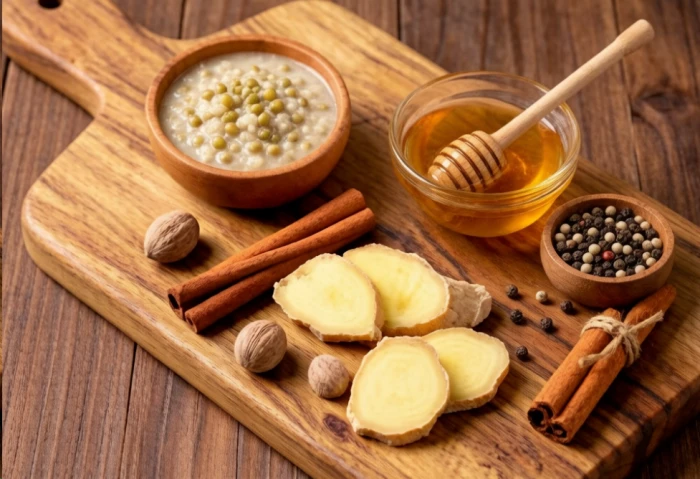
Kapha's signatures are "cold, heavy, oily, steady," so the diet reverses them: warm, light, pungent, dry. Each word addresses a specific quirk of earth-water.
Warm counters "cold" — favor warm food, avoid iced drinks and raw cold. Warm water is Kapha's best friend. Light counters "heavy" — less oil, less sugar, less dairy; more vegetables, more legumes; choose berries over bananas. Pungent counters "sweet" — ginger, black pepper, cinnamon, turmeric — these heating spices are Kapha's natural antidote. Dry counters "oily" — fewer soups and porridges (Kapha doesn't need more water), more roasted and baked, less stewed.
| Type | Good for Kapha | Minimize |
|---|---|---|
| Vegetables | Leafy greens, broccoli, celery, mushrooms, chili | Heavy potato, sweet potato, avocado |
| Fruit | Apples, pears, berries, pomegranate | Banana, mango, coconut, excess melon |
| Grains | Oats, quinoa, buckwheat, corn | Heavy rice, wheat, pasta |
| Legumes | Red lentils, mung beans, chickpeas | Soybeans, black beans |
| Fats | Small amounts of corn oil, mustard oil | Heavy ghee, sesame oil, dairy |
| Spices | Ginger, black pepper, cinnamon, turmeric, cumin | Heavy salt, sugar, sweeteners |
Kapha's food golden rule: warm, light, pungent, dry. Eat one bite less, move one step more.
Ayurveda's taste theory: Kapha does well with pungent, bitter, astringent — pungent breaks up stagnation, bitter cools, astringent reins in. Minimize sweet, sour, salty — they all add weight to the earth-water. Put plainly: a Kapha person trying to "nourish" with milk tea is pouring syrup into a swamp.
Giving Earth-Water a Flow: Movement Beats Supplements
Kapha is "earth-water." What earth-water fears most isn't cold — it's stagnation. Give it a flow and it stops being a swamp.

Here's the great Kapha paradox: the steadiest people sink the fastest. Kapha is earth-water; earth-water wants to stay put, hold steady, not move. Tell a Kapha person to run every day, wake up early, eat less, and they'll say, "I'm fine as I am, why bother." That "fine" is exactly where Kapha breaks — steady becomes stuck, and stuck becomes sunk.
What Kapha most needs to build isn't "what to eat" but "how to move, how to sleep less, how to break the steady." These look dull, but for Kapha each one beats any dampness-dispelling tea:
- Wake early, no lingering: Kapha loves the snooze button — the more they sleep, the heavier they get. Waking around 6 a.m. is the day's first line of defense.
- Move every day: doesn't have to be brutal, but must happen. Brisk walking, running, strength training all work — Kapha is the only dosha that thrives on high intensity. The more they move, the more alive they feel.
- Breakfast is optional: Kapha's digestive fire is weak. If you're not hungry in the morning, don't eat. Light intermittent fasting works for Kapha — the exact opposite of Vata.
- Change the scenery: Kapha sinks most easily in familiar environments. Vary your route, switch cafés, meet new people — you're stirring the water.
- Declutter: Kapha's hoarding tendency is the body's "heaviness" spilling into life. Throwing things out regularly beats drinking dampness tea.
Kapha imbalance almost always traces back to "couldn't get moving" — sitting, sleeping in, air-conditioned rooms, takeout. Get the body moving every day first, then talk about herbs. Otherwise everything you eat turns into "weight." A Kapha person trying to recharge with extra sleep is like throwing a wet blanket over wet firewood — the more you cover, the damper it gets, the heavier it sinks.
Want to break the stagnation with breath? Abdominal breathing paired with brisk walking works best — five minutes and you'll feel the heaviness begin to loosen.
Herbs Are Support, Not the Main Act
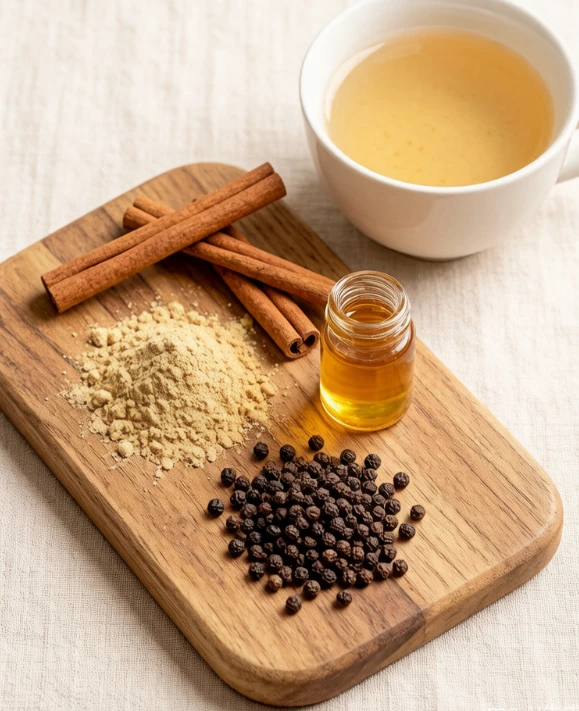
Worth saying three times: herbs are support, not the main act. Sleep ten hours a day, eat takeout three meals, lie on the sofa all day, and the best ginger tea on earth won't dissolve that heaviness. Get the body moving first — then herbs have room to work.
Once movement is in place, these herbs have traditional use and modern research behind them for Kapha:
Ginger: warms the middle, disperses cold, transforms dampness — Kapha's #1 friend. A cup of ginger tea in the morning beats coffee for Kapha. Coffee overstimulates; ginger warms steadily.
Black pepper: heating, dispersing. Add it to dishes to stoke Kapha's weak digestive fire.
Turmeric: warming, circulating, anti-inflammatory. Helps with Kapha's heavy joints and excess mucus.
Honey: raw honey is one of the few sweets Ayurveda approves for Kapha — it's dry and warming, transforms mucus. It must be raw; heated honey is considered toxic in Ayurveda.
Ashwagandha: supports mood when Kapha imbalance comes with low spirits. See our ashwagandha guide.
Spice isn't punishment — it's a wake-up call for earth-water.
Things Kapha Should Do Less
For Kapha, "do less" beats "do more." Each of these is a common Kapha pusher — every one adds weight to the earth-water:
- Less sleeping in — the more Kapha sleeps, the heavier they get; 7–8 hours is enough
- Less sweet and greasy food — sugar and oil are Kapha's fuel
- Less dairy — milk, cheese, yogurt are all Kapha's kin
- Less sitting — Kapha stagnation starts the moment your hips touch the chair
- Less daytime naps — Kapha doesn't need more sleep
- Less hoarding — things or relationships; what doesn't move turns to silt
Give the earth-water a flow and it stops sinking. Give it a stir and it stops stagnating.
A Note from Bong

Chinese medicine calls it "phlegm-dampness." Ayurveda calls it "Kapha imbalance." Both see "heavy, sticky, sluggish" as the same body state. Not a coincidence — it's observation: the body contains something "heavy," and when it goes over, it sinks.
The modern Kapha disorder isn't about eating the wrong thing. It's about not moving. Sitting, staying in, takeout, streaming — every one of them adds weight to the earth-water. Calming Kapha isn't about buying the most expensive dampness tea. It's about getting yourself to move every day.
Earth-water isn't there to be dug out. It's there to flow. Tomorrow, try waking ten minutes earlier. No need to run — just walk one loop outside. Move, and what's heavy starts to dissolve.
References
- Chopra A, et al. "Ayurvedic medicine for rheumatoid arthritis: a randomized, controlled trial." PubMed, PMID: 21575739.
- NIH National Center for Complementary and Integrative Health, "Ayurvedic Medicine: An Introduction."
- World Health Organization, "WHO Traditional Medicine Strategy 2014-2023."
- Charaka Samhita (English selection), classical Ayurvedic text.
- Sharma PV. "Classical Uses of Medicinal Plants." Chaukhambha Visvabharati.
FAQ
Not at all. A balanced Kapha has the best endurance, the most reliability, the most containing presence — they're the best executors of long-term projects. Laziness is a signal of imbalance, not Kapha destiny. Balance the earth-water and it becomes a foundation. Don't balance it and it becomes silt.
Of the three doshas, Kapha is the one that benefits most from high intensity: running, strength training, HIIT, swimming all work. Kapha has great endurance — the more they move, the more alive they feel. The hard part isn't the exercise; it's the first step out the door.
Depends on how long it's been off and whether you can move. Kapha takes the longest to shift — earth-water is heavy by nature, and dissolving it takes time. But move every day and within two weeks you'll feel lighter. The hard part is that Kapha most resists moving — so the work is momentum, not method.
Highly overlapping. TCM's "phlegm-dampness constitution" describes exactly the "heavy, sticky, sluggish" state — water retention, excess mucus, lethargy — which is essentially the same population as Kapha imbalance. Two systems, same phenomenon, different angles. To check your TCM constitution, take the TCM Constitution Quiz.
Find Your Type
Are you Vata, Pitta, or Kapha?
Take the Ayurveda constitution quiz and get your primary dosha plus a personalized result page. This article covers general Kapha care; your result page gives you specific recommendations.
Start the quiz