If nothing in your life has changed — same job, same relationships, same rent — yet since late September you feel flat: hard to get up in the morning, sluggish all day, overthinking at night, and the snack portions keep getting bigger. Before you call yourself lazy, or diagnose yourself with depression, notice one detail: the coworker who was loudest on the summer basketball court has gone quiet too. The friend who always started group chats now replies hours later. That is not coincidence. The season is turning the dial on a whole crowd of people at once.
Traditional Chinese Medicine (TCM) calls this seasonal mood dip "autumn grief." Modern medicine calls it seasonal mood variation, and has a formal name for the severe end: Seasonal Affective Disorder (SAD). This article does three things: explains why it is autumn specifically, draws the line between autumn blues and real depression, and hands you a six-direction reset list you can start today.
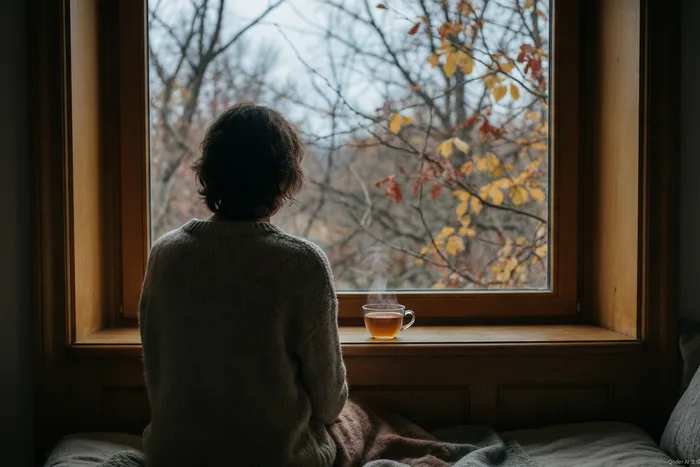
The character for "sorrow" puts autumn over the heart
In Chinese, the character for "sorrow" is built from two parts: "autumn" written on top, "heart" underneath. Whoever composed it thought carefully: when autumn arrives, something presses on the heart. That is not poetry — it is a whole system of observation compressed into brushstrokes. In the 3rd century BC, the poet Song Yu opened his "Nine Laments" with "Grievous, indeed, is the air of autumn" — and installed "autumn sadness" permanently into Chinese literature. For the next two thousand years, writers felt gloomy every fall. Turns out there was a physiology underneath all those poems. It was not mere posturing.
Dismissing the autumn blues as sentimentality is the modern world's biggest misreading. There are at least two explanation systems for it — and, interestingly, both are describing the same thing. First what modern medicine says; then what TCM says.
An invisible hand is turning your dials
The whole mechanism runs on one variable: daylight length.
After September, sunset moves earlier every single day. In London, daylight shrinks from nearly 16.5 hours at the summer solstice to under 8 hours by early December — the sun is quietly rescheduling your life. Your retina registers less light, and the brain's orders change with it: the window for melatonin (the hormone that makes you sleepy) stretches longer, while serotonin (the neurotransmitter that gives you drive) drifts down with the sun. So you get sleepier, you crave carbohydrates, you move less, your thoughts tilt darker. This is not a mood problem — it is an endocrine one. Your body clock has been shifted by the season.
The phenomenon got its formal name in 1984 from American psychiatrist Norman Rosenthal, and his starting point is a vivid one: working in Alaska, he noticed his winter clinic looked different. Many patients were not the classic insomniacs losing weight — they were the reverse: sleeping endlessly, eating endlessly, gaining weight, avoiding people. Human hibernation. That opposite-of-typical-depression seasonal pattern was named Seasonal Affective Disorder (SAD).
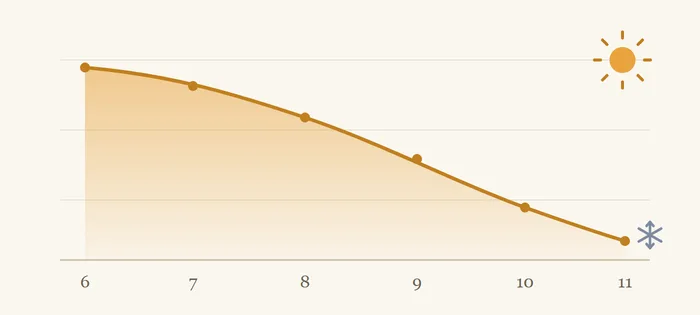
Its geography is the hardest evidence of that "invisible hand": the farther from the equator, the more common. Roughly 1–2% of adults in Florida; over 10% in parts of the northern US like New Hampshire and Washington State; higher still in Scandinavia. The same adult, moved to a different latitude, faces a mood disorder risk an order of magnitude apart. Latitude presses on mood like a hand you never see.
One more layer people miss: weak winter sun means less vitamin D made in the skin, and vitamin D participates in serotonin synthesis — a real factor for northern and high-latitude populations. So "something is off with me this autumn" is usually three or four physiological links loosening at once. Like a phone with a dozen apps open in the background: nothing is broken, everything is just slow.
The TCM view: autumn answers to grief — and grief traps you back
TCM never heard of melatonin, but it built a parallel, self-consistent language. In the Five Elements, autumn is Metal, corresponds to the lungs, and matches the emotion of grief (and worry). The Yellow Emperor's Classic defines autumn precisely: "The three months of autumn are called balance… let the will be as if hidden, as if concealed" — in autumn, human feeling is supposed to turn inward, quiet, unshowy.
Note what that is not: a disease. It is part of the season's rhythm. Summer sends qi and blood outward and loud; autumn gathers them inward, and your spirit ("shen") settles along with them. Settle too far, and quiet tips into grief.
The deeper layer is in the elemental cycle: Metal restrains Wood. Wood corresponds to the liver, whose job is the free, outward flow of emotion and impulse; when autumn Metal is in charge and lung-qi descends, the liver's rising push gets pressed down at the top. That is why many people feel "unable to open up" in autumn — talking less, caring less, sighing more. Nothing happened to you; the season simply put its hand on the force that pushes outward.
Less light → melatonin window stretches, serotonin drops → sleepiness, appetite shifts, low mood. Circadian disruption is the driver.
Autumn Metal in charge → lung-qi descends, the emotion is grief → the will turns inward. "Gathering" taken too far reads as low mood; and Metal pressing Wood makes free flow harder too.
Two languages, one phenomenon: humans are supposed to be quieter and slower in autumn. The problem is that modern people do not allow quiet — you caffeine your way through the day pretending it is still July, and fill the dark evenings with short videos. The body wants to gather; you refuse to let it. The gap becomes the symptom.
The autumn blues are neither a willpower failure nor a diagnosis to grab. They are the physiological product of light, hormone rhythm and lifestyle acting together — and "grinding through it" costs exactly as much as "self-diagnosing depression": the first refuses adjustment, the second manufactures panic. The right stance sits between them: adjust seriously for two weeks while watching for a few red lines.
Mechanism settled. Now the practical question: how do you know where you stand on the spectrum?
Autumn blues, SAD, depression: one spectrum, where are the lines?
These are not three diseases but three marks on one spectrum. Read the table, then run your own check.
| Dimension | Autumn blues (seasonal mood shift) | SAD (seasonal affective disorder) | Depression (major episode) |
|---|---|---|---|
| Timing | Mild dip after September, waxes and wanes with daylight | Recurring in the same season two years running; dominates most of the year's illness | Season-independent; low mood nearly every day for 2+ weeks |
| Sleep & appetite | Slightly sleepier, slightly hungrier; basically normal | Classic "hibernation pattern": oversleeping, carb binges, weight gain | Insomnia or hypersomnia; appetite clearly changed |
| Interest | Faded, but you can still get absorbed once you start | Clearly reduced; social withdrawal begins | Loss of interest in nearly everything, including old favorites |
| Self-view | Basically stable | Self-blame or worthlessness possible | Intense worthlessness, guilt |
| Functioning | Work and life maintained — just "no spark" | Noticeable difficulty at work and socially | Daily functioning breaks down |
| Danger signs | None | A minority develop suicidal thoughts | Suicidal thoughts or plans may appear — get help immediately |
- Does it move with the seasons — clearly worse in autumn, easing by late winter, same pattern in past years?
- Does it feel like "low-power hibernation" — sleepier, carb-craving, reluctant to move — rather than losing interest in everything and feeling worthless?
- Is it damaging basic function — can you still work, study, see people? Any thought of "just disappearing"?
If the first two lean "yes" and the third leans "no," this is most likely a seasonal mood shift: work the list below and it usually loosens within weeks. The moment the third answer is "yes" — especially any thought of self-harm — skip straight to the "see a doctor" section. That is beyond the autumn-blues level, and beyond any checklist.
The reset list: six directions
If the root of autumn grief is "the body wants to gather and life won't let it," the fix is six words: change along with the season. Six directions, ranked by payoff.
| Direction | What to do | The TCM reading |
|---|---|---|
| 1. Light | Walk outside within 30 minutes of waking, 20–30 minutes; save the brightest hours of the day for outdoors; add 10–15 minutes at lunch. Where winter mornings are pitch dark, ask a doctor about a light-therapy lamp (~10,000 lux, 20–30 min) | Follow the yang — borrow the sky's light by day instead of coffee by night |
| 2. Sleep | Go to bed half an hour to an hour earlier than in summer, aiming for 22:00–23:00; keep rising at the usual hour. Don't "steal the day back" with late-night scrolling — you gain hours and pay in rhythm | Autumn's classic rule: "early to bed, early to rise, meeting the rooster" — gather the spirit |
| 3. Movement | Gentle and consistent: Ba Duan Jin, brisk walking, stairs — 30 minutes, 5 times a week, stopping at light sweat. Autumn is not the season for all-out sprint workouts that end in soaked shirts | Movement raises yang; over-sweating in autumn leaks lung-qi |
| 4. Food | Build on white, moistening foods (pear, white fungus, lily bulb, lotus root), then add spleen-friendly yellows (Chinese yam, pumpkin, millet). Go easy on chili and barbecue — pungent flavors scatter, and autumn is for storing: saving money with one hand while the other leaks | Metal and Earth feed each other — moisten first, tonic later |
| 5. Emotions | Give "gathering" an outlet: a three-line diary (one small thing from today is enough), sitting in the sun doing nothing, tidying a drawer — turn feelings from rumination into placement | Grief dissolves qi; joy overcomes grief — seeking pleasure is not escape, it is elemental medicine |
| 6. Company | At least one face-to-face meal or walk per week. Cut every "obligation outing" you like — but don't zero out human contact. Contracting inward is not sealing yourself in | Sitting alone feeds grief; people warm each other |

20 minutes outdoors in the morning light. It delivers light, movement and a clear head in one go. Hold it for two weeks before judging your mood — far more useful than lying on paper rehearsing "am I depressed?" Change starts from the smallest doable action. It never starts from figuring it all out first.
Origin: a simplified daily-drink take on "Gan Mai Da Zao Tang," a famous formula from Zhang Zhongjing's Essential Prescriptions from the Golden Cabinet (c. 220 AD), traditionally used for "visceral agitation" — sudden sadness, wanting to cry, restless sleep. A common autumn cup for people whose mood dips with the season.
Ingredients: 30 g wheat berries (floating wheat if you can find it; ordinary whole wheat is fine), 5 red dates (jujubes) torn open, 2–3 thin slices of licorice root.
Method: put all three in cold water, bring to a boil, simmer 20 minutes; drink it through the afternoon as tea.
Cautions: skip the licorice if you have high blood pressure or edema; check with a doctor first if pregnant or breastfeeding. The formula is famously mild — but no food therapy should replace proper treatment.
Of the six directions, "emotions" is the one people skip — and the one worth a story. A Chinese poet more than a thousand years ago already ran the experiment: Liu Yuxi wrote, "Since ancient times, autumn meant desolation — but I say this season beats spring." Note: he was not whistling past the graveyard. He spent 23 years in political exile; he knew desolation. What he did was not deny autumn's gloom but take a different stance toward it. Seasonal mood works the same way: don't argue with autumn. Step aside for it, then get on with your own business.
When to see a doctor without waiting
The list above is for "fluctuation." For the situations below, stop self-adjusting and go to a professional:
- Any thought of "disappearing" or self-harm: contact a doctor, a trusted person, or a crisis line immediately (in the US: call or text 988).
- Low mood lasting over two weeks with no easing, or work, study and basic relationships can no longer be held together.
- Nights without sleep, days without appetite, or clear weight change in a short time.
- Every past winter was this hard: don't grind through to spring — SAD has mature treatments (light therapy, psychotherapy, medication when needed); earlier help means an easier path.
- You genuinely cannot tell autumn blues from depression: instead of scaring yourself, get one professional assessment and hand the uncertainty to a diagnosis.
Mood catching a seasonal "cold" is common; pneumonia needs a doctor. Asking for help is not weakness — it is handing the job to someone trained for it, the way chest pain that won't quit deserves more than pear soup. And one more: if someone around you has been "disappearing" all autumn — unanswered messages, no outings, self-deprecating jokes more often than usual — one honest check-in from you may beat every checklist in this article.
Let AI draft your autumn mood schedule
FAQ
Watch two lines: the timeline and the functioning line. Autumn blues is a mild dip after September — you still get absorbed in your work and life runs on schedule. SAD is a clinical diagnosis: recurrent season-linked episodes meeting depression criteria and clearly impairing functioning, classically the "hibernation pattern" — oversleeping, carb binges, weight gain, social withdrawal. Cross the functioning line and checklists stop being the tool.
Not after 2 p.m. Caffeine cancels sleepiness, not rhythm — it makes nights harder, mornings worse, and rolls the autumn debt forward. Running on coffee in autumn is like pointing a fan at a fever: the air feels cool, the fever stays.
Test first, supplement second — that is the safest order. Levels run low in darker seasons and indoor lives, but dose and form are individual, and overdoing it carries real risks (toxicity at high long-term doses). One blood test and a doctor's answer beats months of guessing.
From the TCM view, two stand out: the Qi-Stagnation type (flow was already constrained; autumn Metal presses further and "opening up" gets harder) and the Yang-Deficiency type (less sun hits them twice as hard). Qi-Deficiency people also run out of battery faster this season. Unsure which you are? The quiz at the end tells you in three minutes — knowing beats guessing.
For most people the seasonal dip eases as daylight grows again after the winter solstice. If December and January bring worse rather than better, don't wait — that is outside the "autumn blues" explanation and deserves a professional assessment.
Bong's note

Part of grief is just an unpaid bill. Don't rush to staple "depression" onto yourself, and don't scold yourself for being soft — run the list for two weeks: walk in the morning, lie down earlier, eat pears, cut the midnight hours. If nothing loosens after two weeks, see a doctor. That is not being soft. That is taking yourself seriously.
References
- Yellow Emperor's Classic · Suwen · Treatise on Regulating the Spirit According to the Four Seasons — "The three months of autumn are called balance… let the will be as if hidden" — the classic source of autumn emotional care.
- Zhang Zhongjing, Essential Prescriptions from the Golden Cabinet — origin of the Wheat, Date and Licorice Decoction, for "visceral agitation: frequent sorrow, wanting to cry."
- Rosenthal N. et al. (1984), Seasonal affective disorder, Archives of General Psychiatry — the original description and naming of SAD (pubmed).
- StatPearls, Seasonal Affective Disorder, NCBI Bookshelf — definition, epidemiology and light-therapy review.
- Song Yu, Nine Laments (c. 3rd century BC) — "Grievous, indeed, is the air of autumn": the opening of China's literary tradition of autumn sorrow.
Know your constitution, aim more precisely
Which body constitution are you?
18 questions · about 3 minutes · find out if you're the type autumn hits hardest, and aim this list at your own body.
Start the TCM constitution test