If you've read our guides to spring and summer wellness, you've probably caught on to how TCM treats the seasons — spring teaches you to push things out, summer teaches you to let things go. So what about autumn? Autumn doesn't teach anything. It only does one thing: gathers summer's noise back in. The cicadas stop, the leaves start falling one by one, and the wind turns from sticky to crisp. If you keep living at summer's pace — late nights, cold drinks, always pushing outward — autumn will use a string of small complaints to remind you: it's time to slow down.

The Core of Autumn Wellness: Settling & Gathering
The Neijing describes autumn with an elegant phrase: rong ping — the qi of heaven and earth settles and levels off, and all things move from abundance to harvest. Spring's qi rises, summer's scatters, autumn's gathers. Follow the season and everything flows; fight it and autumn has its ways of letting you know.
The big direction for autumn: care for your lung qi, counter autumn dryness, and settle your emotions. Don't rush to “put on the autumn fat” — first learn to gather.
What does “gather” mean in practice? Gather your sweat (no drenching workouts), gather your mind (no wild emotional swings), gather your nights (go to bed earlier), gather your mouth (ease off the iced drinks and fried food). Every little subtraction you make in autumn is savings for winter.
“The three months of autumn are called rong ping. The weather turns brisk and the earth grows clear. Sleep early and rise early, keep company with the rooster. Settle your will and be at peace, to ease autumn's thinning.” — Huangdi Neijing · Suwen · Four Qi Tiao Shen Da Lun
In plain words: in autumn, live like a rooster — to bed at nightfall, up at dawn. Keep your heart still instead of sinking with the season. And bring summer's extravagance home, slowly, on the way to winter. Read those lines again — isn't there more “quiet” in them than in the summer passage?
The Six Solar Terms of Autumn
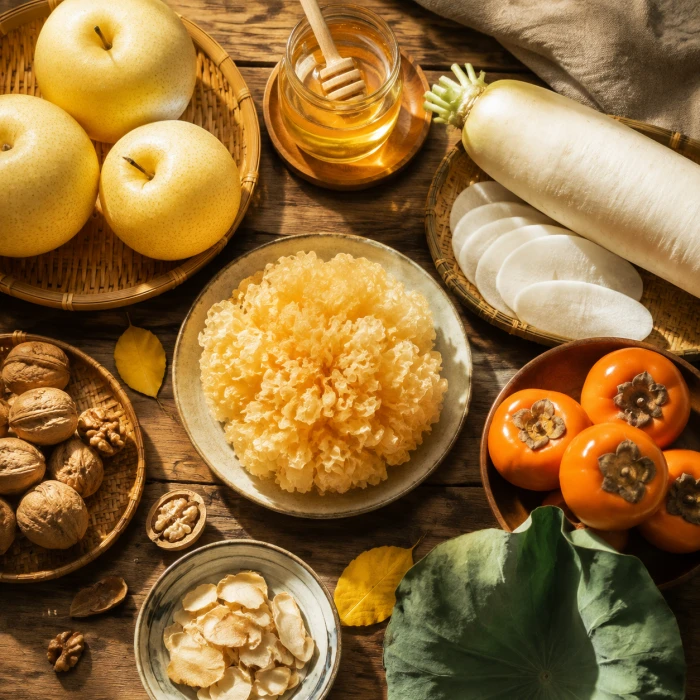
Autumn runs from Start of Autumn to Frost's Descent — six solar terms. The first three still carry summer's warmth; the last three get colder step by step:
| Solar term | Around | Climate | Wellness focus | Foods to favor |
|---|---|---|---|---|
| Start of Autumn | Aug 7–9 | Summer heat lingers; autumn begins | Moisten and nourish the lungs, don't rush to bulk up | Pear, white fungus, lily, Chinese yam |
| End of Heat | Aug 22–24 | Heat fades; dryness shows | Clear lingering heat, guard against dryness | Lotus root, snow pear, honey, sesame |
| White Dew | Sep 7–9 | Day-night gap widens; dew appears | Layer up mornings and evenings, protect the neck | White radish, winter melon, duck, lily |
| Autumn Equinox | Sep 22–24 | Day and night equal; yin-yang balanced | Nourish yin, moisten dryness, eat evenly | White fungus, lotus seeds, pumpkin, chestnuts |
| Cold Dew | Oct 8–9 | Dew turns cold; autumn deepens | Guard against cold, nourish lungs, firm defenses | Walnuts, sesame, lamb, red dates |
| Frost's Descent | Oct 23–24 | Temperatures drop; first frost | Warm the spleen-stomach, store for winter | Chestnuts, Chinese yam, pumpkin, beef |
Lung Care: Autumn's Top Priority
Autumn corresponds to the Metal element, and Metal's organ is the Lung. The lungs govern qi, breathing, skin and hair, and they manage your wei qi — the defensive layer just under your skin. Nourish the lungs in autumn and you'll catch fewer colds, cough less, and your skin stays supple all winter.
- Take a few deep breaths each morning to let out the night's stale air
- Eat the moistening white foods (next section)
- Cover your neck and chest when the morning-evening temperature swings
- Don't linger in dry, stuffy rooms; add a little humidity
The lungs “open into the nose” and “shine in the hair.” So if your nose feels dry, your skin itches, or you're shedding more hair than usual in autumn, don't file it under “seasonal superstition” — in TCM terms these all trace back to dryness in the lung system.
Autumn Dryness: The Season That Dries You Out
Typical autumn-dryness symptoms: chapped lips, dry nasal passages, scratchy throat, dry cough with little phlegm, flaky skin, harder stools. Severity varies — mild cases pass with water; stubborn ones can tail you all season.
For a more systematic view, check the Yin Deficiency Constitution guide (yin-deficient people dry out harder in autumn).
Autumn Eating: Moistening, White Foods, Skip the Bulking
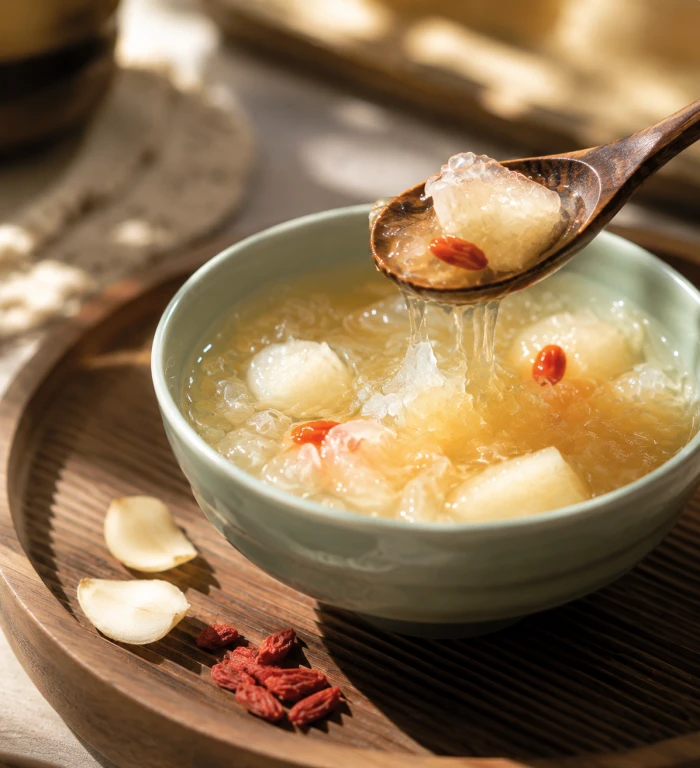
Autumn eating in one line: moisten first, favor white foods. TCM holds that white enters the lungs, so the autumn table features a white parade.
- Moistening white foods: snow pear, white fungus, lily, Chinese yam, white radish, lotus root, winter melon, tofu
- Nourish yin: honey, sesame, walnuts, duck, white-fungus-lotus-soup
- Strengthen the spleen for winter: pumpkin, chestnuts, red dates, millet porridge
- Don't rush the “autumn bulking”: moisturize first, then consider tonics — jumping straight to heavy food with a weak spleen just creates stagnation
Ingredients: 1 snow pear, 15 g dried white fungus (soaked), 10 g dried lily, a small handful of goji berries, rock sugar to taste.
Method: ① Tear the fungus into small florets and simmer with the lily in cold water for 40 minutes; ② core and cube the pear, add with the rock sugar, cook 15 more minutes; ③ scatter the goji berries, turn off the heat, and rest 5 minutes.
Notes: The fungus needs to release its gel to be truly moisturizing; those with cold spleen-stomach or easy diarrhea should drink less or swap the fungus for Chinese yam.
Daily Rhythm & Exercise: Early to Bed, Restrained Training

Autumn is the easiest season for sleep — no summer heat to fight, no winter chill to dread. The Neijing's answer is simple: early to bed, early to rise, keep company with the rooster.
Want to follow along? The Baduanjin guide for beginners is built on restrained movements — a perfect autumn fit.
Autumn Blues: Your Emotions Need Gathering Too
For the autumn blues, TCM doesn't say “tough it out.” It says two things: joy counters grief, and movement disperses stagnation:
- Get more sunlight — shortening days reduce exposure, and daylight lifts the mood
- Move regularly — walking and Baduanjin let pent-up qi out
- Don't hole up — a meal or a call with a friend helps more than you'd think
- Allow the low mood, but not for more than two weeks — persistent lows deserve professional support
If autumn low mood comes with poor sleep and stress, start with the Sleep Quality Test and the Anxiety & Stress Test to get your bearings.
A Note from Bong

This article can already help you more than enough. As for the rest of autumn — let your body tell you how to spend it. It knows better than anyone.
Ask an AI Assistant for a Custom Autumn Plan
References
- Huangdi Neijing · Suwen · Four Qi Tiao Shen Da Lun — source of the “three months of autumn” teaching.
- China Meteorological Administration, official notes on the 24 solar terms (Start of Autumn to Frost's Descent).
- World Health Organization, materials on Seasonal Affective Disorder (SAD) and light therapy.
- US National Institutes of Health, reviews on air humidity and respiratory mucosa.
FAQ
“Autumn bulking” made sense when winter food was scarce. Modern diets are usually ample — so moisturize first, then moderate tonic. People with a weak spleen especially shouldn't jump straight to heavy meat, which tends to stagnate.
Autumn-dryness coughs are usually “dry, low-phlegm, itchy-throat” types; pears, white fungus and lily help. But if a cough lasts over two weeks, or comes with fever or yellow phlegm, see a doctor instead of toughing it out.
Yes, but in order — clear and moisten first, then strengthen the spleen, then consider warm tonics. Yang- or qi-deficient people do well with gentle foods like Chinese yam, pumpkin and beef. For formulas, get a practitioner's guidance.
“Spring fatigue” ties to dampness and blocked rising qi; “autumn fatigue” ties to the body settling after summer's spending, plus shorter daylight. Both respond to consistent sleep, moderate movement and light food. Severe sleepiness deserves a check-up.
Find Your Body Constitution
Which body constitution are you?
18 questions · about 3 minutes · to point your autumn wellness in the right direction.
Start the test