If you feel somehow "soaked" all the time — puffy face and eyelids in the morning, heavy limbs all day, a row of teeth marks along the edge of your tongue, worse weather on damp days — you've probably been told to "drain the dampness." Search for "remove dampness" and the two names that pop up most are adlay millet and poria. Everyone knows adlay. Poria, though, gets done a disservice by its fame protocol: it has none of ginseng's story, none of dong quai's pretty name — it's a plain white lump like a piece of tofu, and it smells of almost nothing. Yet in TCM it's the go-to herb for "spleen deficiency with dampness." So today, no hype and no trashing — let me walk this "white tofu" through from top to bottom.
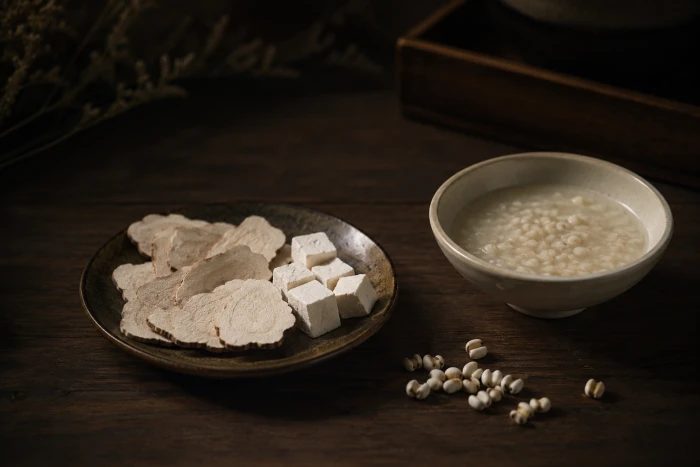
What poria is: not a root, a fungus — the "peaceful herb"
First, one of the most common mix-ups: poria is not the root of a plant. It's the underground sclerotium of a fungus in the Polyporaceae family that grows on pine roots — dug up, washed, and sliced, it's that "white tofu" in your medicine cabinet. White, clean, almost tasteless, it was graded a top herb in the Shennong Ben Cao Jing, praised as "long-term use calms the spirit, nourishes without hunger." The ancients filed it with yam and lotus seed among the gently tonifying foods — it walks a "mild and safe" road, not a strong-herb one.
TCM's billing for poria is "drain dampness through urination, tonify the spleen, calm the spirit." Plainly: it helps the body "pass out" the water that should go, without roughing up the stomach and spleen, and steadies you when the mind won't settle and sleep escapes you. It's not bitter, not cold, not greasy — like the nicest, most inoffensive character in the pharmacy: damp people lean on it to drain, spleen-weak people to tonify, phlegm-heavy people to help dissolve. Follow the thread and it's simple: poria spends its whole life circling two things, the spleen and water.
Now that you know what it is, you're bound to ask: modern people want evidence — how much can this old herb actually do? Let's get into that.
What modern research says: poria polysaccharides, poricoic acids, and the weight of the evidence
The two ingredients poria is studied for most are poria polysaccharides and triterpenoids (like poricoic acid). The evidence currently clusters around a few directions:
One is promoting urination / draining fluid. In animal studies, water and alcohol extracts of poria show a trend of increasing urine output; solid human-level evidence is thin, but "draining dampness by promoting urination" has been its use direction for two thousand years. Two is immune modulation. Like astragalus polysaccharide, test-tube and animal work hint that poria polysaccharide nudges immune cell activity — still "promising, undecided." Three is calming the spirit. TCM uses poria for "restless mind, insomnia and many dreams"; the mechanism is less crisp than sedative herbs, more a deposit of centuries of clinical practice.
I should also put this out front: high-quality randomized trials in humans are scarce, so don't treat it like a miracle cure. It really behaves like a gentle dietary herb — its virtue is that it rarely does harm and can be eaten long-term. Slot it into daily life as a slow nurture and you've got the right mindset — hoping a few slices will "whoosh" the dampness out in one go is exactly the wrong frame.
Reputation and lineage sorted — now for the practical bit: how, exactly, do you get this white tofu into your day?
How to eat poria: powder, porridge, Four-Spirits Soup and stews
Poria's biggest plus is that it barely tastes like anything — it vanishes into porridge, soup, and milk without stealing the flavor; it's built to be eaten regularly. Here are three mainstream ways — pick whichever suits you:
| Way | What to do | Best for | Note |
|---|---|---|---|
| Poria powder drink | 1–2 spoonfuls of poria powder stirred into warm water, milk or soy milk | daily damp-draining, breakfast stand-in | water not too hot; use cooked/fine-ground powder |
| Porridge / stew | simmer with yam and lotus seed, or with pork ribs, chicken | tonify spleen, whole-family | 2–3 times a week is enough, no need daily |
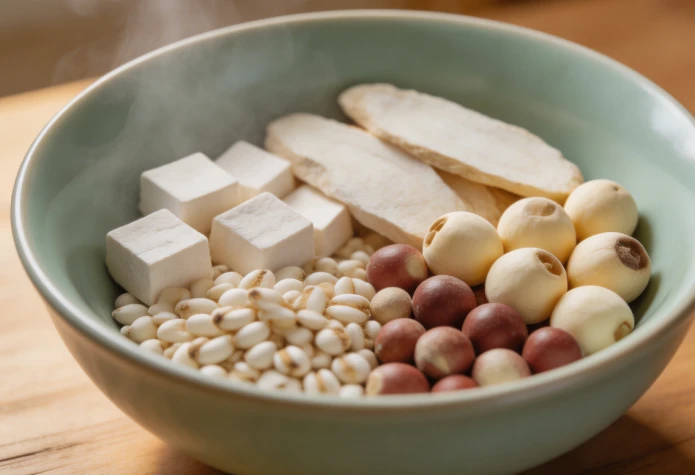
| Four-Spirits Soup / congee | poria + yam + lotus seed + adlay (or euryale seed) simmered together | spleen weakness, heaviness, poor appetite | classic combination; cook well for the stomach |
On amounts, there's no single number everyone must hit; most sources suggest starting at about 10–15 g per day (about 5–10 g as powder), small and short, then watch how you respond. One practical rule: keep going if it treats you well; pause if you're running to the bathroom more, drinking dry, or feeling puffed. Removing dampness isn't "the harder, the better" — drain too much and you carry the body's fluids out with it, losing more than you gain. It's like air-drying clothes: it comes out best slow, and nobody relies on setting them on fire.
Genuine poria is white, firm, breaks with a fine floury cleft, has no sharp sour smell, and turns soft and powdery when simmered long; fakes often mix in plaster or starch — too even, too hard, won't break down, and the water turns cloudy and gummy. For powder, watch for starchy fillers — pure poria powder brightens to a faint white as it settles, not a sticky slurry like cornstarch.

So you know the ways to eat it now — but poria isn't for everyone. Next section is about who should set that bowl down for a moment. Don't rush ahead; look at your own table first.
Who should skip poria
Poria is generally gentle, but if you're in one of these groups, pull that hand back a moment:
- People who already urinate a lot, clear frequency: poria promotes fluids, so it can make that more obvious.
- Kidney-deficient, sperm-loss, bed-wetting, sore/weak lower back: in TCM, continued draining and leaking drains further; someone short on kidney qi shouldn't keep opening the outlet.
- Yin-deficient with little dampness, low fluids: people with dry mouth, nose, constipation, or dry skin only get drier if you push more water out.
- People who are pregnant: human safety data is insufficient — no long-term self-dosing; if you need it, ask a doctor first.
- Weak digestion, chewing raw blocks: poria is hard and hard to digest; people with sluggish guts may bloat — cook it well or grind it.
No "dampness food" means "safe for everyone." If you're on medication, or have kidney disease or heart failure where fluid and salt must be controlled, ask your doctor before eating poria. Removing dampness costs effort; a mistaken regimen costs your body. That's an easy ledger to balance.
One more reminder: dampness almost never runs alone — one ingredient often isn't enough to bring it low, you usually need a few helpers. So who does poria team up with most naturally? On to that.
Poria's reliable partners
Poria rarely fights alone; TCM pairs it with other gentle ingredients, each handling a stretch and backing the others:
- Yam (Shan Yao): poria drains, yam tonifies the spleen — the core of Four-Spirits Soup, dampness and spleen managed together.
- Lotus seed (Lian Zi): poria calms the mind, lotus seed anchors sleep — a common pair when the head runs at bedtime.
- Adlay / red adzuki bean: the classic dampness duo, great for a bright, fluid-clearing effect.
- Euryale seed (Qian Shi): leans astringent and firming — paired with poria it "anchors while it drains," steadier on the stomach.
- Tangerine peel (Chen Pi): moves qi and dries dampness; with qi moving, dampness leaves easier — a fine pair for the guts.
Ever noticed: what you may be missing isn't "a more aggressive dampness formula" but a little gentle consistency every single day. That's poria's nature — it won't make you "lose a size tonight," but it will help you bolster the spleen bit by bit and wring out that dampness slowly. Easing dampness can't be rushed; like a good pot of congee, the flavor comes out when the heat has been right for long enough.
FAQ
Adlay is more fluid-clearing and a touch cooler, draining fluid while clearing heat; poria is more balanced — it drains dampness but also tonifies the spleen and calms the spirit. If you tend to run cold or worry about eating anything cooling, poria is the gentler, more common pick.
If it fits your constitution, you can keep it up short-term, but it's better to pause a few days after about two weeks, or aim for 2–3 times a week. Steady heavy draining can bleed the body's fluids — more urine, dry mouth, dry skin mean stop and pause.
Porridge and stews are kinder to the stomach and spleen, and easier to digest; powder is convenient for travel or people who rarely cook. If your digestion is weak, don't chew poria blocks raw — always cook them or use fine powder.
Completely different! Poria is the white sclerotium of a fungus, used to drain dampness, tonify the spleen and calm the spirit; tufuling (Smilax glabra) is the rhizome of the greenbrier plant, leaning toward clearing heat and dampness and resolving toxicity — often for joint pain and skin issues. The names sound alike but the uses are not; read the label when you buy.
A note from Bong

That spell of muggy weather, the pharmacy drawers felt waterlogged, heavy to slide. In walked people and eight out of ten asked the same thing: "Got anything for the damp?" Watching them stand blank in front of the shelves, I kept thinking of the poria in the middle row — white, no attitude, the least conspicuous thing there, and yet on days like those, it's the one that earns its keep. Water beading on the walls, that faint mildew smell in the closet — that pale little shelf unit just looked like it let a person breathe.
I've met so many people who believe the heavier the prescription, the surer it works. But with dampness, it's the "light" ones that win. Does poria smell special? No. It's like that bag of rice every household keeps — you don't remember it most days, but it has never let you down. When the spleen behaves a little and a little water moves out, a lot of the puff and the fog turns out on its own.
I won't say more. I'm off to make myself a bowl of poria congee. Sleep well tonight and be lighter in the morning — see you around.
References
- Pharmacopoeia of the People's Republic of China (current edition), Poria entry: functions and indications "drain dampness through urination, tonify the spleen, calm the spirit."
- Poria polysaccharide & immune modulation research (PubMed): pubmed.ncbi.nlm.nih.gov/?term=poria+cocos+polysaccharide
- Poria triterpenoid pharmacology (PubMed): pubmed.ncbi.nlm.nih.gov/?term=poria+cocos+triterpenoids
- NCCIH overview of Traditional Chinese Medicine: Traditional Chinese Medicine.
Always "damp," tired, low — are you phlegm-dampness, qi deficiency, or spleen weakness? Take three minutes to find out, then decide how to adjust and where to focus.
Take the TCM constitution quiz