Few herbs in TCM carry a warmer "persona" than dong quai: in Chinese its name literally means "should return." It's also the recognized "herb for women" and "herb of the blood" — irregular periods, period pain, dull complexion, postpartum care: you'll find dong quai written into seven out of ten formulas. But in the kitchen it's harder to read: what's the real difference between the root body and the root tail? How much goes in a chicken soup? Can you actually take it during your period? No hype, no trashing — let me walk this "dong quai" through from top to bottom, and you check it against your own case as you read.
What dong quai is: the women's herb and the "body vs. tail" split
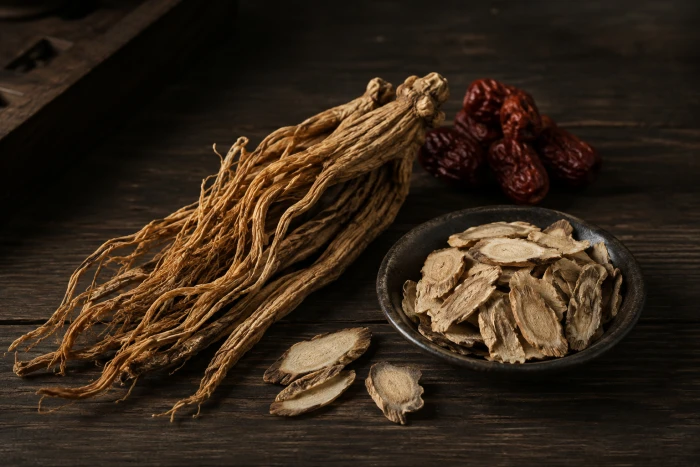
Dong quai (Angelica sinensis) is the dried root of a plant in the carrot family, grown mainly in Gansu and Yunnan. Sound it out and it follows a warm aroma, with a slight oily sheen. Its name is what wins people over: "Dong Quai" means "should return" — the ancients used it because it makes the qi and blood "each return to where it belongs," settling what should come back and what should be set in its place.
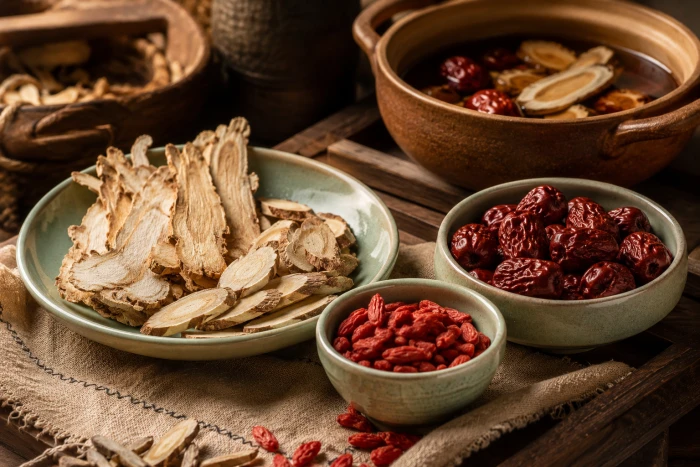
In the pharmacy the root is split into three segments — this is the "deep water" people discover when they shop: the body (the middle section) leans into nourishing the blood, the tail (the root ends) leans into moving the blood, while whole dong quai both nourishes and moves. If you're just steeping it in tea, whole root or the body is enough — no need to fuss; if the goal is specifically moving blood and easing pain, tradition favors the tail. For daily table use, whether it's one slice or a few doesn't matter much; the real points are "don't buy blindly, don't supplement blindly."
Root understood — you're probably wondering whether modern science backs the "women's herb" title. Let's dig into it.
What modern research says: polysaccharides, ferulic acid, and the weight of the evidence
The two ingredients dong quai is studied for most are dong quai polysaccharides and ferulic acid. The evidence clusters around a few directions:
One is hematopoiesis and blood cells. Animal and some test-tube work hints that dong quai polysaccharide may affect hematopoiesis and red blood cell production — often mapped to the TCM idea of "nourishing the blood"; to be fair, solid human evidence is still thin. Two is anti-inflammatory and immune modulation. Ferulic acid and dong quai extract show antioxidant and anti-inflammatory promise in the lab — again, "promising, pending confirmation." Three is modulating uterine smooth muscle. Dong quai was traditionally used to regulate periods and ease pain; modern work shows a tendency to modulate uterine contractions in both directions — one of the mechanism guesses behind its "women's herb" fame.
I should also be straight: dong quai's blood-nourishing and period-regulating reputation rests on a long clinical tradition and limited modern evidence, so treat it as a gentle daily ingredient, not a drug — and never a substitute for real medical treatment.
Mechanism sorted — now the part you actually eat. This slightly bitter herb, how do you treat it so it tastes right?
How to eat dong quai: stews, dong-quai eggs, and Four-Substance Soup
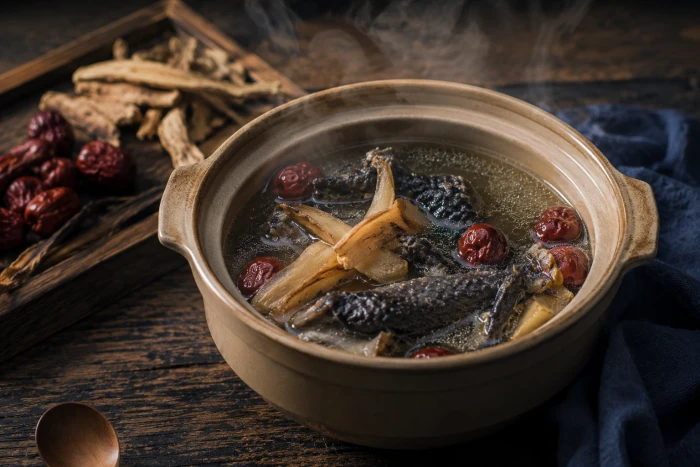
Dong quai is aromatic, slightly bitter, with a mild sweet aftertaste — steeped straight it's hard for most people to drink, so the most common move is to "borrow" its flavor by stewing it into broth. Three mainstream ways, pick one that sounds good:
| Way | What to do | Best for | Note |
|---|---|---|---|
| Dong quai chicken soup | 5–10 g of dong quai slices stewed with chicken, silkie chicken or ribs | daily blood-nourishing, cold/weak | avoid if your period bleeds heavily; 1–2 times a week |
| Dong quai eggs | dong quai + red dates + egg, simmered; eat the egg, drink the broth | gentle blood nourishment, better color | the egg steadies the stomach — a milder combo |
| Four-Substance Soup | dong quai + ligusticum + peony + prepared rehmannia, decocted or stewed with meat | blood deficiency, irregular periods | it's a formula — use it under a practitioner's guidance |
On amounts, start at about 5–10 g per serving for daily food — enough to borrow the flavor, no need for intensity. A practical rule: start small and short, watch your body; stop if you run hot, dry-mouth, or your stools get loose. Dong quai isn't "endlessly nourishing" — if you're genuinely blood-deficient it's a help; if you're not deficient or you run damp-heat heavy, force-feeding it adds congestion. Nourishing the blood is like salting your food: too much and it's inedible.
Good dong quai has thick, supple roots, an oily sheen on the cut, and a rich proper aroma. Body vs. tail by need: choose body or whole for nourishing blood, the tail for moving blood and easing pain. Avoid the dry, broken, faint-smelling cheap stuff — that oiliness is the clearest sign of quality.
That said, dong quai has real "force" to it — not everyone can catch it. Next is which groups should pull their hands back — keep reading and you'll see.
Who should avoid dong quai
Dong quai is a herb with clear "force," so these people must be careful and not push it:
- People who are pregnant: especially early pregnancy; dong quai is traditionally considered to move blood and could affect the uterus — never take it on your own, ask a doctor first.
- Heavy period flow, clearly heavy bleeding: dong quai moves blood and can make it heavier — during your period, also go easy on longan and donkey-hide gelatin.
- Bleeding tendency or on anticoagulant medication: dong quai's blood-moving action may stack with anticoagulants; self-dosing is risky — always ask a doctor.
- Diarrhea, loose stools: dong quai moistens the intestines (which is why it's used for constipation) — if you already run loose, it can leave you weaker.
- Yin-fire rising, heavy damp-heat: hot palms and soles, dry throat, red tongue with yellow coat — taking dong quai alone may "pour oil on the fire" unless it's carefully combined.
"Naturally nourishing" does not mean "safe for everyone." If you're pregnant, have heavy periods, are on anticoagulants, or about to have surgery, always ask a doctor before using dong quai. It isn't a syrup dispenser add-on; it's you running an experiment on your own body — do the math before you start.
One more ramble: single supplements are rarely stable, and dong quai also likes to bring a few familiar partners to work. Who does it team up with most? Read on.
Dong quai's reliable partners
Dong quai rarely works alone; TCM pairs it up so each piece takes a stretch:
- Astragalus: Dong Quai & Astragalus Soup — the classic "qi and blood together" pair; when blood runs low, qi comes as a base so the nourishment can actually land and stay.
- Red dates: one nourishes blood, one nourishes qi and blood — the most common duo for stews and eggs.
- Ligusticum, Peony, Prepared Rehmannia: Four-Substance Soup — the foundational blood-nourishing formula, but it's a formula; use it under a practitioner's guidance.
- Egg: steadies the spleen and softens dong quai — the dong-quai egg is a very steady daily choice.
- Silkie chicken: nourishes yin and blood; stewed with dong quai it's the classic autumn-winter pick for improving color.
The nicest line is still "should return." The blood should return to the place it belongs, and the qi to its own station — what your body wants is never "the more supplement the better," but to set the days you already have in order. Get the little daily things of moving qi and nourishing blood done steady, and that beats fussing over which herb is more potent every time.
FAQ
It depends on the person. If your flow is light and you have period pain, tradition allows a moderate amount before your period under a practitioner's guidance; but if your flow is naturally heavy or you bleed a lot, dong quai's blood-moving action isn't right. If you're unsure, don't self-dose during your period — learn your constitution first.
Tradition holds that the body leans toward nourishing blood, the tail toward moving blood, and whole dong quai does both. For everyday soup or tea, choose whole or body and don't fuss; if you really want the blood-moving help of the tail, get someone who knows the herbs to help you tell them apart.
Not heavy, every day. Dong quai nourishes blood but also moves and moistens; long, heavy use tends to bring heat and loose stools. For daily food, aim for 1–2 times a week at 5–10 g each time; if you're clearly blood-deficient, let a practitioner guide you.
In classic TCM, "Huang Qi with Dang Gui" is the blood-nourishing piece of the Dong Quai & Astragalus Soup idea: when blood runs low, qi comes first as the base so the nourishment can land. For daily soup, take a small amount of each and stew together — but let a professional judge the exact proportions.
A note from Bong
People are always coming in for Four-Substance Soup, most of them regulars fetching herbs for somebody else. One time it was a lady in glasses; she'd called out her formula, then dropped her voice a little: "My daughter lives out of town. I sent her some dong quai — tell her to stew it, tell her not to go easy on herself." I nodded and started folding the packet, and suddenly the thing in my hands felt heavy — it wasn't a herb anymore, it was a "should return" wrapped in paper.
The name gets me. You can't quite measure how much blood it nourishes, but it keeps reminding people: who should come back, can come back; the qi and blood that should return to their posts, should. Half the worry in this world finally lands on a "take care of yourself."
I promised her — the packet's folded up right. May the people you're hoping for be well, wherever they are.
References
- Pharmacopoeia of the People's Republic of China (current edition), Dong Quai entry: functions and indications "nourish blood and move blood, regulate the period and ease pain, moisten the intestines and open the bowels."
- Dong quai polysaccharide & hematopoiesis research (PubMed): pubmed.ncbi.nlm.nih.gov/?term=angelica+sinensis+polysaccharide
- Ferulic acid antioxidant/anti-inflammatory research (PubMed): pubmed.ncbi.nlm.nih.gov/?term=ferulic+acid
- Dong quai gynecologic use review (PubMed): pubmed.ncbi.nlm.nih.gov/?term=angelica+sinensis+gynecology
Pale, easily tired, irregular periods — it may not be "time to buy dong quai." Take the test to see your constitution first, then decide whether to supplement and in which direction.
Take the TCM constitution quiz