The night before finals, the middle-schooler downstairs wouldn't come back inside. His mom yelled through the door three times before the reason came out: it wasn't that he was being difficult — every time the pressure hit, his stomach sent him running to the bathroom, again and again, until his legs went numb. Finally he huffed a surprisingly grown-up line: "Mom, it's not me — it moved first." "It" is your gut. In this piece, I'm going to straighten out that thread that always moves first — it's called the gut–brain axis.
1. Why this “mood line” pulls rank on you
The gut–brain axis isn't mysticism; it's anatomy you can point to. Your gut is lined with hundreds of millions of neurons — so many they've earned the nickname “the second brain.” Between it and the head runs a vagus nerve, a phone line that never stops ringing: you get tense and it tightens first; you get inflamed and it quietly rains “emotions” onto your brain. So those old sayings “a stomachful of anger” and “too upset to eat” aren't metaphors — they're physiology.
Three cold numbers to draw the line for you:
- About 90% of your serotonin — the chemical messenger that keeps your mood steady — is not made in your head; it's made in your gut.
- Your gut carries hundreds of millions of neurons, brainier than plenty of stand-alone organs.
- Roughly 80% of the signals travelling up the vagus nerve come from the gut — most of the time the gut calls the shot, and the brain just nods along.
Let’s crack a myth first: some people decide “feeling low is just being precious — power through it.” But your gut is more honest than your mood. Emotions it can’t process get pushed down; your belly puts them flat on the table. It isn't overreacting — it's sending you a real-time battlefield report.
2. “I get stomachaches under stress” — that isn't drama
When pressure hits, cortisol and the sympathetic nervous system move first, and the gut is the least patient member of that alarm system. On the days you're racing to hit deadline, your stomach feels suspended in midair; the bowels either go all lazy or sprint for the bathroom — and not a single trip goes unnoticed.
Worth asking yourself right now: in the last month, has your gut gone ahead and gotten tense before you even admitted anything was wrong? Try trading the phrase “my stomach's sensitive” for “am I so stressed that my belly is keeping the books” — those two sentences point in very different directions.
Your belly keeps the grudges the brain doesn't show. It won't complain in words — it just goes on strike with the rhythm of your life.
3. The inflammation you eat can eventually reach your brain
The easiest place for this line to break isn't the nerves — it's inflammation. If you're keeping yourself alive on milk tea, refined carbs and fried food, the gut barrier slowly gets pushed loose. Things that shouldn't leak into your blood start to leak, and your immune system winds up fire-fighting on the gut wall all day. When the fire never fully dies, inflammation climbs the nerve to the brain, and your mood and focus collapse together.
The idea gets dry fast, so here's an easy punch line: all food is food, but some is feeding you while some is burning you.
| What you keep eating | How it feels to the gut | Mood balance |
|---|---|---|
| Ultra-processed snacks, fried food, piles of refined sugar | Round after round of inflammation, lopsided gut flora | High first, then a foggy afternoon |
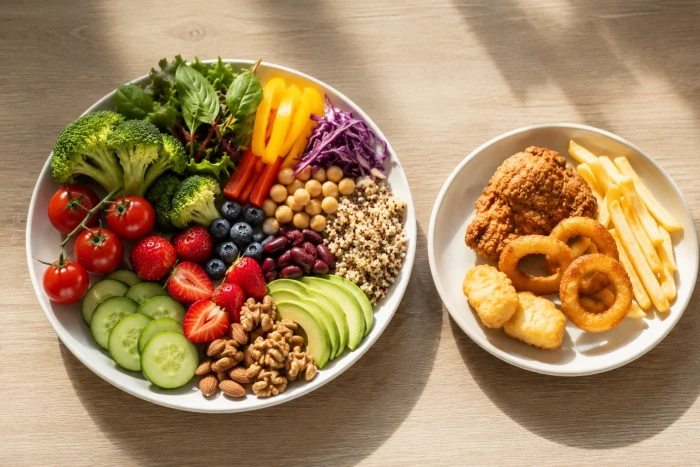
| Whole grains, fermented food, in-season vegetables | Rich flora, calm barrier | Steady, hard to knock over |
| Dietary fiber (vegetables, beans, whole grains) | Feeds your good bacteria so they can stand guard for you | Steady with a bit of bounce |
If you want to start with just “which fork,” go straight to The Anti-Inflammatory Eating Guide: How to Put Out Your Body’s “Fire” at the Table and follow it to the letter — that’s the full route from the plate to the nerves.
4. So how do you feed this “mood line”? — five things that don't take much
Don't picture feeding this line as some grand project. It honestly recognizes only a handful of things — these five, and none of them is a chore.
Checklist: three tiny things you can start today
- ☐ At every meal, put a fistful of fresh vegetables on the plate first — eat that, then talk about the rest
- ☐ Add one local fermented food (pickles, yogurt, natto, miso — whichever you love)
- ☐ Put the phone down and actually chew your dinner for ten minutes — chewing alone feeds this nerve
Two more, and these count as “adjusting without a fork.”
① Slow down and touch your vagus with your breath. The vagus nerve is the trunk line of this hotline, and a long, slow exhale works like a direct cool-down for it. If complicated isn't your thing, try Belly Breathing: The Simplest Stress Reliever and the 4-7-8 Method — it comes in handy exactly when anxiety tightens your stomach.
② When your mind is a mess, don't soldier through alone — find something that steadies it. If your head is a tangle, the gut only tangles harder. For an anchor that isn't food, look at Lotus Seed Benefits: A Calming, Spleen-Friendly Remedy — it carries an Eastern kind of slowness, just right for when this line is jumping around.
You don't owe your gut a good mood — you just owe yourself one proper meal, and one proper breath.

5. While we’re here, might as well test yours
By now you're probably curious which bracket your own “mood line” falls into. Rather than me guessing across the room, just take the quiz — three minutes, free, and when you're done you'll know which gut type you are (there are six in all; the “brain-gut resonance” type we've been talking about is only one of them):
Let’s be clear: everything above is science education, not diagnosis. If you have persistent stomach pain, blood in your stool, or unexplained weight loss, see a doctor — don't sit it out in a wellness article.
FAQ
Not necessarily. The gut and emotions really do shape each other, but lots of digestive complaints have their own independent cause. If symptoms last more than two weeks and keep getting worse, see a doctor and get the cause pinned down before you start any regimen.
Research on probiotics is promising, but there is no “one jar fixes it” magic. The bigger win is feeding the good bacteria you already have, long term — give them fiber (vegetables, beans, whole grains) and they'll have the energy to stand guard for you.
Under stress, cortisol and the sympathetic nervous system rewire the gut into “battle ready” mode, throwing off bowel movement and secretion. So some people cramp up and others sprint to the toilet. It isn't all in your head — it's your body being called up by pressure.
A note from Bong

There was a grad student at the shop, a girl studying for her entrance exams, and a stomachache showed up for every single one. One day she came to restock on yam and said she'd been studying till midnight and her belly had panicked before she did. A regular next to her jumped in: “When you tense up, your gut winds up like a clock, tighter than you are.”
In Chinese medicine we sometimes don't look at what you eat — we look at what you carry. Carry it heavy and the qi-blood gets blocked; block it long enough and bloating, bad breath and a restless, unexplained irritability all show up. The girl said she wasn't carrying anything. I smiled: “You're carrying tomorrow’s exam.” The tongue may say “I'm fine,” but the gut doesn't lie.
Digestion isn't afraid of your overeating — it's afraid of what you keep swallowing without saying, holding without letting go. The moment you slow down is the moment you untie it. And if there truly is something you can't put down, set it down for ten minutes first; the rest, the days will digest for you.
References
- Cryan JF, et al. “The Microbiota-Gut-Brain Axis.” Physiological Reviews, 2019.
- Mayer EA. “Gut feelings: the emerging biology of the gut–brain axis.” Nature Reviews Neuroscience, 2011.
- World Health Organization. “Healthy diet.” WHO
Which gut type is yours closest to?
Gut type and daily mood are tightly linked — brain-gut resonance people usually “feel the stomach knowing before the mind does.” Take three minutes to find out yours.
Start the gut health quiz