There's a word in Chinese that carries its own answer: "shanghuo" — literally "to have too much fire." A young person breaks out on the chin, and an elder's first line is usually "you must be running hot lately." The saying is blunt, but not wrong: sore gums, a blister on the corner of the mouth, red bumps on the jawline — most people assume the problem is the face. But chase the "fire" down into the belly and you'll often find the gut got out of order first. This article follows the line that ties the stomach and the face to the same rope — the gut-skin axis — and asks whether a meal of good food and one proper night of sleep can actually reel it in.
A two-way road between the gut and the skin, pulled together by hormones, immune cells and nerves — when the gut flora drifts out of balance or the barrier loosens, inflammation rides that road upward, and the skin is usually the first visible exit.
1. "Too much fire" — the phrase that already ties face to gut
Our ancestors had a way of naming the invisible links in the body with plain everyday words. Think about it: which situations make your face "act up"? Nearly always one of two things — eating without restraint (bbq, fried food, late-night takeaways), and sleeping in the red (all-nighters, flipping day and night). And none of it was the skin's own doing; it all comes up the gut line.
This isn't forcing old wisdom onto modern science. Current research on the gut-skin axis really does land on the chain "food → gut → inflammation → skin": the more holes in the gut barrier, the more impurities slip into the blood, the busier the immune system gets, and the more the skin — that "exposed internal organ" — ends up taking the hit.
An observation
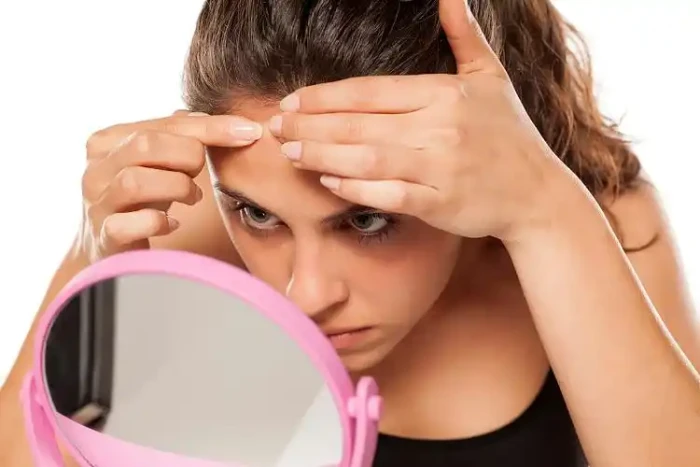
Curious how the same "acne" shows up differently: some on the forehead and hairline, some almost always on the chin and jawline. It's not a rule, but chin-and-jaw breakouts tend to follow late nights and digestive trouble — the skin is more honest than you are; it reveals whichever system came undone first.
2. That pimple on your face is often your gut "leaking the secret" first
Once you poke this hole in the paper, a lot of skin problems that "never quite heal" stop being mysterious. You stay up till midnight, your body thinks you're in danger and raises cortisol; you knock back two milkshakes, and your gut flora gets tilted toward sugar. Between the two, a little gang of inflammation rides the bloodline upward and writes itself across your face in patches.
The most classic type is the one where "skin is usually fine, but break out the moment you stay up late or eat something heavy." And the position is oddly consistent — chin, jawline, cheeks. That's not coincidence, and it's not all hormones; it's often just that the gut barrier quietly loosened during your two most exhausting days.
Ask yourself right now:
Have you had this — a few late nights in a row, or a few nights of takeaway and bbq, and the next day your face "acts up"? Try rephrasing "my skin looks off lately" as "maybe my gut got tired for me first" — the two sentences point you in completely different directions.
3. Same eating, different result: some feeds help, some sabotage
Since the root is "food → gut → inflammation → skin," the answer is clear enough: whatever kind of acne you have, get the "what do I eat" question right first. The same thing going in the mouth feels a world apart to the gut —
Heavily processed snacks, fried food, lots of free sugar
Repeated inflammation, one-sided flora
Chin and jawline pimples, oily face
Whole grains, fermented foods, seasonal vegetables
Rich flora, settled barrier
Calm skin that doesn't throw tantrums
If you want to start at the level of "which bite to take," follow An Anti-Inflammatory Diet Guide: how to extinguish the body's "fire" at the table — it's a full route from the dinner table to a better complexion.

4. Five small daily habits that actually work, from the source
Don't turn caring for your skin into some epic "change your fate" project. The stuff that really works is usually the unglamorous small stuff you do every single day. Pick five that are enough, and you can start today:
Check off these three most urgent ones first:
- Reach for a fist-size pile of fresh vegetables at every meal — eat them first, then talk about anything else
- Add one fermented food from your own region (sauerkraut, yogurt, miso — whatever you love) to feed the good bacteria in your gut
- Put the phone down at arm's length before sleep and get six or seven hours — when sleep is uneven, the skin tells the truth
Two more that don't even require you to change what you eat.
① Don't rush to swap skincare products; give your skin a few days "off." Layer fewer products and let the barrier catch its breath. What actually builds skin from the ground up is the gut and the quality of sleep behind it.
② Don't just power through a stubborn recurring problem; point it in the right direction first. If you tend to run "damp-heat," break out from greasy food, have a bitter taste in the mouth and dark urine, see Damp-Heat Constitution: oily face, bitter mouth, pimples — you might be "damp-heat" — clearing it through the spleen-damp route is more on-target than scrubbing acid into your face.
Your skin doesn't owe you a good face — you owe it a clean meal and a steady night.

5. Test it — which road does your gut recognize?
By now you're probably curious what type your own gut actually is. Instead of me guessing for you here, spend three minutes testing it yourself — there are six gut types in all, and the "skin-axis sensitive" type we've been talking about is just one of them:
To be honest: everything above is science communication, not a diagnosis. If your face is breaking out badly and repeatedly, if it won't heal, or if the itching is ruining your sleep, see a dermatologist — don't try to live in a wellness article forever.
FAQ
Not necessarily. A lot of acne has independent skin, hormone, or hygiene causes. But if it keeps flaring in the same region (chin, jawline) and often comes with digestive discomfort, the gut line is worth checking together. If symptoms persist or worsen, get a doctor to pin down the cause first.
The research is promising, but it's not a "one jar and you're radiant" quick fix. What matters more is feeding the good bacteria you already have over the long run — give them enough fiber (vegetables, beans, whole grains) so they keep the barrier and suppress inflammation.
You're not imagining it. Sleep loss raises cortisol and disrupts immune rhythm, and the gut barrier's nightly repair is cut short too — inflammation has nowhere to go, so it shows on your face. Catching up on sleep often works better than changing skincare.
A word from Bong

There's an old saying where I'm from about not being "used to the water and soil" of a new place. You move somewhere new, and first your stomach won't take to it, then your face joins in. The elders don't call it a sickness; they just say, it'll settle, give it time. Rough words, but true — your skin follows your gut; once the belly makes peace with the local water and food, the skin will settle down too.
I've been around this line of work long enough to learn that no patch of skin on you is a pointless problem. When a pimple keeps showing up in the same spot, don't be too quick to blame the face — look back and ask if this stretch of weeks has been messy in both eating and sleeping. Good skin isn't built by piling bottles on your face; it's built by how honestly you treat the bacteria in your belly and the few meals on your table every day.
Have you eaten today? Skin matters — take it slow.
Sources
- Salem I, et al. "The Gut Microbiome as a Major Regulator of the Gut-Skin Axis." Frontiers in Microbiology, 2018.
- De Pessemier B, et al. "Gut–Skin Axis: Current Knowledge of the Interrelationship between Microbial Dysbiosis and Skin Conditions." Microorganisms, 2021.
- National Institutes of Health. "The Microbiome." NIH
Which gut type are you closer to?
Gut type and skin state often echo each other — in the skin-axis sensitive type, the face tends to know first after one heavy meal or late night. Spend 3 minutes finding out your gut.
Start the gut health self-test