When spring arrives, the first part of you to notice isn't the calendar — it's your body. Mornings feel a little easier, your hair seems to shed a bit more, you get irrationally restless at night, and your appetite swings between ravenous and nonexistent. Two thousand years ago, the Huangdi Neijing (Yellow Emperor's Classic of Medicine) gathered all these scattered sensations into one line: “The three months of spring are called fa chen.”
The Core of Spring Wellness: Renewal
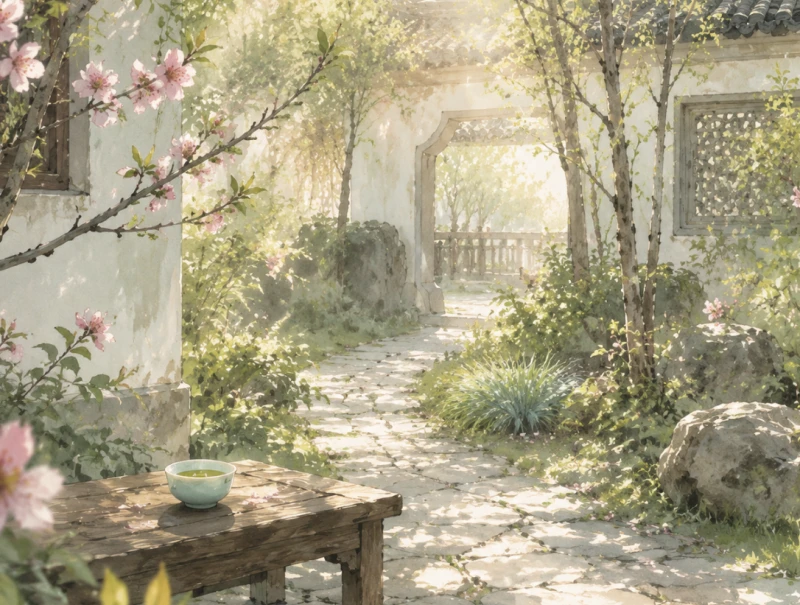
Fa chen means digging up what winter stored away. For plants, that's pushing through the soil; for your body, it's getting your qi and blood moving again. In TCM, spring corresponds to the Wood element, whose nature is to rise, expand and unfold. A tree sprouts in spring — and if you spend the season hunched over, holding in your emotions and never moving, you're basically keeping a tree that wants to grow inside an airtight jar.
The big direction for spring: let your yang energy rise smoothly and your emotions stretch out. Don't bottle things up, don't push through, don't burn the midnight oil right now.
This is also why people get so easily “heated up” in spring: all those hotpot dinners, late nights and long hours of sitting from winter get stirred by the rising yang energy, and the pent-up heat surfaces. So spring wellness isn't about heavy tonic — it's about unclogging. Clear the blockages and let things flow.
“The three months of spring are called fa chen. Heaven and earth give life to all things. Sleep late, rise early, walk with long strides in the courtyard, loosen your hair and relax your body — this lets your aspirations be born.” — Huangdi Neijing · Suwen · Four Qi Tiao Shen Da Lun
In plain words: sleep a little later than winter (but don't stay up late), get up early, take a slow walk outdoors, wear loose clothes, and give yourself room to want things. Today that means: don't stay up late, move your body in the morning, skip the skin-tight outfits, and leave a little space in your day for “what do I actually feel like doing?”
The Six Solar Terms of Spring
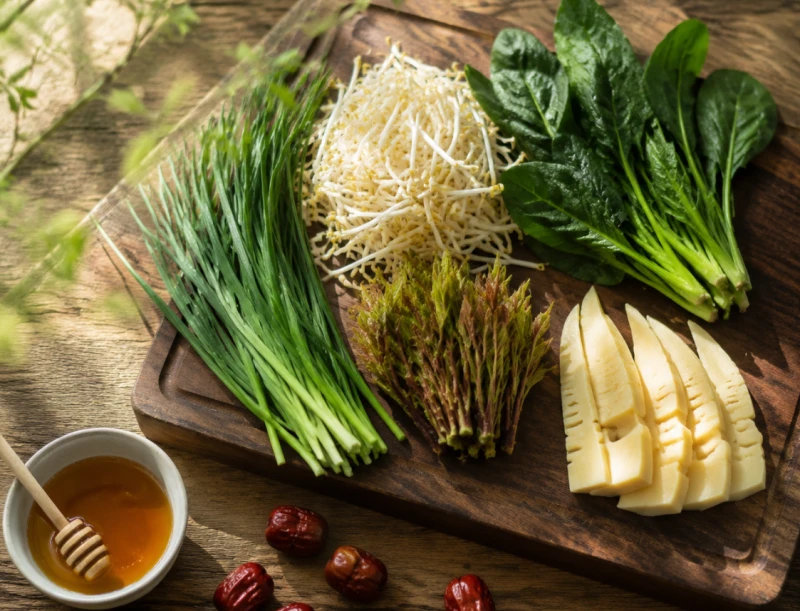
Spring runs from Start of Spring to Grain Rain — six solar terms in all. Each one has its own climate and its own wellness focus:
| Solar term | Around | Climate | Wellness focus | Foods to favor |
|---|---|---|---|---|
| Start of Spring | Feb 3–5 | Yang qi begins to stir; warm spells and cold snaps | Soothe the liver, stay warm against wind | Chives, scallions, bean sprouts, red dates |
| Rain Water | Feb 18–20 | More rain, dampness creeping in | Strengthen the spleen, drain dampness | Chinese yam, barley, red beans, crucian carp |
| Awakening of Insects | Mar 5–7 | First spring thunder; everything stirs | Nourish liver and eyes; sleep and rise early | Spinach, celery, goji berries, eggs |
| Spring Equinox | Mar 20–22 | Day and night equal; yin and yang balanced | Harmonize yin and yang, ease the mind | Toon shoots, bamboo shoots, honey, strawberries |
| Clear and Bright | Apr 4–6 | Clear skies; liver qi at its peak | Clear the liver, protect the eyes, avoid grief | Shepherd's purse, mugwort, green tea, white fungus |
| Grain Rain | Apr 19–21 | Abundant rain; all grains grow | Strengthen the spleen, drain dampness, guard against allergies | Winter melon, asparagus lettuce, mulberries, coix seed |
Liver Care Is Spring's Top Priority
TCM says the liver “governs free-flowing movement” — it keeps your body's qi moving smoothly everywhere. When qi flows, emotions stay level; when it gets stuck, you get irritable, sigh a lot, feel tight across the ribs. In spring the liver qi naturally runs high, and if you pile late nights, swallowed frustration and hours of screen-staring on top of it, the “traffic jam” in your liver gets worse.
- Stretch and take a few deep breaths when you wake up — it “opens the gate” for your qi
- During the day, look into the distance for 5 minutes near a window or outdoors to rest your eyes (the liver “opens into the eyes”)
- When your temper flares, take three slow breaths before you speak
- Skip the late nights — aim for lights out before 11 pm so liver blood can flow back and replenish
Liver care isn't about expensive supplements — it's about not blocking it: don't stay up, don't swallow your feelings, don't sit still for hours. Curious about your own liver-qi state? Take the TCM Body Constitution Test — the “Qi Stagnation” profile is the one most closely tied to how your liver moves.
Guarding Against Wind: The “Spring Layer” Rule
Spring wind looks gentle, but it's actually the season's trickiest enemy. TCM names wind as spring's governing qi: it comes fast, changes fast, and loves to slip in through the neck, the upper back and the ankles, bringing colds, headaches and aching joints. Add a sudden “cold snap” and you have a perfect setup for catching a chill the moment you shed a layer too soon.
If spring wind-cold does catch you early on, a steaming mug of ginger and brown sugar tea to work up a light sweat is the simplest, most classic “scatter the cold” move. But heads-up: if your throat is dry, sore or you're running a fever (wind-heat signs), skip the ginger — you'd be using the wrong tool.
Spring Eating: Pungent & Warm, Less Sour, More Sweet
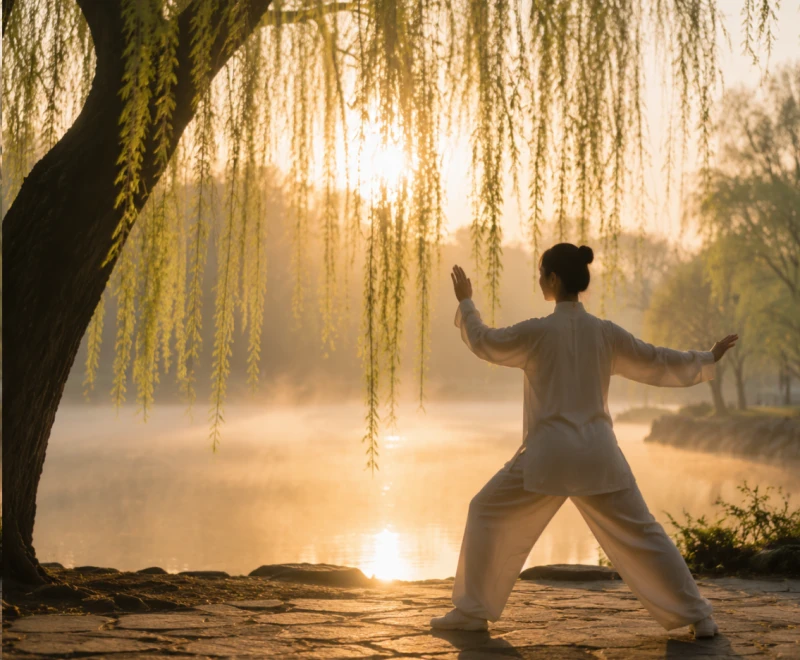
The Neijing sets spring's table with a rule: “reduce sour, increase sweet, to nourish the spleen.” Sour taste pulls inward and holds back the rising yang; sweet taste feeds the spleen, and a well-fed spleen in turn supports the liver (Wood). In practice: go easy on very sour foods, favor mild sweet ones, and add a few pungent-warm ingredients to help things open up.
- Eat more: chives, scallions, garlic sprouts, bean sprouts, toon shoots, shepherd's purse, bamboo shoots, spinach, Chinese yam, red dates, honey
- Eat less: very sour foods (vinegar, sour plums, lemon in excess), heavy greasy dishes, cold and iced drinks
- Try a tea: 5 g goji berries + 3 chrysanthemum flowers + a thin slice of dried tangerine peel, steeped in warm water — a classic spring tea for clearing the liver and brightening the eyes
Want to fine-tune your eating by your own body type? The diet advice in the Nine Constitutions guide is a good starting point.
Daily Rhythm & Exercise: Follow the Sun
Spring calls for “taking long strides in the courtyard” — which in modern terms means getting out for a walk in the morning or evening and catching some sunlight instead of staying cooped up all day. Keep exercise to a “light sweat, no panting” level; drenching workouts actually drain your yang energy in this season.
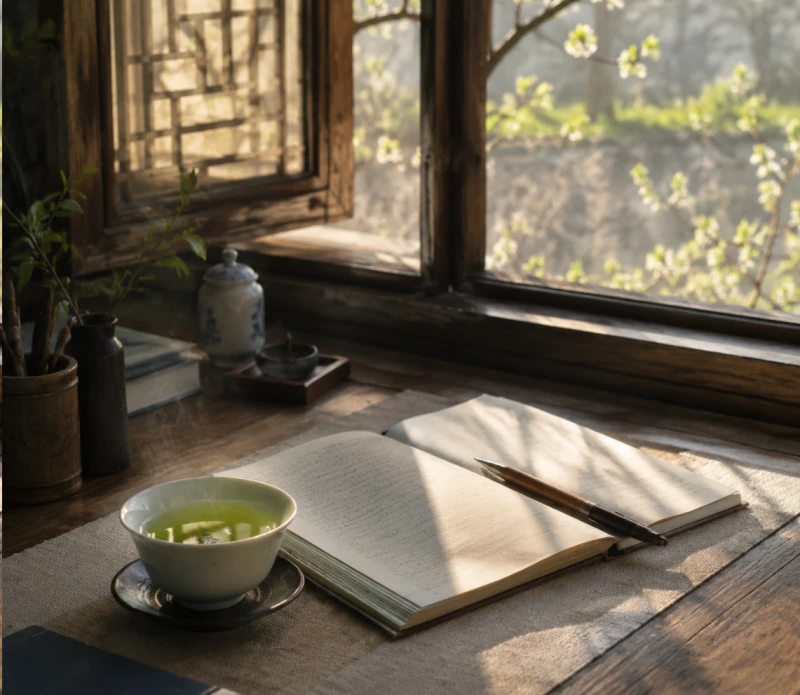
Good spring picks: walking, brisk walking, tai chi and Baduanjin. Baduanjin is especially well suited to spring — its slow, expansive movements mirror the season's “growing outward” theme. For a step-by-step intro, see the Baduanjin guide for beginners.
Spring Allergies and Old Ailments
Spring is also allergy season on repeat: pollen, dust mites and willow fluff take turns, and allergic rhinitis, hives and eczema flare up. The TCM angle is “strengthen the upright, expel the pathogenic”: avoid the triggers, yes, but also regulate the spleen and build up your body's defenses so it stops overreacting.
If spring brings you nonstop sneezing, itchy eyes or rashes, get the allergen identified properly rather than toughing it out or self-medicating. Everyday habits that help: a mask when out, washing your face and changing clothes when you get home, and washing bedding often.
A Note from Bong

Every year at Start of Spring, my father would do the same thing: open every drawer of the apothecary cabinet, one by one, and reorganize the herbs. “Spring is for clearing,” he'd say. “Clear the cabinet, clear the qi.” As a kid I thought it was a quirk. Later I understood — it was a pharmacist's ritual: sort out what's been packed away all winter, so there's room for what's new.
Same for you. Don't hand yourself a list of New-Start-of-Spring resolutions. Start small: go to bed half an hour earlier, walk two extra blocks after work, and finally say the thing you've been holding in. Air out the old, and there'll be room for the new.
Ask an AI Assistant for a Custom Spring Plan
References
- Huangdi Neijing · Suwen · Four Qi Tiao Shen Da Lun — source of the “three months of spring” teaching.
- China Meteorological Administration, official notes on the 24 solar terms (Start of Spring to Grain Rain).
- World Health Organization, materials on Seasonal Affective Disorder (SAD).
- US National Institutes of Health, reviews on light exposure and circadian rhythm / serotonin.
FAQ
There's no fixed date. A simple rule: once daytime highs stay steadily above 15°C (59°F) and there's no obvious cold snap, you can start peeling layers — slowly, one at a time, not a whole wardrobe switch in a day.
“Spring drowsiness” usually comes from shifting daylight and your body clock recalibrating, and it can also point to spleen weakness with dampness. Remedies: consistent sleep, daytime movement and sunlight, light meals. If the sleepiness is severe and persistent, see a doctor.
Yes — but only with a formula prescribed by a qualified TCM practitioner. Spring formulas usually revolve around soothing the liver and strengthening the spleen, yet the same formula isn't right for everyone. This article is general education, not a diagnosis.
The big picture matches (soothe liver, guard against wind, promote rising). The details differ: northern springs are dry and windy, so add moisture; southern springs are damp, so emphasize draining dampness. Adjust to your own environment.
Find Your Body Constitution
Which body constitution are you?
18 questions · about 3 minutes · to point your spring wellness in the right direction.
Start the test