Suppose you came through a cold last week. The congestion is gone, your throat stopped hurting, you are willing to leave the house again — and one thing refuses to pack up and go: a tickle somewhere deep in the throat that turns into a run of dry coughing. It finds you the moment you sit up in the morning, when you talk too much, when you breathe in cold air, when you laugh slightly too hard. There is hardly any phlegm. Your chest does not feel tight. So your mind starts its usual work: is something wrong with my lungs? Should I be taking antibiotics? Am I just run-down?
Four things to settle here. First, how to put a clock on a cough, and whether yours is still inside normal limits. Second, why a throat keeps coughing after the virus is gone — what is actually happening in the airway, and how Chinese medicine described the same picture long before anyone had a name for it. Third, a direction problem: the ginger-and-jujube soup that helps in the first two days can make this stage worse, and the reason is not mystical. Fourth, the three things in your kitchen that are worth doing, the two at the pharmacy that are not, and a list of signs that mean stop waiting.

Put a clock on it: are you still inside normal limits
The first rule medicine sets for a cough is not about what to take. It is about how long. Chinese respiratory terminology, standardised in 2018, cuts cough into three bands: acute under three weeks, subacute from three to eight weeks, chronic at eight weeks and beyond. The American College of Chest Physicians was already using the same yardstick in 2006, and it said plainly that a cough left behind by a respiratory infection counts as three to eight weeks — past eight weeks, you stop calling it post-infectious and start looking for something else.
That yardstick does one very useful job: it separates "not better yet" from "not going to get better". In the body these two feel identical. In what you should do about them, they are not the same at all.
Set those numbers side by side and the two self-accusations people usually reach for stop holding up. "I must still be sick" — the median is around ten days, and not being finished at two weeks is ordinary. "My immune system must be weak" — among people who see a doctor for a cough, about seventy-three to ninety-two per cent are told it is an ordinary respiratory infection. Immune deficiency is rare, and it usually does not turn up wearing nothing but a cough. That is the general rule, not yours: if your immune system is genuinely suppressed, by treatment or by illness, none of the reasoning in this article applies to you, and the warning box at the end is where you start. The one worry worth keeping is the third: "three weeks now — has this turned into pneumonia?" With no other abnormal signs, three weeks still sits inside the normal tail of an acute and subacute illness. The line where testing starts to make sense is eight weeks, plus the specific signals in the list further down — and for pregnant people, anyone with COPD, anyone immunosuppressed and small babies, that line moves earlier; see the warning box.
You probably know someone like this. There is always a throat lozenge in their pocket, they stop mid-sentence to cough twice, and everyone around them assumes the cold never left — including, eventually, the person themselves. Partly that is true and partly it is not. The infection is finished. What has not finished is the wiring. Those two have been talked about as one thing for years — and both Chinese medicine and modern medicine have gone and given the not-finished part its own name, which is what the next two sections are about.
A long cough is not the same thing as an unhealed one. After a cold, the median is around ten days; at two weeks somewhere between a third and sixty per cent of people are not fully done, and at four weeks about one in five is still coughing. That is the normal shape of this, not a warning.
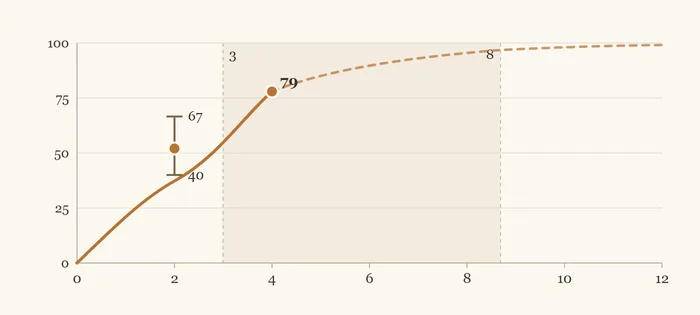
It is like the tide going out. The water has left; the marks on the sand still take a few days to dry. You do not need to push the water back, and you do not need to dig the whole beach over either. The only question left is: why do the marks last so long? And the clock matters more than any single remedy — what is sensible on day three can be the opposite of what is sensible in week three.
The virus is gone. Why is the throat still not quiet
The acute symptoms of a respiratory infection — fever, blocked nose, runny nose, sore throat — have resolved, but the cough stays on for three to eight weeks. It is usually a tickling dry cough, or one that brings up a small amount of white, sticky phlegm. The chest film shows nothing abnormal and breathing function is broadly normal — in a small number of people the airways test over-reactive for a short stretch inside this same window — and other causes have been ruled out. It is the most common explanation for a subacute cough, and its defining feature is that it ends on its own: most people are done within eight weeks.
The "post" in the name is the whole point. At this stage you are no longer fighting a pathogen. You are living with the scene of the fight. Modern explanations come down to three things happening at once.
The lining was stripped. The airway is covered in a carpet of ciliated epithelium, and viral infection peels part of it away. Immune cells clear the site, but rebuilding is slow work — measured in weeks, not hours.
The sensors are now exposed. The airway wall is full of vagal nerve endings (C-fibres among them) that normally sit underneath that lining. Once the lining is damaged, they face the air directly: cold, dryness, dust, perfume, cooking fumes, one breath taken too deep — sometimes simply the movement of air. Their trigger threshold drops, so stimuli that would not normally register start to count. Chinese medicine has a saying for exactly this spot — "without wind there is no itch" — and the order it describes is the order you feel it: the itch first, then the cough, then a string of them.
Some people develop temporary airway hyper-responsiveness. A bronchial provocation test can come back positive for a short while — the airways constrict more easily than usual. What separates this from asthma is that it leaves on its own. Which is exactly why people get mislabelled with "asthma" or "bronchitis" and take a run of medication they did not need. The mistake runs the other way too: some people do first show their asthma in this exact window, and whether you are the leftover cough or the first appearance of asthma is not something you can settle at the kitchen table. That is a clinician's call.
And why is it always worst at night and first thing in the morning? Lying flat lets nasal secretions track down the back of the throat; vagal tone peaks from the small hours until dawn, when airway calibre is at its smallest; and bedroom air is dry and cold. Three causes arriving at the same minute — that is the 2 a.m. coughing fit.
"A cough is the body clearing dirt. Suppress it and you trap the illness inside." Half right, half wrong. When there is phlegm, hammering the cough reflex is genuinely a bad idea — getting mucus out depends on coughing. But a post-infectious dry cough is not moving much of anything. It is an alarm that has become oversensitive, not a dustcart at work. So "never suppress a cough" does not automatically apply here. What does apply is looking after the circuit the alarm sits in: humidity, temperature, irritants, and time. Two limits on that: this reasoning is for adults, and children have their own age line (further down); and a suppressant only lends you one night of sleep. It does not shorten the course.
The other way round too: if you are bringing up yellow-green phlegm with fever, chest pain or breathlessness, that is no longer an alarm problem. Something is still burning. That belongs to the red-flag list at the end, not to home care.
The body at this stage is a room that has just been renovated. The dust has not settled, and if you open the windows and start dancing, it will cough at you. Give it a few quiet days and the dust lands by itself. So what did people who watched this closely, without microscopes, write down about those few days?
Two characters for one nuisance: a distinction that is younger than it looks
In English a cough is a cough. Chinese has one word for it — 咳嗽 (késòu) — but older writers sometimes treated it as two conditions. The Jin-dynasty physician Liu Wansu gave a very tidy split: the ke, 咳 (ké), is sound without phlegm, from injured lung qi that cannot clear; the sou, 嗽 (sòu), is phlegm without sound, from spleen dampness producing phlegm; together, sound and phlegm both. The Qing compendium Yizong Jinjian copied the formula almost word for word, and the distinction then sat in Chinese medical textbooks for roughly eight centuries.
Here is the awkward part. Before the Song dynasty, these two characters meant the same thing. The cough chapter of the Huangdi Neijing speaks only of coughing — "the five organs and six viscera all make people cough; it is not only the lungs" — and never uses the second character at all. In older texts the same cough is often written with an earlier character, 欬 (kài), and the Liji sets court etiquette on it: do not cough loudly in a carriage. Splitting the two characters into two different disease mechanisms was Liu Wansu's move, not something the oldest layer of the tradition ever said.
And clinically the split does not survive contact with patients. A "sou" with phlegm but absolutely no sound is very hard to find — phlegm only leaves the body by being coughed out. Several modern Chinese clinical writers have said so openly, which is why the textbook pair of definitions reads today more like a teaching diagram than an observation.
Why spend time on it? Because it hands you a coordinate. In the older framework, the cough this article is about — throat itch, runs of dry coughing, almost nothing coming up — is filed under ke: the location is the lung, and the failure is in the opening and closing of lung qi. It is not filed under spleen dampness and phlegm. Which category you are in decides whether the next step is to disperse and open, or to dry and transform phlegm. Wrong category, and every cup of something warm you drink is wasted.
The character for lung, 肺 (fèi), has a trap in it. Its right-hand side is not 市 (shì, "market") but 巿 (fú) — a vertical stroke running straight through. In the Shuowen Jiezi, the first Chinese dictionary to analyse character form systematically, 肺 is glossed as "the metal organ: from 肉 (ròu, flesh), with 巿 giving the sound". That 巿 was originally the leather panel that hung in front of a sacrificial robe, covering the knee. The two shapes are one stroke apart, and the stroke that separates them is at the top: 市 carries a small dot there and starts with it, while 巿 has no dot and opens with the horizontal that the vertical then runs clean through. It is a long-lived mix-up. The same part turns up in 沛 (pèi), 芾 (fèi) and 霈 (pèi). Why "the metal organ"? In the five-phase scheme the lung belongs to metal, sits at the outermost position, governs drawing things in and down, and dislikes dryness. Those three ideas — outer layer, descending, hating dryness — are what the rest of this article grows out of.
One more thing about that vertical stroke running through 巿 (fú): it looks like a curtain hanging in a doorway. Chinese medicine says external pathogens enter through the mouth, nose and skin, and the first curtain they meet is the lung. Those few days when the curtain is still swinging in the wind — that is where you are now.
Wind cough: tickle first, coughing fits, cold air as the trigger
If Chinese medicine had to offer one concept for a leftover post-cold dry cough, the closest fit is wind cough (风咳 fēng ké). The phrase is old. The Liji, listing what happens when a season is disobeyed, says that if spring's orders are carried out in midsummer, "the state will have much wind-cough" — written there with the older character for cough, 欬 (kài). The Sui physician Chao Yuanfang picked the thread up in the Zhubing Yuanhou Lun: he sorted coughs into ten kinds, put wind cough first, and gave its symptoms in a single line — you start to speak and a cough interrupts you, and the sentence never finishes. Read that against your last few days and notice how exact it is.
Turning that old label into something usable at the bedside is a modern job. Chao Enxiang, a respiratory physician at China-Japan Friendship Hospital and one of the country's named Master Chinese Physicians, followed a large group of patients whose tests were all normal and whose cough medicines did nothing. His conclusion: much of this is wind, and it should be treated as wind. Today's Chinese-medicine reference books state the mapping plainly: a post-infectious cough, a cough-variant asthma or an eosinophilic bronchitis that presents mainly as dry cough with an itchy throat can all be managed by reference to wind cough. The pattern he described reads like a checklist of your week — dry cough with little phlegm, itch in the throat that fires the cough, worse with cold air, smells or talking, arriving in bursts that start and stop abruptly, worst lying down and on waking. His explanation in the old grammar: wind pathogen in the lung, the lung failing to disperse and descend, the airway cramping. Wind, the classics say, moves quickly and changes often — and wind is what itches.
What is striking is how well the two vocabularies describe one set of observations. That is overlap in the description, not proof of each other: the "wind" of Chinese medicine is not nerve sensitisation, and neither reading cancels the other.
| What you notice | In Chinese medicine's words | In modern words |
|---|---|---|
| An itch in the throat, then a run of coughing | Without wind there is no itch; wind strikes at the airway | Sensory nerve endings in the upper airway are sensitised; the trigger threshold falls |
| Cold air, perfume, cooking fumes, talking too much | Wind is a yang pathogen that attacks the upper positions; the lung is a delicate organ, tolerant of neither cold nor heat | Non-cholinergic irritants fire a sensitised cough reflex arc |
| Comes and goes in bursts, good hours and bad hours | Wind moves quickly and changes often | Airway responsiveness fluctuates with circadian tone and environment |
| Worst at night and on waking | 卫气 (wèi qì, defensive qi) travels inward at night; the lung fails to disperse | Vagal tone peaks before dawn, airway calibre is smallest, secretions drip backward |
Chao's treatment principle became "disperse wind and open the lung, still the cough, free the throat, relax the spasm and calm the wheeze". His formula is Suhuang zhi ke tang (苏黄止咳汤 sū huáng zhǐ ké tāng, the perilla-and-ephedra cough decoction) — the name is built from those two herbs in the pot. It was first called "wind-cough decoction", and a patent medicine grown from it now appears in Chinese cough guidelines. Around the same period the ENT specialist Gan Zuwang described a "throat-origin cough", pinning the problem even more precisely to the throat. The two views do not conflict; they are different zoom levels on the same anatomy.
Boundaries, since this is where readers get into trouble: formulas and patent medicines need a licensed practitioner to prescribe them after pattern diagnosis. Do not order herbs by name for yourself, and nothing here is a product recommendation. The reason this section is worth reading is not that there is a prescription to copy. It is evidence of sheer attention. Long before "post-infectious cough" became a term, somebody had already recorded the trigger conditions, the daily timing and the throat itch that arrives first, in enough detail to diagnose from.
An experienced Chinese physician reads this cough the way an old electrician reads a faulty circuit: not guessing which wire is shorted, but running a hand along it to find which section is warm. Which leads to the practical question — should you be pouring something warm into yourself this week, or not?
Wrong direction: the same soup that helped can now make it worse
This is the most common mistake in the whole sequence, and it is also the line between the previous article and this one.
In the first two days, when wind-cold has the surface shut, the picture is "the doors clamped closed by cold": chills, clear nasal discharge, no sweat, aching limbs. So you use something warm and pungent to unlock them — 姜 (jiāng, ginger), 枣 (zǎo, jujube) and 葱白 (cōngbái, the white of a spring onion) all point that way. But at the "leftover dry cough" station, what is usually in front of you is no longer surface cold. It is wind lingering in the lung, with dryness and damaged fluids: throat dry and itchy, sticky phlegm you cannot clear, thirsty, tongue reddish with little coating, the dry cough worse at night. Pouring more warm, dispersing liquids into that picture is like turning the gas up under a pan that has already boiled dry. You will feel it almost immediately: drier throat, more itch, more coughing.
Now the honest caveat, because Chinese medicine is not in the business of banning foods. Some people at this stage are genuinely in a different pattern: phlegm that is white, thin and plentiful, feeling cold, low energy, pale tongue with a wet white coating — that is 寒饮 hán yǐn (cold fluid lying in the lung) and 痰湿 tán shī (phlegm-dampness), and warming is the right direction. So the question was never "is ginger good or bad". It is which station are you standing at.
"It has lasted this long, so there must still be an infection — a few days of antibiotics will put it out." In Chinese usage, the "anti-inflammatory" people keep in the medicine drawer is nearly always an antibiotic — that is the habit being argued with here. In a post-infectious cough, active bacterial infection is usually not part of the picture at all, so antibiotics address neither the cause nor the symptom. The Cochrane review of antibiotics for acute bronchitis puts the benefit at about half a day off the total cough duration — 0.46 days — paid for with a real increase in diarrhoea and rash, plus the slow tax of resistance. Trading half a day for all that is a bad deal, unless a clinician has specifically found a bacterial problem such as bacterial sinusitis or pneumonia.
The table below is the whole of this section: look at the phlegm, then the throat, then the daily pattern, then the tongue. The more boxes you tick in one column, the closer you are to that station.
| What you look at | Surface cold still not cleared (previous station) | Wind lingering in the lung — wind cough (the usual station) | Dryness and damaged fluids (common in autumn and winter) |
|---|---|---|---|
| Phlegm | None, or thin and clear | Very little, sticky at the back of the throat, never comes up | Scanty and sticky, or dry cough with itch |
| Throat | Barely itchy; runny nose dominates | One itch fires a fit; talking or inhaling triggers it | Dry, itchy, sore, worst in the morning, eased by water |
| Daily pattern | Worst on the chills-and-no-sweat day | Worst lying down and on waking; starts and stops abruptly | Dry all day, worse at night and after talking |
| Triggers | Being chilled, wind | Cold air, smells, cooking fumes, talking, laughing | Dry air, heated rooms, drinking too little, spicy food |
| Tongue | Pale, thin white coating | Often unremarkable | Redder, scanty or dry coating |
| Direction | Warm and disperse the surface (the ginger-and-jujube soup station) | Disperse wind, open the lung, free the throat, relax the spasm | Moisten and nourish, avoid dryness |
One more note: if the drink you have been having all week is the one in Fresh Ginger: Warm the Stomach, Stop Nausea, and Dispel Cold, this is exactly the moment to ask whether it still fits. Warm things are not the enemy. They have an expiry date.
Anyone who cooks knows this. A wok needs a roaring flame for the aromatics and a low one to finish the sauce. Same pan, two heats, and use the wrong one and you have simply cooked a different dish. Fine — now what actually goes in the pan.
Three things worth doing at home, two not worth doing at the pharmacy
Let us be blunt about status: everything in this section is support, not treatment. The one intervention with real weight is time. The rest is about not making the alarm ring unnecessarily.
Number one — and the only item here with trials behind it — is honey. The Cochrane review of honey for acute cough in children (2018 update) is deliberately cautious: evidence quality low to moderate; compared with doing nothing, honey reduced cough symptoms and improved sleep for children and parents; compared with dextromethorphan, the difference was small or absent; honey may be a little better than the antihistamine diphenhydramine. A 2023 systematic review pointed the same way. Doses used in paediatric practice: 2.5 ml (half a teaspoon) for ages 1–5, 5 ml (one teaspoon) for 6–11, 10 ml (two teaspoons) for 12 and up, adults included — once before bed, straight from the spoon or stirred into warm water. Two reminders: brush your teeth afterwards (sugar parked on molars overnight is a bad trade), and never give honey to an infant under twelve months — botulism spores are a shrug for an adult gut and a genuine danger for a baby's.
Why would something sweet blunt a cough? It is still a hypothesis: the high osmolarity and the coating feel of syrup quiet the throat locally, and the sensory pathway for sweetness runs anatomically close to the cough reflex in exactly this stretch of plumbing. Sounds like folklore. It is cheap, safe above one year, and it has actually shown up in trials.
Prep: 8–10 g dried white fungus (银耳 yín'ěr, snow fungus) — about a quarter of a typical head — soaked in cold water for at least an hour, tough base trimmed out, torn into small pieces. Smaller pieces release more of the gel that makes this worth doing. One pear, washed, skin on, cut into chunks (the skin carries most of the flavour). 900 ml water.
Pot: fungus into cold water, bring to the boil, drop to the lowest heat with the lid ajar, simmer 20 minutes. Add the pear, another 10–15 minutes, until the liquid is faintly glossy and coats the back of a spoon. The gap under the lid and the low flame are what stop it catching.
Finish: take it off the heat and let it cool until it is comfortable in the mouth (below about 60 °C), then stir in one or two teaspoons of honey. Adding honey to a warm rather than boiling bowl tastes noticeably better, and it keeps you from scalding yourself. No honey for a child under one, and skip added sugar entirely.
Scale: this is a sweet soup, not medicine. One small bowl (about 150 ml) at a time, no more than twice a day. If you are watching blood sugar or carbohydrate, count it as part of a meal rather than as a wellness drink you sip all afternoon. Want it plainer? Simmer the fungus without the pear, or just eat a pear. More on the fungus itself: White Fungus (Tremella): The "Poor Person's Bird's Nest" for Moistening Dryness.
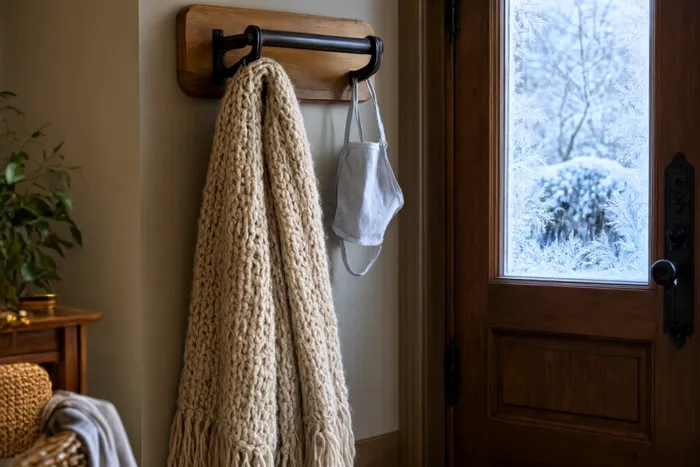
Number two: fix the air. Indoor air in autumn and winter routinely falls below 30 per cent humidity — heating, air conditioning, a dry climate — and a repairing airway lining likes the band where nothing feels dry, call it 40 to 60 per cent. Read that as a comfort you can feel on your face, not a laboratory target. A humidifier counts, so does hanging damp washing in the room, so does lingering in the bathroom after a shower. Change the water in a humidifier every day and clean it as the instructions say; if your immune system is suppressed, this is precisely the machine that must not become an aerosol source for you. Keep the bedroom cool enough that a single layer of bedding feels neither cold nor stuffy — an overheated room is a dry room by definition. Do not sleep with a cold draught or an air-conditioning vent aimed at your face, and when you go out into cold air, put a scarf or mask over your nose and mouth: you are pre-warming the air before it reaches the sensitive part.
Number three: give the throat less work. Talk less, and never raise your voice to be heard over noise. Sip warm water rather than gulping it. Gargle with saline, or rinse the nose, since post-nasal drip is a frequent author of the night-time fit. If reflux is in the picture, stop eating three hours before bed. Cut smoke entirely — active and second-hand. The single most damaging thing you can do while coughing is not skipping the soup. It is smoking through the cough.
The two things not worth doing at the pharmacy: putting yourself on antibiotics (see the arithmetic above), and buying over-the-counter combination cough-and-cold medicines for pre-school children. This is not the preference of one or two chemists; it is an age line drawn by the product labels and the regulators. Under six, no self-administered OTC combination cough-and-cold medicines — the position set out in 2008 by the US FDA together with the American Academy of Pediatrics. Under two, no dextromethorphan. Under twelve, no codeine-containing suppressants: the FDA's 2017 Drug Safety Communication contraindicates them there, and says to avoid them while breastfeeding too. The benefit is unclear; the risk is not.
Infants under one: no honey, ever. Any cough in a young baby deserves a clinician's opinion, and if there is visible effort breathing, skin pulling in between the ribs or at the base of the neck, blue lips, poor feeding or listlessness, seek care immediately rather than watching. Pregnancy and breastfeeding: do not stack patent herbal medicines on top of cough suppressants on your own, and suppressants containing codeine or tramadol are the ones to keep away from while breastfeeding — both pass into milk and can give the baby opioid exposure. Asthma or COPD: a post-infectious cough can aggravate the underlying disease — keep your follow-up clinician in the loop rather than improvising. Anyone on an ACE-inhibitor blood pressure medicine (the "-pril" drugs, such as enalapril or benazepril): these cause a persistent dry cough in a well-recognised minority of people. Whether to switch is a decision for your prescriber — do not simply stop taking it. If you are immunosuppressed: move every threshold in this article one notch earlier.
The cost-benefit of all this is like putting a wet cloth on the floor: it does not repair the air conditioning, but the dust does settle more slowly. Every item here belongs to the category of "let it finish repairing". What if it does not?
When to stop waiting: a red-flag list
Half the diagnostic value of a cough is in the clock. The other half is in what arrives alongside it. Any single line below takes you out of the "wait and see" category.
- A cough that reaches eight weeks — that is the chronic-cough pathway: cough-variant asthma, upper-airway cough syndrome, reflux, eosinophilic bronchitis and friends, all of which need a clinician to sort out.
- Blood in the phlegm, or rust-coloured sputum, or phlegm that suddenly turns yellow-green with fever.
- Shortness of breath, chest pain, obvious wheeze on activity, or being woken gasping and needing to sit up.
- Fever that returns after settling, or any fever lasting more than three days.
- Night sweats, unexplained weight loss, prolonged fatigue — tuberculosis and other consumptive illness need ruling out.
- Fits of coughing that end in vomiting, or a crowing sound on breathing in afterwards — think pertussis. It is missed often in older children and in adults, because the classic whoop may simply not be there. Pertussis is nicknamed the hundred-day cough: the paroxysmal stage runs in weeks, and the whole course can reach two or three months. A cough after Mycoplasma pneumoniae also commonly lasts for weeks. Both are a good deal longer than "still coughing a fortnight after a cold", and neither is settled by looking — a clinician needs a swab or a blood test.
- Twenty or more years of smoking, or a new persistent cough after forty — the threshold for being seen should be lower, not higher.
- Babies: skin pulling in at the ribs or neck, blue lips, refusing feeds, floppiness — emergency, not observation.
- TB contact, recent long-distance travel, or immune suppression — say so out loud when you are seen.
There is also a softer and more useful test. If the cough has been disturbing your sleep, your work or your ability to hold a conversation for more than three weeks, go once — even with none of the flags above. The point of the visit is not to collect a bottle. It is to have somebody rule out "this needs a different explanation".
A list like this is the airbag light on the dashboard. When it comes on, it does not mean a crash is happening. It means this is no longer something to keep driving on.
FAQ
If a clinician has already judged this to be the sensitive phase left behind by a cold, then contagiousness really is low: it runs on sensitised receptors, not on shedding virus. Do not read that sentence backwards, though. A cough that has run past two or three weeks, coughing that comes in fits you cannot stop, or a household with a baby, a pregnant person or someone immunosuppressed — those still get treated as contagious, and pertussis and Mycoplasma should be ruled out first (pertussis is highly contagious during its paroxysmal stage). Two more things to keep apart. If the picture has gone back to fever, aching and a running nose, that is more likely a new infection, so treat it as contagious. And in the first two weeks of coughing, distance and hand-washing cost nothing and are always worth it.
Speech is air repeatedly rubbing across the throat and upper airway — which is precisely where the receptors are densest and most sensitised after an infection. So "I cough when I talk" is not a damaged voice; it is a lowered threshold on that stretch of wiring. The countermeasures are as plain as the cause: talk less, talk slower, do not clear your throat (that is friction again), and break the cycle with a small sip of water. A scarf or mask warming the inhaled air usually helps within minutes.
The "dry" description is fair. The "keep moistening" plan is not always. The commonest pattern in a post-cold dry cough is wind lingering in the lung, where the work is to disperse and open, not to moisten; moistening foods (honey, white fungus, pear, a little fat) soothe the throat but do not address the wind. A second pattern — red tongue with little fluid, dry itch worst at night — genuinely leans toward dryness and damaged fluids. Running both together is usually harmless. But if nothing shifts after two or three weeks, that is a signal to have the pattern re-assessed, not to raise the dose.
For an adult, a short course of an OTC suppressant to buy back a night's sleep is a reasonable thing to discuss with a pharmacist or doctor — with the understanding that it does not shorten the illness, it lends you one night. Do the bedroom at the same time: humidity, temperature, no cold draught on the face, head of the bed raised, honey before bed. If you need medication several nights a week, that itself is a reason to be seen — disturbed sleep is already on the list of things that justify a visit.
If energy, appetite and sleep are basically normal and there is no wheeze or visible effort breathing, a cough of a dozen days or so is still inside the normal curve. Do not wait at all if any of these are present: any cough in a baby under one; skin pulling in at the ribs, blue lips; coughing fits that end in vomiting or a crowing breath in; persistent fever; night coughs that are getting heavier each time. At home, honey before bed is fine above one year — and take the combination cough medicines out of the trolley instead.
A Note from Bong

In Chinese, cough is written with two characters, and for a few centuries teachers insisted they were two diseases: one with sound and no phlegm, one with phlegm and no sound. That reading is roughly eight hundred years old. Before it, the two characters meant the same thing, and the oldest texts simply describe a person coughing.
I do not think the old writers were wrong. It looks more like patience: no instruments, no slides, just standing beside someone, noting when they cough, what sets it off, whether anything comes up, how many times they wake. Noting it until you invent a word for it and then a list of ten. So if you are the one awake at two in the morning, coughing into a pillow so nobody else has to get up — this exact shape of miserable was seen, written down and given a name a very long time ago.
References
- Huangdi Neijing (Suwen), chapter on cough — "the five organs and six viscera all make people cough; it is not only the lungs"; the basis for reading 咳 (ké, cough with sound) and 嗽 (sòu, cough with phlegm) as one idea in the earliest layer.
- Liu Wansu (Jin dynasty), Suwen Bingji Qiyi Baoming Ji, chapter on cough — sound without phlegm as ke, phlegm without sound as sou: the origin of the two-word split.
- Wu Qian et al., Yizong Jinjian (Qing dynasty), cough chapter — the split restated almost word for word, which is how it reached modern textbooks.
- Chao Yuanfang, Zhubing Yuanhou Lun (Sui dynasty), cough section — the ten kinds of cough, with wind cough listed first: "you start to speak and a cough interrupts you, and the sentence never finishes".
- Liji, "Monthly Orders" and "Rules of the Conduct" — "the state will have much wind-cough" as an image of a season disobeyed (written there with the older character for cough); the etiquette rule against coughing loudly in a carriage. The same passage recurs in the Lüshi Chunqiu.
- Encyclopedia of China, "wind cough" entry — the phrase traced to the Liji "Monthly Orders", its clinical description to the Zhubing Yuanhou Lun; post-infectious cough, cough-variant asthma and eosinophilic bronchitis presenting mainly as dry cough with an itchy throat may be managed by reference to wind cough.
- National Committee for Terminology in Science and Technology, Respiratory Medicine Terminology (approved April 2018) — acute cough under three weeks, subacute three to eight weeks, chronic eight weeks and beyond.
- Chinese Thoracic Society (Respiratory Branch of the Chinese Medical Association), Guidelines for the Diagnosis and Treatment of Cough (2021) and the 2024 Primary Care Guideline on Cough — post-infectious cough as the commonest cause of subacute cough: dry, tickling, or a small amount of white sticky sputum, lasting three to eight weeks, chest film unremarkable, usually self-limiting.
- Irwin RS et al. Pharmacologic and Nonpharmacologic Treatment for Acute Cough Due to the Common Cold: ACCP Evidence-Based Clinical Practice Guidelines. Chest 2017;152(5):1021-1037. — no honey under one year, no dextromethorphan under two.
- US FDA, Drug Safety Communication (2017): contraindications for codeine and tramadol in children and warnings for use during breastfeeding — codeine-containing cough medicines contraindicated under twelve (and under eighteen after tonsil or adenoid removal), and to be avoided while breastfeeding.
- US FDA with the American Academy of Pediatrics (2008), labelling and production information for OTC cough and cold products for infants and children — no self-administered OTC combination cough and cold medicines under six.
- Oduwole O, Udoh EE, Oyo-Ita A, Meremikwu MM. Honey for acute cough in children. Cochrane Database of Systematic Reviews 2018, Issue 4. Art. No.: CD007094. — honey versus no treatment, dextromethorphan and diphenhydramine, with evidence graded low to moderate.
- Kuitunen I, Renko M. Honey for acute cough in children — a systematic review. European Journal of Pediatrics 2023. doi:10.1007/s00431-023-05066-1 — trials published after the 2018 Cochrane cut-off, pointing the same way.
- Bergmann et al. Prevalence, aetiologies and prognosis of the symptom cough in primary care: a systematic review and meta-analysis. BMC Family Practice 2021;22:151 (PMID 34253179) — median recovery of 9–11 days, 40–67 per cent fully recovered at two weeks and 79 per cent at four, and respiratory infections accounting for 73–92 per cent of cough presentations.
- Smith SM, Fahey T, Smucny J, Beckingsale LA. Antibiotics for acute bronchitis. Cochrane Database of Systematic Reviews 2017, Issue 6. Art. No.: CD000245. — total cough duration shortened by about 0.46 days (95% CI -0.87 to -0.04), with more diarrhoea and rash.
- Chao Enxiang (China-Japan Friendship Hospital; National Master of Traditional Chinese Medicine) — the "wind cough" pattern and the principle of treating cough by dispersing wind; his formula Suhuang zhi ke tang (originally "wind-cough decoction") and the patent medicine derived from it, listed in Chinese cough guidelines. Described here as academic history, not as treatment advice.
- US Centers for Disease Control and Prevention, patient education on respiratory infection — pertussis in its stages (catarrhal, paroxysmal, convalescent), with cough commonly lasting weeks to two or three months, and cough after Mycoplasma pneumoniae often running to weeks too. Cited here only for the order of magnitude of these two easy-to-miss causes, not for any percentage.
Same cold: why one person coughs for three days and another for a month
First, look at your own baseline
The constitution test cannot measure wind or dryness in you. It scores nine tendencies, that is all. But qi deficiency, phlegm-dampness and yin deficiency are three cards that genuinely change which direction your care should take. 60 questions, about 10 minutes — a tool for stopping you from assuming you are ordinary, not a diagnosis.
Take the TCM constitution test