Here is a scene most people know too well. Yesterday you stood in a draft for half an hour, or got caught in rain without an umbrella, and you thought nothing of it. This morning your throat feels tight when you swallow, your back has a cold streak down it, and your nose is blocked from one end of the day to the other. By afternoon you feel as though someone reached inside you and removed a part. That is what the first 48 hours of a cold usually look like from the inside. And notice this detail: almost everybody's first thought is "take something to shut this down." The first thought in Chinese medicine is the opposite one — "get it out before it settles in."
Four things to settle in this article. Why the first 48 hours deserve their own chapter. What Chinese medicine actually means by "wind-cold binding the surface" and "pushing the pathogen out" — it is a description of a physiological situation, not a spell. A plan you can take straight into the kitchen: ginger, jujubes and scallion whites, how much of each, how long to boil them, and when drinking it still counts as early. And the part that matters most: the moment you should stop making broth and go and see a doctor instead.
Why the first 48 hours deserve their own chapter
An ordinary cold is a play with a script. The virus gets into the upper airway and replicates first; your immune system notices and only then starts fighting back. Which is why most of what you feel miserable about — the blocked nose, the sore throat, the ache in your limbs, the low-grade heat — is not damage the virus inflicted directly. It is the cost of your own counterattack. So the timeline runs like this: something feels off on the first evening, days two and three are the worst of it, days five to seven are the retreat, and some people end up dragging the last of it out for two full weeks.
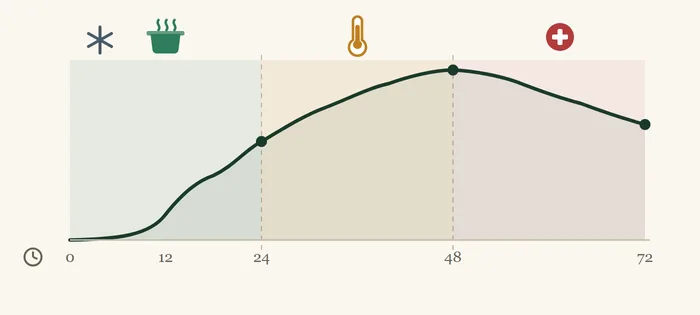
What makes the first 48 hours unusual is that two things are true at the same time: the virus is still replicating heavily in the superficial layers, and your immune army has not fully deployed. The two findings most often quoted in the modern literature land in exactly this window. Zinc lozenges appear to shave a day or two off the illness only when they are started within 24 hours of the first symptom; start late and the effect mostly disappears. And vitamin C does very little for a cold that has already begun — it is a "take it regularly" thing, not a "take it now" thing.
Chinese medicine said this earlier, and in a far more pictorial language. It calls the opening phase of a cold a surface pattern (表证, biǎo zhèng): the pathogen is still hanging on the outermost door of the body and has not walked in. So the working principle for that phase is not suppression. It is escort duty — send it out while it is still near the exit. Once it has moved deeper, the tactics designed for the doorway are wasted effort. Think of damp getting into a room: opening the window solves it. Waiting until the plaster has bubbled off the wall means repainting the whole wall, and the bill goes up immediately.
What is being "pushed out"? One word: biǎo
The word this whole idea rests on is biǎo (表), "surface", and the oldest Chinese dictionary explains it through clothing: the ancients wore fur coats, and the face of the coat where the hair (毛) was is 表. So when Chinese medicine says "the surface", it is not being abstract. It means the outermost layer of a person — skin, pores, mucous membranes, and the defensive qi (卫气, wèi qì) that stands guard on that layer. "The pathogen is at the surface" means the intruder is still caught in the curtain at the door. It has not entered the living room.
The defining property of cold, in this framework, is contraction. The moment cold gets a hold of you, the pores and the shallow blood vessels close and tighten. First you feel chilly, get goosebumps, and cannot sweat; then the nose blocks up and runs clear and watery, and the back of your neck and your shoulders and upper back go stiff and sore. Look at the tongue and the coating is thin and white. Chinese medicine calls this whole bundle "wind-cold binding the surface": the doors of the body surface have been clamped shut by cold, so heat and fluid that should be venting outward cannot get out — and you end up simultaneously cold, stifled and aching.
The treatment principle for that situation is one line, from the Huangdi Neijing:
Translated into something you can execute tonight: in the first two days of a wind-cold chill, your job is to get the body warm again, reopen the clamped-shut doors, raise a thin sweat off the surface, and then go to sleep immediately. That is not "sweating a cold out" as folk superstition. It is creating the working conditions your immune system needs: temperature, circulation and fluid all running properly, so the counterattack can actually be fought.
Now the part that will annoy some people: the most common mistake at the first sign of a cold is reaching for the clearing-heat, cooling remedies — and that is the wrong direction. Chills, clear nasal discharge, no sweat, body aches: this is cold, and what it wants is something warm and pungent to unlock the doors (辛温解表, xīn wēn jiě biǎo). Pouring bitter-cold remedies into a body whose surface has clamped shut is like leaning on the door from the inside while the wind is trying to get out. When is the cooling route the right one? The next section, one table, five rows.
Cold or heat? Settle that before you cook anything
Skip this step and everything after it is wasted. Wind-cold and wind-heat are two opposite directions of treatment, and the word "cold" in English covers both, which is exactly why people get it wrong.
| What to look at | Wind-cold 风寒 (needs warming and opening) | Wind-heat 风热 (needs cooling) |
|---|---|---|
| Chills vs fever | Chills dominate; adding a layer feels like relief, fever is comparatively mild | Fever dominates, you dislike the wind, throwing the covers off feels better |
| Throat | Tickly, dry cough, little visible swelling or pain | Red, swollen, painful — swallowing feels like sandpaper |
| Nasal discharge | Clear and watery, runs steadily | Thick, yellow, blocked |
| Sweat and thirst | No sweat; mouth not dry, or only wants something hot to drink | May sweat; mouth dry and craving cold drinks |
| Tongue coating | Thin and white | Thin and yellow, tongue tip and edges reddish |
- What I feel worst about right now — is it the cold, or is it pain and dryness? Only if cold is winning does the warming route make sense.
- Does a mouthful of hot water make me feel better, or is it just neutral? "Better" is a useful signal.
- Did this start today, or am I already on day three? After day three the line between cold and heat starts blurring; do not force the template.
One more group deserves to be mentioned separately: people who catch a cold every time the wind changes, who then spend a fortnight recovering, who run out of breath talking and sweat at the least provocation. In Chinese medicine that is qi deficiency (气虚, qì xū) — the defensive qi on the surface is not strong enough, so the door does not close properly and any draft walks straight in. For those people the work belongs in ordinary weeks, not in the two days when they already feel rotten.
Ginger-jujube-scallion broth: four steps and one easy mistake
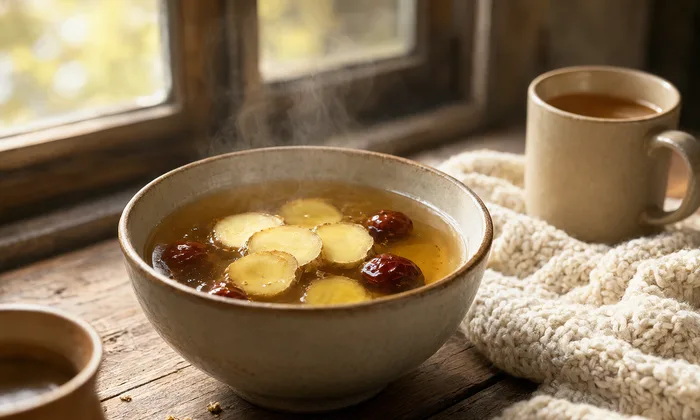
Set the boundary first: this broth is for wind-cold on day one or day two. It is not for every cold, and it is not a charm you swallow for three days to be exempt from illness. Direction right, and within roughly half an hour of a warm bowl you will notice the back loosening and the nose opening a little. Direction wrong, and you will simply feel more parched and more irritable.
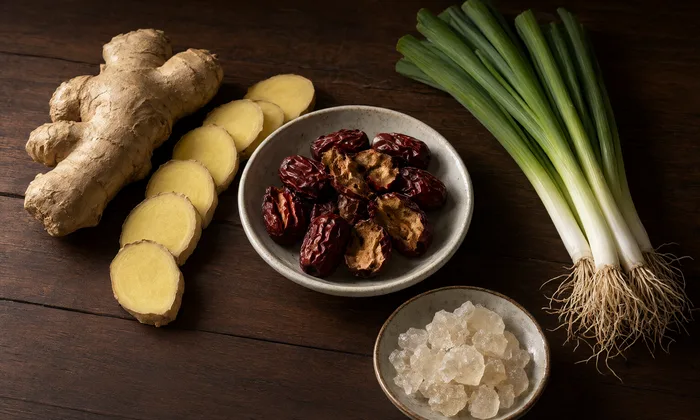
Prep: 15–20 g fresh ginger (生姜, shēngjiāng — a thumb-sized piece — bruise it, then slice, which gives up far more flavour than dropping a whole lump in); 3–5 dried jujubes (大枣, dàzǎo), torn open (leave them whole and the taste stays inside the skin); 2–3 sections of scallion white (葱白, cōngbái), roots on if you can, bruised. Sugar optional: a teaspoon of brown or rock sugar at most, and the broth is complete without it.
Pot: about 600 ml (2½ cups) cold water. Ginger and jujubes go in cold, bring to the boil, then simmer 10 minutes. The scallion whites go in for the last 3 minutes only — their value is in the volatile pungent fraction, and long boiling evaporates it away. This is the single most common mistake in the whole pot. Aim to reduce to roughly 400 ml.
Drink: strain out one warm cup (about 200 ml), sip it slowly, then get into bed and stay covered for 20–30 minutes. The target is a damp sheen of fine sweat across the back and forehead. When that shows up, stop — do not keep hunting for more sweat. Then change into dry clothes and drink some plain warm water.
Rhythm: this pot is two warm servings, one in the morning and one in the afternoon. If you genuinely want a third, make a second pot rather than drinking last night's. Do not take the last serving too late in the evening, or you will pay for it with both alertness and night-time bathroom trips. Do not run it for more than 2–3 days: stop as soon as it turns, and stop even sooner if it does not.
Three optional adjustments, each for a specific situation: neck and shoulders locked up, add a small stick of cinnamon (about 3 g) to the pot; stomach feels cold and queasy, add two more slices of ginger and use fewer jujubes; you avoid sugar or watch your blood glucose, skip the sugar entirely — it was never load-bearing. In the other direction: once the throat starts hurting and the nasal discharge turns yellow, this pot is finished.
Plain speaking: the real value of this broth may not be the ginger, jujube and scallion at all, but the thing it forces you to do — stop, get warm, sleep. In a cold, the most expensive early medicine is not a pill. It is sleep. Cancelling the afternoon meeting and being in bed by ten does more than two extra cups of broth.
Four things that make these two days worse
- Warm water and warm fluids all day; keep the urine pale
- Sleep whenever the chance appears; drop all training intensity to walking pace or below
- Hot, soft, plain food; if the appetite is small, split it into several sittings
- Saline nasal rinse when the blockage is what is stopping you resting
- Digging out last year's leftover antibiotics — a cold is a virus, and antibiotics have no purchase on it at all; the CDC says this in plain words
- "Starving the virus", or going to lift heavy and run 10 km as planned: the first withholds ammunition, the second spends it
- A couple of spirits before bed "to work up a sweat" — very little sweat, and sleep and immune function take the hit first
- Mega-doses of vitamin C and zinc from hour one, in the hope of halving the illness
Zinc deserves one more sentence, because it is one of the few things with actual trial support: starting zinc lozenges within 24 hours of the first symptom may shorten the illness by a day or two. But the evidence is graded low certainty, the preparations and doses differ wildly between studies, nausea and a metallic taste and an upset stomach are common side effects, and long-term high doses interfere with copper absorption. It is an option, not an obligation — and it is certainly not a licence to stay up late tonight on the assumption that tomorrow's lozenge will cover it.
When to stop drinking broth and see a doctor
An ordinary cold is self-limiting and most people never need a clinic. But the following are not a matter of "toughing it out a bit longer": temperature above 39.5°C (103°F), or fever that has not broken after three days; any effort to breathe, chest pain, or having to stop for air mid-sentence; severe headache with a stiff neck, light hurting the eyes, or confusion — those last ones mean emergency care, now; and symptoms that were improving and then suddenly worsen, thick pus-like discharge, or pain in one cheek or the upper gum (that pattern suggests a secondary bacterial infection, most often sinusitis). None of these four depend on which medical system you prefer. They are common ground.
- Infants under three months: any fever, no home observation — see a doctor. And lower the threshold by a notch for pregnancy, age 65 and over, chronic heart, lung, kidney or liver disease, poorly controlled diabetes, or anyone immunosuppressed. Asking early is cheap.
- Anyone on regular medication: do not treat ginger broth, cinnamon or zinc as "just food" and stack them freely. Pregnancy and breastfeeding, anticoagulants, diabetes medication — ask a doctor or pharmacist first.
- A caution on foot baths and hot showers: people with diabetic peripheral neuropathy or peripheral vascular disease lose the temperature alarm in their feet and get scalded easily. Test the water with your elbow, not your feet.
- Cough past three weeks, waking at night gasping, blood in the phlegm, unexplained weight loss — that stopped being a cold's script some time ago. Get it checked.
Let AI build your plan for these two days
FAQ
Both, and the two layers are worth separating. As a warm-pungent "release the surface" measure, in the wind-cold window (chills, clear discharge, no sweat, body aches) it does warm you up and raise a thin sweat, and people subjectively feel a good deal looser. At the same time it forces three things on you — warm fluid, a pause, and sleep — and those three are the most valuable part of early management anyway. It is not an antiviral. Do not expect it to compress the illness into two days.
Stop. Obvious sore throat, discharge turning yellow, fever taking over, dry mouth wanting cold drinks — that is wind-heat, or cold that has already transformed into heat, and continuing with warming pungent herbs only adds dryness. Move to light and cool food, plenty of warm water, and see a doctor if it escalates.
The direction is right; the dose is where people go wrong. The classical standard is a slight sheen of sweat — damp all over, then stop. Push it to streaming sweat and you end up dehydrated and wrecked, and the illness does not clear; in someone already running a high temperature, heavy wrapping can drive the temperature higher still.
Lost appetite is the body reallocating, so do not force food, and do not go to the other extreme of starving yourself either. Hot, soft, easy food in small portions, and get the fluid in — drinking enough matters more than eating enough. Tonics such as astragalus, angelica or sticky herbal pastes are generally a conversation for after the acute phase; taking them while you feel worst tends to add congestion rather than support.
Two to four ordinary colds a year is normal adult territory, and children do worse. But if yours genuinely come often, drag on for a fortnight each time, or always leave you weak, chilly and sweating at nothing, Chinese medicine reads that as qi deficiency with an unstable defensive layer — and the correction is ordinary-week work on sleep, food and exercise rather than firefighting every time you feel bad. A constitution assessment makes the direction much clearer.
Bong's note

Broth assists the body; it does not do the body's shift for it. Before you drink it, work out what you can cancel today.
References
- Huangdi Neijing · Suwen, "Major Arguments on the Pattern of Yin and Yang" — "what is in the skin, bring it out by sweating": the classical source for treating disease at the body surface by inducing sweating.
- Zhang Zhongjing, Shanghan Lun (Han dynasty), post-dose notes to Cinnamon Twig Decoction and Ephedra Decoction — the line asking for a fine damp sheen over the whole body and warning that streaming sweat leaves the illness in place, and the terse instruction to the dry type: keep covered until a slight sweat appears: the operating standard of obtaining a slight sweat and avoiding a heavy one.
- Plan-issued textbook Internal Medicine of Traditional Chinese Medicine, chapter on common cold — the wind-cold versus wind-heat pattern differentiation and the corresponding principles of warming-pungent and cooling-pungent release.
- US Centers for Disease Control and Prevention — causes, course and management of the common cold, and its repeated public line that colds do not need antibiotics (cdc.gov/common-cold).
- Oregon State University, Linus Pauling Institute — evidence review of the common cold, zinc and vitamin C: zinc needs to start within 24 hours of symptom onset and the certainty is low, while vitamin C mainly affects incidence and duration rather than treating a cold already under way (lpi.oregonstate.edu).
Catch a cold every time the wind blows? Check for qi deficiency
Is your "security guard" strong enough?
60 questions · about 10 minutes · separates a plain chill from a qi-deficient constitution that keeps catching colds — the two need completely different treatment.
Take the TCM constitution test