Maybe this is your winter: you pull off your long johns and a fine drift of skin comes with them. You sit in a meeting and your hand wanders to your back without being invited. And at 3 a.m. you wake up scratching a spot that only itches when the lights are off. Itch feeds on itch — scratch once and you have booked the next one. If that sounds familiar, your skin has almost certainly slipped into winter mode. Notice one detail while you decide whether to nod: nobody's skin got better this season, but the number of people scratching has visibly grown. Winter itch is not a personal defect. It is the default response to this season, and some of us just run out of tolerance first.
Three things to settle here: why skin is always the first thing to crack; what Chinese medicine makes of it (the lungs rule the skin, plus one 800-year-old line about blood); and a two-week self-rescue list running in four directions — showering, moisturizing, humidity, eating. At the end, the line where creams stop being the answer and a doctor should be.
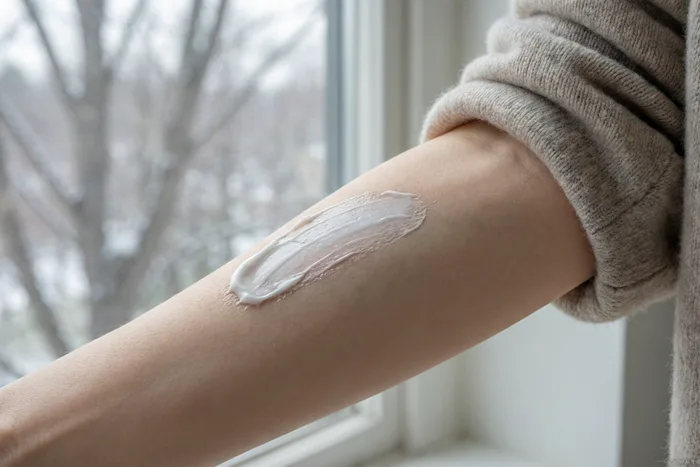
Why skin is always the first to crack
On the surface of your skin there is an invisible film: sebum emulsified with natural moisturizing factors into a slightly acidic layer that keeps the water inside the outermost skin cells. In winter, that film gets attacked from three sides at once.
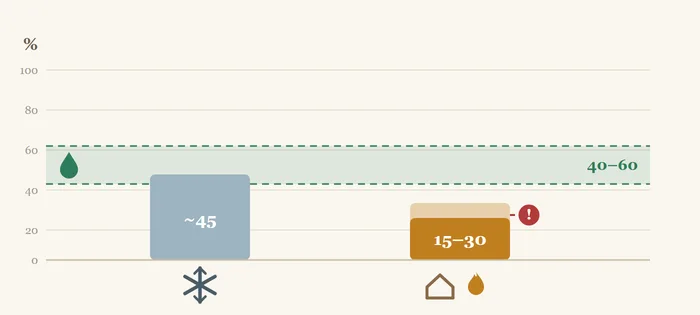
Attack one: cold air simply cannot hold water. As temperature falls, the amount of water vapor a given volume of air can carry collapses, so outdoor humidity drifts downward on its own. Skin exposed to that air loses water along the gradient — not a feeling of dryness, but evaporation with the physics turned up.
Attack two: the radiator turns your rooms into a pump. You think indoors is the refuge? Cold outdoor air brought inside and heated to 21°C (70°F) often ends up at 15–30% relative humidity — drier than the winter air outside your window. Your skin steps out of the cold and into a room that is hungrier than the weather. It pays a second water tax.
Attack three: hot water and body wash, applied by your own hand. A scalding shower in cold weather is a small pleasure everyone understands. The problem is that the hotter the water, the more thoroughly it dissolves your sebum; add a strong cleanser and an exfoliating mitt and that film is not thinned, it is stripped. The ten minutes after you get out are when the payment arrives: tightness first, then itch.
Stack the three attacks and you get the standard winter loop: wash more, dry more; dry more, itch more; itch more, scratch more; scratch and the barrier breaks further. It is not a tragedy on a loop — it is a chain you can cut at almost any link. The only real question is whether you know which link to grab.
The TCM view: blood, wind and dryness in a triangle
Chinese medicine holds that the lungs govern the skin — the Suwen says of the lungs that their bloom is seen in the hair and their nourishment in the skin. Skin is not a standalone organ; it is the outermost layer of the lung system laid over your body. Whether that system has enough fluid, whether it circulates freely, shows up on the skin first. Autumn dryness injures the lungs; winter cold constricts the surface. The front line is the first place to fall.
What Chinese medicine actually looks at in winter itch is not the four words "skin lacks water". It is a deeper chain: deficient blood → generates wind → turns into dryness.
"Blood", in this framework, is the nourishing function — it delivers fluid and nutrition out to the four limbs, the hundred joints, the hair and the skin. In winter, yang withdraws inward and surface circulation is thinner than in summer anyway. If you already run short (pale complexion, dizziness when you stand up quickly, pale nail beds and lips), the skin never gets enough nourishment, so it dries. Dry long enough and Chinese medicine calls it "blood deficiency generating wind". The "wind" is not air. It is a description of the itch: it arrives fast, leaves fast, and never itches in the same spot twice. That is wind behavior.
Dryness is the drought on the surface. Blood is the well underneath. Dig the well shallow and you can water the topsoil all you like — it stays wet for three days.
So the Chinese medicine approach to moisturizing is the complement of the cosmetic one, not a rival. Cream waters the surface. Inner nourishment digs the well. Someone who cycles through three bottles of body lotion a winter without getting a single meal right has done half the job and skipped the half that makes the first half last.
How dry is normal, and how itchy is a doctor visit
Do not diagnose yourself off a paragraph. Nine people in ten have dry skin in winter, but there are three measurable steps between "dry" and "disease".
| Step | What it looks like | What to do |
|---|---|---|
| 1. Ordinary winter dryness | White flakes on the shins and outer arms, tightness after a shower, and a layer of cream settles the whole thing within two hours | Run the list in the next section. Two weeks should show a clear difference |
| 2. Pre-dermatitis territory (where Chinese medicine says "blood deficiency with wind dryness") | Itch arrives at the same time every night, fine cracks or faint pink patches appear, scratching leaves a raised mark, and moisturizer only half helps | Keep the list going, but shower less. If a week passes with no change, go get a prescription rather than raiding the bathroom cabinet |
| 3. Time to rule out an internal cause | Widespread itching with almost nothing visible on the skin, plus weight loss, unusual thirst and urination, feeling cold and drained — or itching bad enough to wreck sleep entirely | Dermatology plus a medical workup. Diabetes, thyroid disease and liver or kidney problems can all announce themselves as generalized itch. Cream cannot fix that; a blood test can find it |
- ☐ The itch is delaying sleep, or waking you at least three times a week
- ☐ Scratched areas weep, form yellow crusts, or the redness is spreading (signs of infection)
- ☐ Two weeks of real moisturizing and nothing has shifted
- ☐ The area is widening rather than staying on the calves and forearms
- ☐ Fever, weight change, or abnormal thirst and urination along with it
The rescue list: shower, moisturize, humidity, food
Four directions, ordered by how fast they pay out. Moisturizing is fastest, changing your shower stops the bleeding, humidity removes the cause, and food is the slowest but reaches the root. It is the work order for a cracked wall: waterproof first, then plug the leak, then fix the climate in the room, then tend the foundation.
Direction one: get the shower right, since you are going to take it anyway
- Water at 37–40°C (99–104°F): it should feel warm when you put a hand in, not "ahhh, scalding". That "ahhh" is the sound of sebum leaving
- Ten minutes, maximum: nobody needs a full-body wash every day in winter. Every two to three days for the whole body, rinse the important parts with plain water in between. Older skin produces less oil to begin with, so it can go further between washes
- Cleanser only where it is needed: underarms, feet, groin. Everywhere else, water is enough. Choose a mild, pH-balanced wash and put the bar soap away until April
- Put the exfoliating mitt back in the drawer: that roll of "dirt" you can rub off is largely dead cells and sebum — the waterproofing itself. Rubbing it off and then complaining about the dryness is like tearing off your own roof and then calling the plumber
Direction two: the three-minute rule
Pat dry with a towel — do not rub. Then, while the skin is still slightly damp, apply the moisturizer within about three minutes. That is how you trap the water inside the outer layer instead of decorating the outside of a dry wall; the difference against applying to fully dry skin is not subtle. For shins and elbows that have gone rough, pick something genuinely thick: urea, ceramides or a petroleum base. Face cream for the face; one jar everywhere is a compromise your face will report. And plain petroleum jelly, the cheapest thing in the cupboard, is a scientifically sufficient answer to most winter cracking. Before you spend good money on a luxury body cream, apply something ordinary more often — skin responds to consistency, not to the price tag.
Direction three: give the room some humidity back
Holding indoor relative humidity between 40% and 60% lifts your skin out of the desert climate you have been living in. A humidifier is the most underrated appliance of the winter: bedroom first, then the rest of the flat if you can. Two details people skip. One, use clean water, change it daily and wash the tank on schedule — a dirty humidifier sprays microbes into your air, and you lose the skin argument and pick up a respiratory one. Two, buy a hygrometer; they cost about ten dollars. Do not judge humidity by feel. Judge it by the number. Skip this step and every layer of cream you apply is water poured into a leaking bucket.
Direction four: the eating path — digging the well

Nourishing blood and moistening dryness sounds mystical until it is put on a dinner table:
- White and moistening: snow fungus (white fungus), pear, lily bulb, lotus root, honey — in this framework these top up body fluids, i.e. deliver water to the skin
- The blood-building crowd: jujubes, longan, black sesame, peanuts with their red skins on, a little liver — this is the everyday, unglamorous version of "once blood moves, wind settles"
- Do not fear good fat: part of winter dryness is simply not enough oil. Nuts, sesame paste, the fat in a braise — your sebum film is made from raw material, and it has to come from somewhere
- Two things to cut back: hard liquor and very spicy food. Both widen skin blood vessels and speed up water loss — the "wind fans the fire" of Chinese medicine, and the itch gets louder
If your stomach runs loose and cold easily, swap most of the pear for a large chunk of carrot and keep the same idea. If you are watching blood sugar, leave the honey out or let it be a few drops.
Do all four and most people see the "snow on the trousers" and the 3 a.m. scratching settle noticeably within one to two weeks. If two weeks pass and nothing has moved, that is not a failure of the list. It is the body raising its hand: your turn, doctor.
When to stop applying cream
If you ticked two or more of the five questions above, or scratched skin is weeping, crusting yellow or spreading red — go to dermatology rather than improvising from the family medicine drawer. One hard rule in particular: do not keep steroid cream on your face on your own initiative. Topical steroids are genuinely excellent tools for eczema, and the side effects of the wrong strength for the wrong length of time are printed on the same tube. Let a clinician decide what, where and how long.
- Violent itch at night, calm by day, and someone else in the house has started: rule out scabies. It is not a hygiene failure, it is an infection, and it is curable — with the right medicine
- Itchy all over with almost no rash, lasting weeks: check blood glucose, thyroid, liver and kidney function. Itch with an internal cause is exactly what moisturizer cannot reach
- Eczema or psoriasis that reliably flares in winter: get back onto your prescribed treatment. A humidifier and a body cream are supporting cast, not the replacement
Let AI draft your winter skin plan
FAQ
Buy by occlusive strength, not by price. Petroleum jelly seals hardest and is right for the driest patches. Ceramide or urea creams repair the barrier more actively. A light lotion is fine for a whole body that is merely dry. The rule: the drier the area, the thicker the product, and applying often beats applying something expensive.
Not usually. Most winter itch is barrier damage rather than a histamine-driven allergy, which is exactly why the antihistamine often does nothing and moisturizing plus cooler, shorter showers works fast. When the itch genuinely stops sleep, a doctor may prescribe a sedating antihistamine — that is a clinical decision, not a shopping list.
Yes, in the Chinese medicine reading. People with yin deficiency (low body fluids to begin with) or a blood-deficient tendency dry out harder and itch louder in winter; qi deficiency means the defensive surface is loose, so wind-cold gets a better grip. If you do not know which you are, the three-minute test at the end of the page makes the direction clearer.
Right instinct, wrong instruction. The point is not to stop washing; it is to stop using hot water and cleanser over your whole body. Daily cleaning of the parts that need it, full washes at a lower frequency, cream within three minutes — those three sentences together are what "winter showering" actually means.
Only a dirty one. An unwashed tank aerosolizes microbes into your bedroom, which trades a skin problem for an airway one. The routine is dull and effective: fresh water daily, clean the tank weekly per the manual, use purified or boiled-and-cooled water, and keep the room between 40% and 60% with a hygrometer to prove it. If you will not do those four things, hang damp towels instead.
Bong's note

The same "winter itch" is really two different exams. North of the Qinling line the radiator runs from November to March and the flat sits under 20% humidity: you wake with a throat like sandpaper, and pulling a jumper off at night throws sparks. That is hot air pumping the water straight out of your skin. South of the Yangtze it is the opposite — 5–6°C (41–43°F) indoors, water condensing on the inside of the glass, cold enough that the skin's oil glands barely answer the phone, and nobody owns a humidifier because nobody thinks they need one. One side gets dried out, the other gets dried cold, and both walk out of the same exit door called itch. So do not laugh at someone in another city. Same paper, two different questions.
References
- Huangdi Neijing · Suwen — "the lungs rule skin and hair"; "the lungs are the root of qi… their bloom is seen in the hair and their nourishment is in the skin": the classical source for reading skin as the outer layer of the lung system.
- Li Zhongzi, Yizong Bidu (Ming dynasty), chapter on bi obstruction — the received source of "to treat wind, first treat the blood; once blood moves, wind settles by itself". An earlier form, "to treat wind, first treat the blood", appears in Chen Ziming's Furen Daquan Liangfang (Southern Song, 1237). The line was written for joint disease and later applied to blood-deficiency wind-dryness itch.
- American Academy of Dermatology — everyday guidance on dry, itchy skin: lukewarm short showers, patting dry, moisturizer straight after bathing (aad.org).
- StatPearls, Xeroderma, NCBI Bookshelf — a clinical review of dry skin: barrier mechanism, causes including climate and washing habits, and moisturizer evidence (ncbi.nlm.nih.gov/books/NBK565884).
Find your constitution and aim the plan better
Are you the "blood deficiency with wind dryness" type?
60 questions · about 10 minutes · see why your skin takes winter harder than other people's do.
Take the TCM constitution test